What are class boundaries?
A class boundary refers to the dividing line between two adjacent classes or categories in a dataset. It helps in determining the range of values that fall within each class and allows for better analysis and interpretation of data. Understanding class boundaries is crucial for effective data segmentation and can provide valuable insights for business planning and strategy development. The concept of class boundaries is fundamental in statistics and data analysis. It plays a crucial role in the representation and interpretation of grouped data, especially in the context of histograms and frequency distributions. The concept has been developed over time as a means to simplify and summarize data for analysis and visualization.
Applications
Class boundaries are commonly used in various statistical and data analysis applications:
- Histograms are used to visually represent the distribution of data by displaying the frequencies of data points within specified class intervals or bins, aiding in understanding data patterns.
- Frequency distributions summarize the occurrence of values within a dataset, helping to assess the data's spread and central tendency, which is essential in feature engineering and data preprocessing for machine learning.
- Statistical Analysis involves applying mathematical and statistical techniques to analyze data in machine learning, helping to draw meaningful insights and make data-driven decisions.
- Quality Control relies on statistical analysis to monitor and maintain product quality, using data-driven approaches to detect defects and improve manufacturing processes in machine learning applications.
Significance
Class boundaries are significant for several reasons:
- Data Summarization: They allow for the grouping and summarization of data, making it easier to analyze and visualize large datasets.
- Data Presentation: Class boundaries facilitate the creation of charts, such as histograms, which provide insights into the distribution of data.
- Statistical Analysis: Grouped data with class boundaries simplifies calculations of central tendency, dispersion, and other statistical measures.
- Comparative Analysis: Class boundaries enable the comparison of different datasets or distributions using standardized intervals.
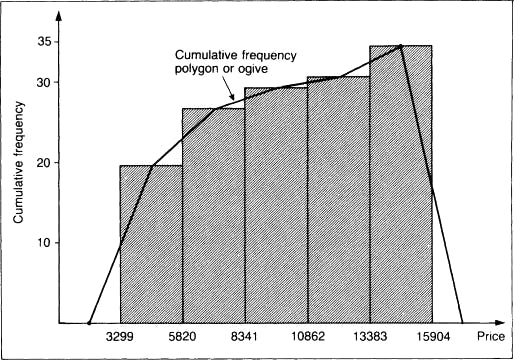
Class Boundary: Key Takeaways
Class boundaries are essential in statistics and data analysis, defining value ranges for effective organization, analysis, and visualization. They're widely used in histograms, frequency distributions, summary statistics, and inferential statistics across multiple fields, streamlining data interpretation and analysis.
Frequently asked questions
- To find the class boundary, subtract the lower class limit of one class from the lower class limit of the next class. This helps in determining the range of values that fall within each class and allows for better analysis and interpretation of the data.
- Class boundaries are the values that define the edges of each class interval in a frequency distribution. They are obtained by subtracting half of the difference between two consecutive lower class limits from the lower class limit and adding half of the difference to the upper class limit. For example, if the lower class limit is 10 and the upper class limit is 20, the class boundary would be calculated as (10 - 0.5) to (20 + 0.5), resulting in a class boundary of 9.5 to 20.5. This calculation ensures that data points falling on the lower or upper class limits are evenly distributed among adjacent classes.
- The upper boundary of a class is obtained by adding half of the difference between two consecutive upper class limits to the upper class limit. The lower boundary of a class is obtained by subtracting half of the difference between two consecutive lower class limits from the lower class limit. These boundaries help define the range within which data points fall into specific classes in a frequency distribution.
- We calculate the class boundary to accurately represent the data and ensure that each data point is assigned to the correct class. By calculating the class boundaries, we can avoid misclassifying data points that fall on the exact upper or lower limits of a class interval. This allows for a more precise analysis and interpretation of the data.