Accelerating Robotics VLA Segmentation with SAM 3: Key Takeaways from the Masterclass

ML Lead at Encord
Training Vision-Language-Action (VLA) models for robotics depends on one critical factor: the quality and structure of visual data. As robotics systems move beyond lab settings into warehouses, roads, homes, and factories, the amount of video data being collected has exploded. Yet annotation workflows have not kept pace.
In this masterclass, we explored how SAM 3, Meta’s latest segmentation model, fundamentally changes how robotics teams can build scalable, temporally consistent perception datasets.
Below, we break down the most important lessons from the session and why they matter for real-world robotics development.
Data Annotation Remains a Challenge in Robotics Pipelines
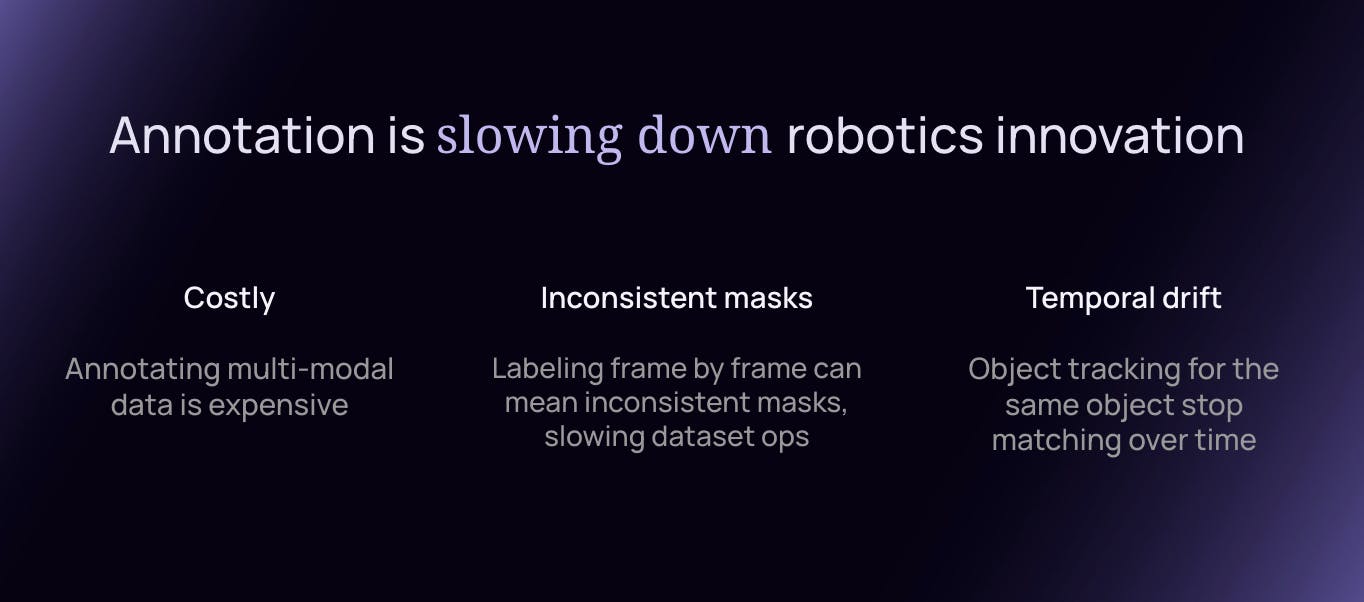
Despite advances in model architectures, annotation continues to be one of the slowest and most expensive stages of robotics development. This challenge is magnified when working with video, which is the dominant modality for embodied AI and VLA training. Annotators are often forced to label the same objects repeatedly across hundreds or thousands of frames, even when those objects are moving smoothly through the scene.
Inconsistent masks, frame-by-frame drift, and object re-identification issues all introduce noise into training data. For robotics, that noise is costly. If a robot cannot reliably understand that it is interacting with the same object over time, it struggles to learn cause-and-effect relationships, such as picking something up, moving it, and placing it elsewhere. In the session, our team explained that annotation is not just a logistical problem, it is a core constraint that directly affects downstream performance.
Natural-Language Segmentation Changes How Labeling Starts
One of the most impactful features demonstrated was SAM 3’s ability to generate segmentation masks using simple natural language prompts. Instead of manually selecting objects pixel by pixel, annotators can now describe what they want to label, such as “robot arm,” “tool,” or “car”, and let the model find all matching instances in the frame.
This approach dramatically shifts how annotation begins. Rather than starting from scratch, annotators start from a nearly complete solution and refine only where necessary. In robotics scenes, where environments often contain many similar objects, this capability enables teams to label dense scenes in seconds instead of minutes. The webinar showed how even vague prompts could surface all relevant objects, while more descriptive prompts could isolate specific instances when precision was required.
Temporal Tracking Brings Consistency to Video Annotations
Segmentation quality alone is not enough for robotics datasets; consistency across time is equally important. SAM 3’s ability to track objects forward and backward through video frames directly addresses one of the most persistent problems in video annotation.
During the demo, objects were labeled once and then reliably tracked across dozens of frames, even as they moved, rotated, or partially disappeared. Backward tracking proved especially powerful: annotators could label an object once it became clearly visible and then propagate that label backward to frames where the object was barely perceptible.
For robotics teams, this solves multiple issues at once. It eliminates repetitive work, ensures stable object identities, and preserves temporal continuity. This is an essential requirement for training VLA models that must reason about actions unfolding over time.
Higher-Fidelity Masks Matter for Manipulation and Control
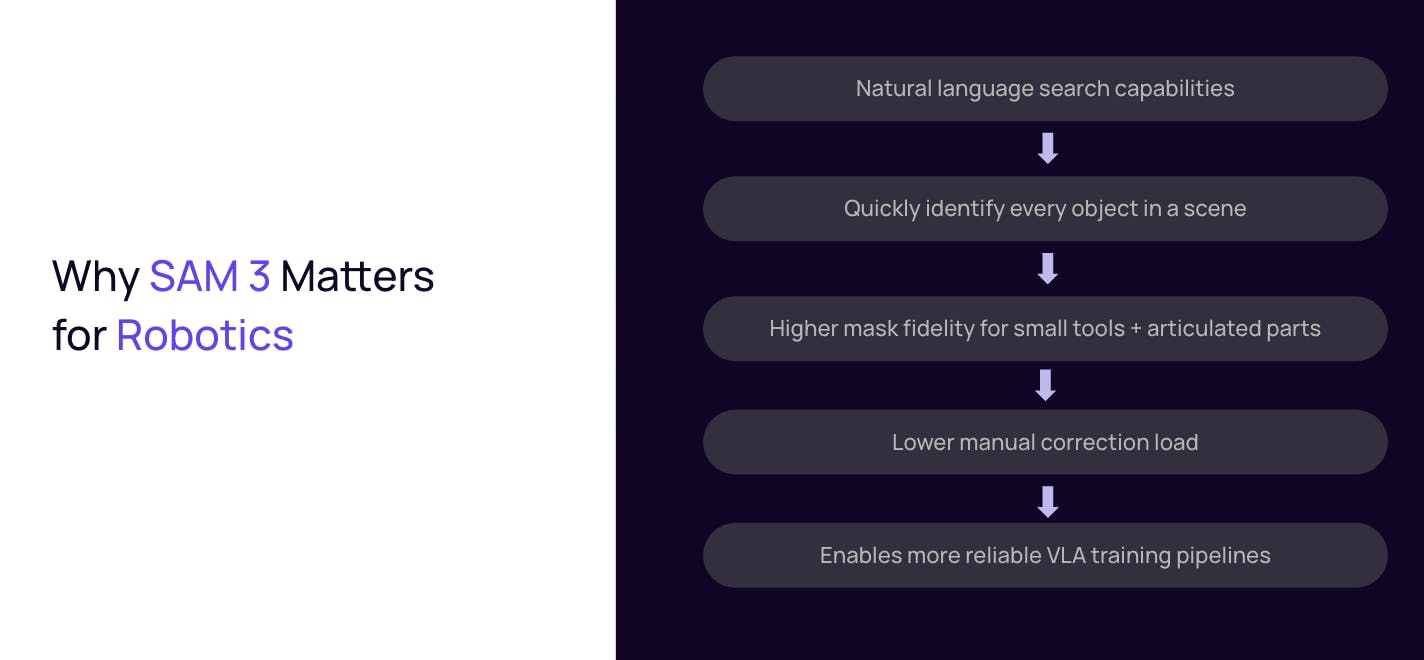
In many robotics applications, coarse segmentation is not enough. Manipulation tasks often involve small tools, thin components, or articulated robot parts where inaccurate boundaries can lead to poor learning signals. SAM 3 delivers noticeably higher mask fidelity compared to earlier segmentation models, reducing the need for manual correction.
This improvement has practical consequences. When annotators spend less time fixing masks, they can move faster and maintain higher overall dataset quality. For tasks involving fine motor control, such as grasping, assembling, or tool use, better masks translate directly into better perception and, ultimately, better control policies.
Automation Accelerates Humans Instead of Replacing Them
A key theme discussed during the webinar was the role of automation in annotation workflows. There is ongoing debate in the field about using model predictions as ground truth, but the approach demonstrated here is fundamentally different. SAM 3 acts as an external automation tool that accelerates annotation without introducing feedback loops from the model being trained.
By combining SAM 3 with other automated techniques, such as object detectors or interpolation, teams can dramatically increase throughput while keeping humans in the loop for validation and edge cases. This hybrid approach preserves trust in the dataset while making large-scale labeling economically viable.
Rather than replacing annotators, SAM 3 amplifies their effectiveness.
SAM 3 Enables Richer, More Grounded VLA Datasets
While SAM 3 excels at identifying and segmenting objects, it is not designed to generate task descriptions or high-level semantic understanding on its own. However, when combined with captions, classifications, and timeline-based annotations, it becomes a critical foundation for VLA datasets.
By grounding language and actions in precise visual segments, teams can build datasets where a robot’s instructions, perceptions, and interactions are tightly aligned. This grounding is what allows VLA models to move beyond pattern recognition and toward meaningful understanding of tasks and environments.
Labeled, Multimodal Data Is Becoming a Strategic Advantage
The discussion also touched on a broader industry trend: while early VLA efforts relied heavily on unlabeled or weakly labeled data, the field is increasingly shifting toward structured, labeled multimodal datasets. As robots are expected to operate in more diverse and unpredictable environments, edge cases become unavoidable. High-quality labeled video, especially with strong temporal consistency, is emerging as a key differentiator between teams that plateau and teams that continue to improve. Tools like SAM 3 make it possible to collect this data at scale without prohibitive costs.
Closing Thoughts
SAM 3 represents more than an incremental improvement in segmentation quality. It changes the economics and feasibility of building large-scale, temporally consistent robotics datasets. By reducing manual effort, improving consistency, and integrating seamlessly into existing annotation pipelines, it enables robotics teams to focus on what matters most: training models that can see, understand, and act reliably in the real world.
For anyone working on VLA or embodied AI systems, scalable segmentation is no longer a nice-to-have. It is a foundational capability for the next generation of robots.