What Is Anomaly Detection in Video Surveillance?
Anomaly detection in video surveillance is the use of computer vision models to automatically identify events, objects, or behaviors in camera footage that deviate from expected normal patterns, such as fighting, loitering, unattended bags, perimeter breaches, or traffic accidents. Unlike traditional anomaly detection, which works on structured, tabular, or time-series data, video anomaly detection has to interpret spatial, temporal, and behavioral information across sequences of frames, often with almost no labeled examples of the anomalies it needs to catch. It underpins modern security, public safety, and smart-city systems that can no longer rely on human operators watching hundreds of live feeds.
 💡Read More about Anomoly Detection
 Why does anomaly detection in video surveillance differ from traditional anomaly detection?
Standard anomaly detection methods, like z-scores, isolation forests, or clustering, work on structured features where "normal" can be defined mathematically. Video surveillance breaks that assumption in three ways:
Anomalies are rare by definition. A model needs to learn what normal foot traffic, vehicle flow, or building activity looks like from mostly normal footage, then flag the small fraction of frames that deviate from it. Positive examples of the actual anomaly (a fight, an intrusion, an abandoned bag) are scarce and often the hardest part of the dataset to source.
Context changes what counts as normal. A person running is unremarkable on a sports field and highly anomalous in a bank lobby at 2 a.m. Video anomaly detection models have to encode scene context, not just object presence.
Time matters as much as space. An anomaly is often defined by how an action unfolds over frames, not by a single frame in isolation. A person standing near a doorway is normal; a person standing near a doorway for eleven minutes while checking it repeatedly is not. This makes temporal annotation and sequence modeling essential in a way that tabular anomaly detection never requires.
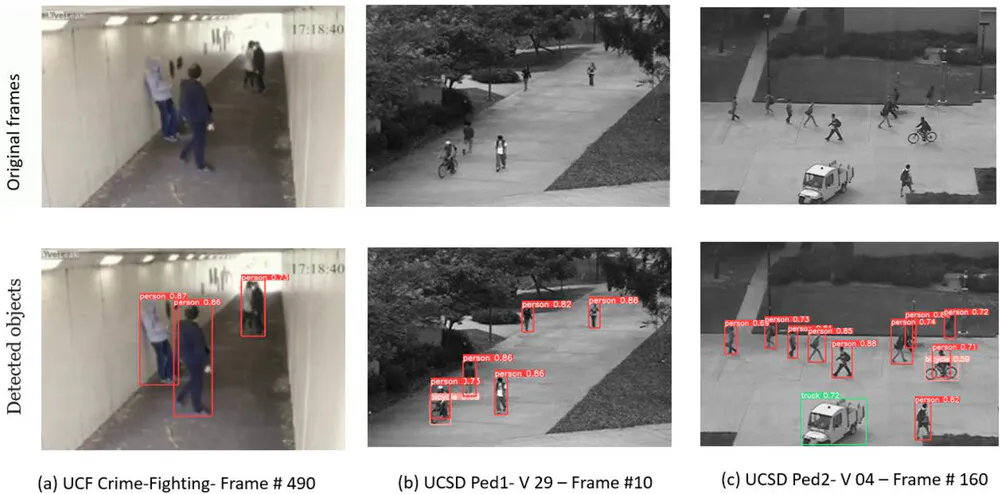
What types of anomalies do video surveillance systems detect?
Most production systems group anomalies into a few recognizable categories:
- Behavioral anomalies: fighting, falling, loitering, running in a restricted zone, or erratic movement patterns.
- Object anomalies: unattended bags or packages, weapons, or vehicles parked in restricted areas.
- Intrusion and perimeter anomalies: unauthorized presence crossing a fence line, tripwire, or restricted boundary, frequently at night or in low light.
- Traffic and incident anomalies: collisions, wrong-way driving, or sudden stops on roadways and in smart-city monitoring.
- Crowd anomalies: unusual density shifts, flow disruptions, or panic-driven movement in public spaces.
Each category demands a different labeling strategy and a different balance of spatial versus temporal annotation, which is why generic object detection ontologies tend to underperform in surveillance-specific deployments.
How do deep learning models detect anomalies in video streams?
Most modern systems fall into one of three architectural approaches:
- Reconstruction-based models (autoencoders, GANs): trained only on normal footage, these models learn to reconstruct typical frames accurately. When a frame contains an anomaly, reconstruction error spikes, which serves as the anomaly signal. This approach avoids the need for labeled anomalous examples but can struggle with subtle or slow-developing anomalies.
- Prediction-based models: these predict the next frame or sequence of frames from previous ones. A large gap between the predicted and actual frame indicates an event the model didn't expect, which is useful for catching sudden behavioral changes.
- Supervised and weakly-supervised classifiers: trained on labeled clips of specific anomaly types (fighting, intrusion, and so on), these tend to have higher precision for known anomaly classes but require significant investment in temporal, event-level annotation and don't generalize well to anomaly types they weren't trained on.
In practice, most enterprise deployments combine these approaches: an unsupervised or reconstruction-based model for open-set anomaly flagging, layered with supervised classifiers for high-priority, well-defined event types like intrusion or weapon detection.
What data challenges make video anomaly detection hard to build?
Anomaly detection in video surveillance is fundamentally a data problem before it is a modeling problem. The most common blockers teams run into:
- Extreme class imbalance. Anomalous events might represent well under 1% of total footage, making it easy for a model to achieve high accuracy by simply predicting "normal" for everything.
- Temporal annotation overhead. Labeling exactly when an anomaly begins and ends across long, continuous footage is far more labor-intensive than single-frame bounding box annotation, and inconsistent temporal boundaries directly degrade model performance.
- Domain shift across camera deployments. A model trained on daylight, high-resolution footage from one site often fails on a different site with different lighting, camera angle, or compression artifacts, requiring re-annotation and re-training per deployment.
- Privacy and compliance constraints. Surveillance footage frequently includes identifiable individuals, which adds redaction, access control, and retention requirements on top of the annotation workflow itself.
- Edge case scarcity. The events that matter most (rare intrusion patterns, unusual crowd behavior, novel object types) are, by definition, underrepresented in any dataset, making active learning and edge case mining critical to closing performance gaps.
What are common use cases for anomaly detection in video surveillance?
- Perimeter and intrusion detection for critical infrastructure, industrial sites, and restricted facilities.
- Retail loss prevention, flagging concealment or unusual checkout behavior across crowded store floors.
- Public safety and crowd monitoring in transit hubs, stadiums, and event venues.
- Smart-city traffic monitoring, detecting accidents, wrong-way driving, or congestion anomalies in real time.
- Healthcare and eldercare monitoring, identifying falls or medical distress in patient rooms without constant human observation.
A peer-reviewed survey on deep learning-based video anomaly detection notes that the task centers on localizing anomalies using both temporal and spatial information across applications such as traffic accident detection, criminal activity detection, and identifying abandoned or dangerous objects (Ullah et al., Sensors, 2023). This reflects why temporal, event-level data quality has become the primary differentiator between systems that work in a lab and systems that hold up in production.
How does Encord support anomaly detection in video surveillance?
Building a reliable video anomaly detection system depends on the quality and structure of the training data behind it, not just the model architecture. Encord supports these teams across the full data lifecycle:
Temporal and event-level annotation for precisely marking when an anomaly starts and ends across long-form footage, not just tagging individual frames.
Surveillance-specific ontologies built for intrusion, loitering, abandoned object, and crowd-behavior use cases, so labeling stays consistent across annotators and camera sites.
Edge case discovery and active learning, surfacing the rare anomalous clips buried in mostly-normal footage, which is where most video anomaly detection models fail without targeted curation.
Quality control workflows, including annotator consensus and review, for the low-frequency, high-stakes events where a single mislabeled clip can materially affect model precision.
💡For teams building or scaling anomaly detection for security, public safety, or smart-city applications, see The Complete Guide to Video Annotation for AI Security and Video Annotation Explained for a deeper walkthrough of annotation techniques and tooling.