The Complete Guide to Security Video Annotation

Head of Forward Deployed Engineering at Encord
TL;DR: Security video annotation is the process of labeling security and CCTV footage so computer vision models can detect and track people, vehicles, objects, and events on camera. It is harder than general video annotation because the footage is continuous, runs at massive scale, often requires real-time inference, and is dense with rare edge cases such as intrusion and theft, all under heavy privacy and compliance pressure. This guide covers what security video annotation is, why it differs from general video annotation, the AI security use cases that depend on it, the annotation types that matter, a step-by-step labeling workflow, the challenges unique to security footage, best practices for CCTV annotation, compliance, and how to choose a tool that labels and tracks objects across long security footage without frame-rate errors.
It is 2 a.m. and a camera is watching a loading bay. Nothing moves for hours. Then a figure slips past the fence line, pauses by a roller door, and is gone in eleven seconds. Whether that clip becomes an alert on a security desk or just another frame lost in a petabyte archive comes down to one thing: whether a model was trained on footage labeled well enough to recognize the moment for what it was.
That training data is the bottleneck for every AI security system. The global video surveillance market, the umbrella that AI security sits inside, is estimated to reach USD 147.66 billion by 2030, expanding at a CAGR of 12.1% from 2025 to 2030. (Grand View Research) The fastest-moving layer of that market is not the cameras, it is the models running on top of them. And within those AI deployments, intrusion detection holds the highest share of revenue, which is exactly the kind of rare, high-stakes event that only works when the model behind it was trained on carefully annotated examples.
 📖 Also Read: The Full Guide to Video Annotation for Computer Vision for the foundations of Video annotation across key domains
 What is security video annotation?
Security video annotation is the practice of labeling surveillance footage, such as CCTV, IP camera, body-worn, and drone video, so that computer vision models can learn to detect and track the people, vehicles, objects, and events that matter for safety and security.
It is a specialization of general video annotation. General video annotation can label anything in any video: animals in wildlife footage, products in retail demos, players in sports clips. Security video annotation narrows that to a security ontology, things like persons, vehicles, packages, weapons, restricted zones, and behaviors such as loitering or forced entry, then applies it to footage recorded continuously, often at low quality, at a scale no team could review frame by frame.
⚙️ Label and track objects across security footage without frame-rate error with Encord's AI-assisted video annotation tool. 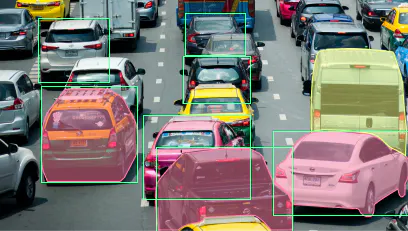
How Security video annotation is different (and harder) than general Video annotation
Most video annotation starts with footage someone already decided was worth keeping: curated clips, trimmed to the action, recorded in decent conditions. Security videos invert that. You inherit an endless feed where almost nothing happens, the conditions are whatever the camera happened to capture, and the few moments that matter can be hidden. That inversion reshapes every downstream decision, from how much you label to how fast the model has to react and significant privacy and compliance obligations. The result is a set of challenges that general video annotation rarely has to deal with all at once.
Here are the four main challenges that set Security video annotation apart.
Continuous, 24/7 footage at a massive scale:
A single camera produces 24 hours of footage every day, and most deployments run dozens to thousands of cameras, creating archives measured in petabytes where the vast majority of frames contain nothing of interest. Annotation has to be selective and efficient, because labeling every frame is neither affordable nor useful.
Real-time and low-latency requirements:
Many security models run live, flagging an intrusion as it happens rather than in an overnight batch. Models destined for edge or low-latency inference need training data that reflects the actual camera resolutions, frame rates, and compression artifacts they will see in production, not pristine clips that flatter the model in evaluation and fail on deployment.
Adversarial and edge-case heavy:
Security is an adversarial domain in which people hide, obscure their faces, move at night, and behave in ways designed not to be caught. The events you most need to detect, such as intrusion, theft, and anomalies, are exactly the ones that are rare, ambiguous, and visually subtle. A dataset that captures only the easy cases produces a model that misses the identification of the important ones.
Privacy and compliance challenges:
Security footage contains faces, license plates, biometric signals, and the movements of real people in real places, which places annotation inside the scope of regulations like GDPR and biometric data laws. Every decision about who can view footage, where it is stored, and how long it is retained carries legal weight, an obligation most general video annotation projects never face.
Security and surveillance use cases for video annotation
Annotated footage is the training input for intrusion detection, retail loss prevention, crowd monitoring, traffic and smart-city analytics, anomaly detection, and access control. These are the verticals where labeling quality translates most directly into model performance.
Intrusion and perimeter detection: Models learn to separate an authorised presence from a trespasser crossing a fence line, tripwire, or restricted zone. This is the highest-value Security use case and one of the hardest to label, because positive examples are rare and often occur in poor light.
Loss prevention and retail theft: Retail analytics models flag concealment, ticket switching, and exit without payment, which requires capturing subtle, intentional human behaviour across multiple frames in crowded store floors.
Crowd monitoring and public safety: Density estimation, flow analysis, and crowd-anomaly detection depend on annotating large numbers of overlapping people in a single frame, often from elevated, wide-angle cameras.
Traffic and smart-city surveillance: Vehicle detection, classification, counting, and incident detection for intelligent transport systems.
See how vialytics uses Encord to annotate and curate road imagery at scale for smart-city AI
Anomaly and suspicious-behavior detection: Instead of detecting a known object, these models learn what normal looks like for a scene and flag deviations, which depends heavily on well-labeled examples of both routine and abnormal activity.
Access control and ID verification: Models confirm identity and authorize entry at gates, turnstiles, and doors, supporting the face, badge, and behavior signals that tie into ID verification workflows.
How to label security camera footage: choosing the right annotation type
The main annotation types for security camera footage are bounding boxes, polygons, polylines, keypoints/pose, segmentation masks, and 3D cuboids, and most surveillance projects combine several of them in one ontology. The type you choose depends on what the model needs to learn. You can apply all of them in the Encord platform, with auto-segment and SAM accelerating the pixel-level work.
{table(Annotation)}
- Bounding boxes are the workhorse of surveillance. Fast to draw and ideal for detecting and counting people, vehicles, and packages.
- Polygons trace irregular shapes precisely, which suits restricted zones and objects a box would over-cover.
- Polylines mark linear features such as tripwires, lane markings, and the paths people walk, feeding line-crossing and trajectory logic.
- Keypoints and pose capture body joints, which is how models recognize behaviors like fights, falls, and loitering.
- Segmentation masks give pixel-level boundaries that hold up in dense, crowded scenes where boxes overlap and merge.
- 3D cuboids add depth and orientation for multi-camera, LiDAR-assisted, and traffic scenarios where 2D is not enough.
How to annotate Security video: a step-by-step workflow
The standard workflow for security video annotation runs in six steps: define objectives and ontology, curate footage, set up annotation, apply AI-assisted labeling and tracking, review and QA, then iterate with model feedback.
Following the sequence keeps long-footage projects efficient and consistent.
- Define objectives and ontology: Decide which events and objects matter before labeling anything. A clear, security-specific ontology, for example person, vehicle, package, weapon, restricted-zone-entry, prevents inconsistent labels later.
- Curate and pre-filter footage: Cut dead frames and surface edge cases first, so annotators spend time on footage that contains signal. Embedding-based curation helps you find the rare events buried in hours of nothing.
- Choose annotation types and set up the workflow: Map each object and event to the right annotation type, then configure the labeling project, hotkeys, and reviewer stages.
- Apply AI-assisted labeling and automated tracking: Use model-assisted labeling, object tracking, and interpolation to label keyframes and propagate them across frames, which is essential at scale.
- Review, QA, and resolve disagreement: Run multi-stage review and measure inter-annotator agreement to catch and reconcile inconsistent labels before they reach training.
- Iterate with model feedback: Close the loop: train, find failure cases, route them back into the queue, and relabel. Over time this active-learning loop tightens the dataset around real-world failure modes.
💡Go deeper: Read more on the Best Data Labeling Platforms for Smart Cities. Challenges of annotating Security footage
The challenges unique to Security footage annotation are low light and night vision, occlusion in dense crowds, motion blur from variable frame rates, re-identification across multiple cameras, and class imbalance between rare events and hours of uneventful footage.
These are Security-specific and rarely appear together in curated datasets.
- Low light, IR, and weather: Night-vision, infrared, rain, and glare degrade image quality, so models must train on footage that includes these conditions rather than only clear daytime clips.
- Occlusion and dense crowds: People and vehicles constantly block one another, which makes consistent identity and boundary labeling difficult in busy scenes.
- Motion blur and variable frame rates: CCTV often records at low or inconsistent frame rates, producing blur and gaps that break naive tracking and cause frame-rate errors if the tool downsamples.
- Re-identification across cameras: Tracking the same person or vehicle across non-overlapping camera views requires consistent identity labels across the entire deployment, not just within one feed.
- Class imbalance: The events you care about are rare against an overwhelming background of nothing, so anomaly sampling and targeted curation are needed to avoid a model that never sees enough positives.
Best practices for annotating security and CCTV footage
The challenges above aren't unbeatable. Teams that label Security footage well tend to do a few of the same things, and most of it comes down to discipline rather than fancy tooling. The practices below are the ones that keep quality from slipping once a project grows past a handful of cameras and a few hours of footage.
- Build a tight, surveillance-specific ontology: Fewer, well-defined classes labeled consistently beat a sprawling taxonomy nobody applies the same way twice.
- Use keyframes and interpolation: Label keyframes and let interpolation fill the gaps to cover hours of footage without labeling every frame.
- Lock consistency across cameras and shifts: Standardize labels across every camera and every annotator shift so the same object is labeled the same way everywhere.
- Prioritize the rare events: Use anomaly sampling and curation to oversample intrusions, theft, and abnormal behavior rather than drowning them in routine footage.
- Keep a human in the loop: Pair automation with multi-stage human QA so model-assisted labels are verified, not trusted blindly.
💻 Explore Webinar: Most Security footage is empty, with the events that matter buried inside. Watch Outside the Bounding Box: Edge Case Detection & Model Evaluation to learn how to surface those edge cases and label the footage that actually improves your model. Managing privacy and compliance when annotating CCTV footage
Annotating CCTV footage responsibly means complying with GDPR and biometric data laws, minimizing and consenting to data use, auditing labels for bias and fairness, and using tooling with access controls, audit trails, data residency, and encryption. Security data is personal data, and treating it carelessly is both a legal and an ethical risk.
The practical obligations are concrete. Footage with faces and license plates falls under GDPR and regional biometric rules, which means consent, purpose limitation, and data minimization apply. Detection models can also encode bias, so labels should be auditable and detection performance checked across demographics. The right tooling reduces this risk through granular access controls, full audit trails, configurable data residency, and encryption.
This is where platform security matters in practice. Encord is SOC 2, HIPAA, and GDPR compliant, and your data stays in your own cloud bucket, so footage does not leave your control to be annotated.

Read more on the Encord security page.
Choosing the right Security video annotation tool
Choosing the right security annotation tool is less about counting features and more about whether it survives real conditions: long footage, low frame rates, many cameras, and strict data rules. Plenty of tools handle a tidy clip. Far fewer handle a petabyte of CCTV without downsampling, dropping objects, or forcing your data outside its bucket.
These are the capabilities that tell you which is which.
- Native long-video handling, no downsampling. The tool should play, scrub, and label long CCTV files directly, without fragmenting them or introducing frame-rate errors.
- Automated object tracking and interpolation. Tracking objects across frames is the difference between a workable and an unworkable security workflow.
- Multimodal and multi-camera support. Video plus LiDAR, radar, and sensor data, labeled in one place, supports modern multi-camera and depth-aware deployments.
- Customizable review and QA pipelines. Multi-stage QA and operations dashboards let you manage annotator teams at scale.
- Enterprise security and compliance as standard. SOC 2, HIPAA, GDPR, encryption, and in-bucket data handling should be baseline, not add-ons.
🔔Ready to label, track, and curate Security footage at scale? With Encord Turn hours of raw CCTV footage into a surveillance model that catches what matters. Book a demo with Encord Annotate AI Security footage at scale with Encord
Encord is a video-first AI data platform for annotating, curating, and managing AI surveillance training data at scale. It is built for exactly the long, messy, high-volume footage that breaks general-purpose tools.
- Native, video-first annotation. Play, pause, scrub, zoom, and adjust brightness on long CCTV files without frame-by-frame fragmentation or frame-rate errors.
- AI-assisted labeling and automated tracking. Track objects across frames and cameras with interpolation and auto-segment to cut manual effort.
- Curate the long tail. Surface rare events and edge cases with embedding-based search before you label, via Encord curation.
- Multimodal and Physical AI ready. Video, LiDAR, radar, and sensor fusion in one platform, built for Physical AI.
- Customizable QA workflows and ops dashboards. Manage annotator teams and review stages at scale.
- Enterprise-grade security and compliance. SOC 2, HIPAA, GDPR, encryption, and data that stays in your cloud bucket. See the security page.
- Data and annotation services. Add workforce or collection support through Encord data services when you need it.
✔️ Get the data right 300+ of the best AI teams in the world use Encord. Take a tourTake a tour · Book a demo Key takeaways
- Security video annotation is labeling Security footage to train computer vision models to detect people, vehicles, objects, and events.
- It is harder than general video annotation because of continuous scale, real-time needs, adversarial edge cases, and privacy pressure.
- The core annotation types are bounding boxes, polygons, polylines, keypoints/pose, segmentation masks, and 3D cuboids.
- The workflow runs in six steps from ontology to a model-feedback loop, and the hardest challenges are low light, occlusion, motion blur, re-identification, and class imbalance.
- Compliance is non-negotiable: GDPR, biometric law, data minimization, and tooling with access controls, audit trails, and encryption.
Frequently asked questions
Encord provides a video-first AI data platform that annotates, tracks, and curates long Security footage natively, supports multimodal and multi-camera data, offers customizable QA workflows, and meets SOC 2, HIPAA, and GDPR compliance with data kept in your own cloud bucket.
Yes. AI-assisted labeling, automated object tracking, interpolation across keyframes, and active-learning loops automate most of the work, with humans reviewing edge cases and verifying labels rather than annotating every frame.
You handle privacy by complying with GDPR and biometric data laws, minimizing and consenting to data use, auditing labels for bias, and using tooling with access controls, audit trails, data residency options, and encryption so footage stays under your control.
You label security camera footage by defining a security-specific ontology, curating the footage to surface relevant events, applying annotation types such as bounding boxes and polylines with AI-assisted tracking and interpolation, then reviewing the labels through a human-in-the-loop QA stage before training.