Data Curation Best Practices for AI: A Step-by-Step Framework

Head of Forward Deployed Engineering at Encord
TL;DR: Data curation is the process of collecting, cleaning, selecting, and organizing data so a model can be trained on it reliably. Most curation efforts fail not because teams skip cleaning, but because they skip everything around it: defining what "good" data means, measuring coverage instead of just tidiness, and treating curation as a one-time task instead of an ongoing loop. This guide walks through where curation typically breaks down, a six-step framework to fix it, and what to look for if you're evaluating a tool to support it.
What Is Data Curation?
Data curation is the practice of selecting, cleaning, organizing, and maintaining data so it is fit for a specific purpose, in this case, training or fine-tuning an AI model. It sits between raw data collection and model training. You gather the data first, then curate it before it ever reaches a training loop.
Curation is often confused with cleaning, but cleaning is only one part of it. A dataset can be perfectly deduplicated and formatted and still be badly curated if it does not represent the conditions your model will actually face in production. Curation covers the full arc: deciding what data you need, collecting it, cleaning it, selecting the right examples, organizing them, and maintaining that quality as new data arrives.
These best practices build on the fundamentals. If you're new to the topic, start with our guide to What Data is Curation
Where Do Most Data Curation Efforts Break Down?
Most curation problems trace back to a handful of recurring failure modes, and they tend to compound each other.
- No shared definition of "good." Teams start collecting or labeling data before anyone has written down what the target dataset should actually look like. Everyone ends up with their own private definition of quality, and the dataset drifts toward whatever was easiest to gather.
- Cleaning gets mistaken for curation. A team removes duplicates, fixes formatting, and calls the job done. But a clean dataset can still be dangerously narrow. If 90% of your examples are the easy case, the model learns the easy case and fails on the 10% that actually matters.
- Data lives in silos. Files scattered across multiple cloud buckets, on-prem drives, and local exports make it nearly impossible to know what you actually have, let alone deduplicate or audit it properly.
- Everything is manual, or everything is automated. Fully manual review does not scale past a few thousand files. Fully automated filtering quietly drops rare, high-impact edge cases because they look like noise to an algorithm with no context for why they matter.
- Nothing is versioned. When a model regresses, teams that cannot answer "what changed in the data?" lose days or weeks to an investigation that should take minutes.
- Curation stops at launch. Real-world data distributions shift after deployment. A dataset that was well-curated at training time slowly stops matching what the model sees in production, and no one notices until performance quietly degrades.
- No one owns it. Curation that is everyone's job in principle is no one's job in practice. Without a directly responsible owner, every failure mode above tends to show up at once.
A Step-by-Step Data Curation Framework
A good data curation framework is a sequence of decisions, not a checklist of chores. The six steps below apply regardless of data type, whether you're curating images, video, audio, documents, or multi-sensor data.
1. Define curation criteria before you collect
Write down what "good" data means for your specific model and task before a single file lands in storage. That means the target distribution (which classes, conditions, and edge cases must be represented, and in what proportion), minimum quality thresholds, and explicit exclusion rules. These criteria become the spec every later step gets measured against.
Skip this step and you end up with a large, expensive dataset skewed toward whatever was easiest to capture, with no way to tell whether it covers the scenarios your model actually needs to handle.
2. Establish a source-of-truth pipeline
Standardize, validate, and deduplicate at ingest, in one place. Every file should be checked against format and metadata rules the moment it arrives, near-duplicates flagged immediately, and everything unified in a single view rather than scattered across buckets. This is what makes the rest of the framework reproducible.
Without it, data ends up scattered across multiple cloud and on-prem stores with no unified view, deduplication becomes impossible, the same file gets labeled twice, and no one can answer a simple question: what's actually in our training set?
3. Build quality metrics into curation, not just cleaning
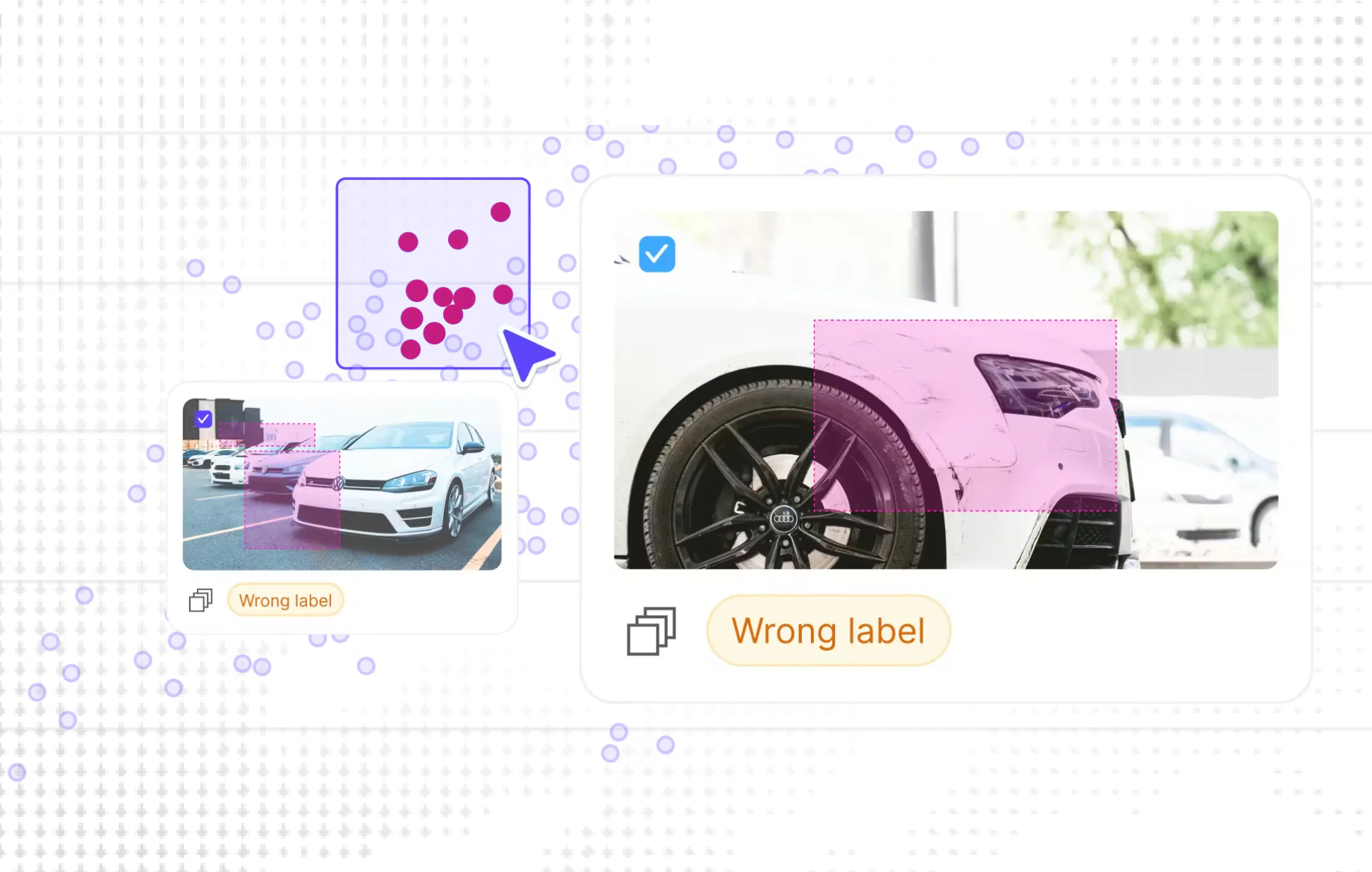
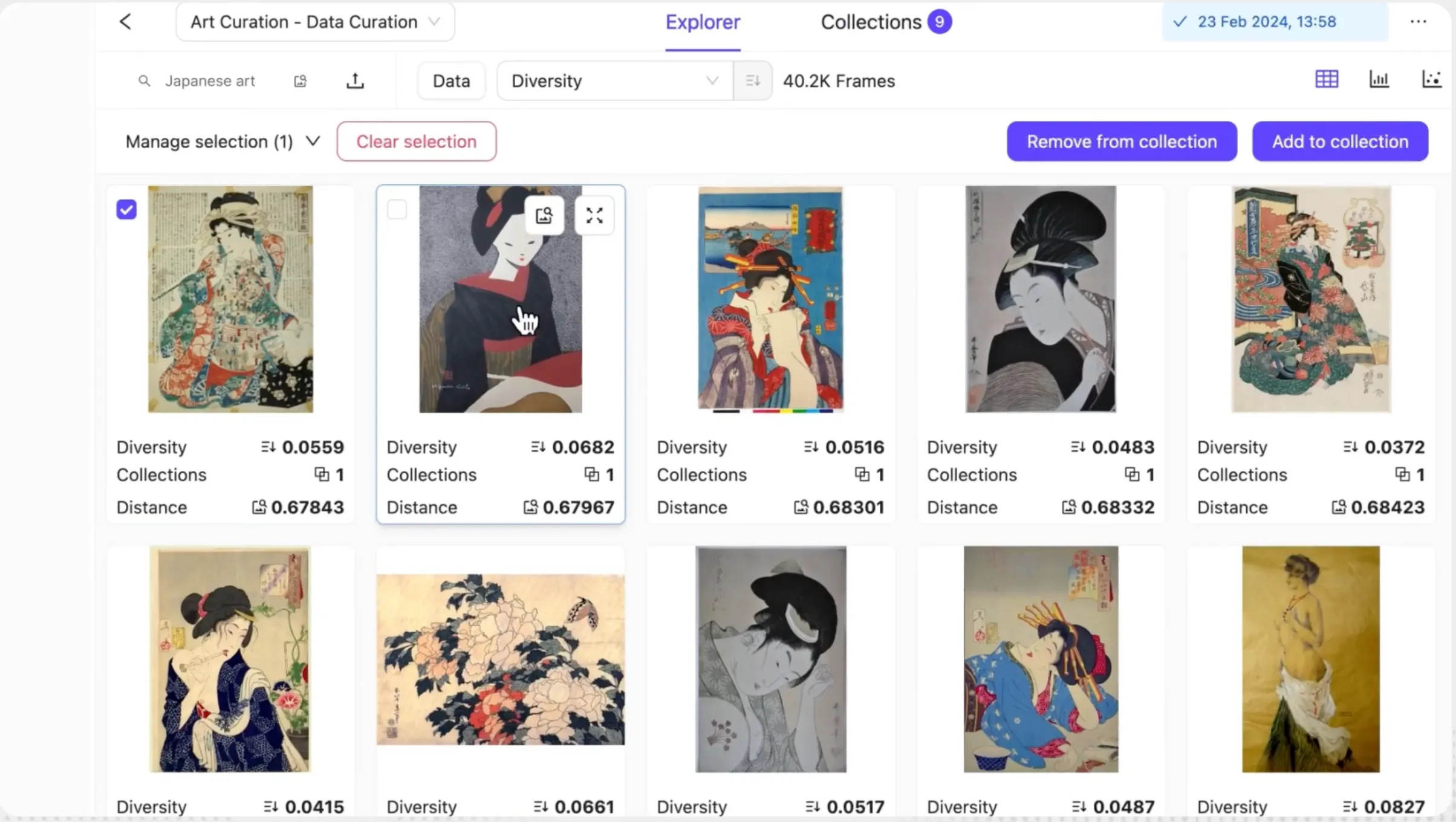
Measure the dataset, don't just tidy it. Use embeddings to visualize coverage, quantify diversity, surface outliers, and find the underrepresented regions where a model is most likely to fail. Selection should be driven by concrete metrics like uniqueness, class balance, and edge-case coverage, not gut feel or "we labeled everything we had."
This is the step most teams skip, and it's the difference between a dataset that is tidy and a dataset that is actually good.
4. Decide your human-in-the-loop threshold
Draw an explicit line between what gets automated and what gets human review. High-confidence, low-risk selections can be automated. Low-confidence, high-impact cases, safety-critical edge cases, ambiguous samples, anything near a decision boundary, should be routed to a person. Deciding this threshold deliberately keeps curation both fast and trustworthy.
Treating this as all-or-nothing is the common mistake: fully manual curation doesn't scale, and fully automated curation quietly drops the rare cases that determine whether a model is safe to deploy.
5. Version and audit every curation decision
Treat datasets like code. Every curated set should be versioned, every inclusion and exclusion decision traceable, and the lineage from raw file to training set fully reconstructable. When a model regresses, you need to answer "what changed in the data?" in minutes, not weeks.
Without versioning, you cannot rebuild the exact set a model trained on, which means you cannot debug regressions, satisfy an audit, or fully trust your own experiments.
6. Treat curation as continuous, not a one-time project
Build a loop, not a project. Monitor for distribution drift once a model is in production, define explicit re-curation triggers (a new deployment environment, a spike in a specific failure mode, a newly discovered edge case), and route production failures back into the dataset.
Declaring a dataset "done" at launch is the mistake here. Real-world distributions shift, and a set that was well-curated at training time slowly stops matching what the model actually sees.
A note on ownership: the framework above only works if someone owns it end to end. Name a directly responsible owner for curation, whether that's an ML engineer, a data-centric AI lead, or a small data operations function, and give that role a single shared definition of "training-ready" plus the authority to gate what moves forward to labeling and training.
What Should You Look for in a Data Curation Tool?
Once a team outgrows spreadsheets and one-off scripts, the tooling question becomes how to support the framework above at scale rather than which product has the most features. A few things are worth checking for specifically:
- Unified view across storage locations. Can it connect to your existing cloud or on-prem storage and give you one queryable view of everything, without forcing a full data migration first?
- Embedding-based exploration. Can you visualize your dataset to spot coverage gaps and outliers, or are you limited to filtering on manually entered tags?
- Near-duplicate and quality detection at ingest. Does it flag duplicates and quality issues automatically as data arrives, or only after a manual review pass?
- Support for a human-in-the-loop threshold. Can you route low-confidence or high-impact samples to a reviewer automatically, rather than choosing between fully manual and fully automated?
- Dataset versioning and lineage. Can you reconstruct exactly which version of a dataset produced a given model, and trace who included or excluded specific samples?
- A feedback loop from production. Can failures observed after deployment be routed back into the curation pipeline, or does curation stop once training starts?
Encord is built around this workflow specifically, connecting to existing storage, surfacing embeddings and quality metrics at ingest, and supporting versioned, queryable dataset snapshots so curation decisions stay auditable over time.

Key Takeaways
Data curation is the discipline of selecting, cleaning, organizing, and maintaining data so a model can be trained on it reliably, and it's a broader job than cleaning alone. We covered where curation efforts typically break down (no shared definition of "good," cleaning mistaken for curation, siloed data, all-manual or all-automated review, no versioning, curation stopping at launch, and no clear owner), a six-step framework to fix it (define criteria before collecting, build a source-of-truth pipeline, measure quality rather than just tidiness, set a deliberate human-in-the-loop threshold, version every decision, and treat curation as continuous), and what to check for when evaluating a tool to support that framework at scale.
The takeaway: a clean dataset and a well-curated dataset are not the same thing, and most of the gap between them comes down to whether a team has a framework at all, or is just tidying up as they go. Curation that has no direct owner and no plan past launch day tends to degrade quietly until a model fails in production.