How to Build Diverse Egocentric Datasets for Robotics: A Practical Guide

Robotic Learning Lead at Encord
TL;DR: Egocentric data is first-person video and sensor data captured from the viewpoint of a robot's own camera in deployment; it removes a translation step that causes grip errors, missed contact points, and poor approach angles. Video alone isn't enough. Production-ready egocentric datasets pair video with depth, motion (IMU), audio, and sometimes tactile/force data. Diversity matters more than volume. Environment, operator demographics, embodiment/hardware, and scripted failure scenarios determine generalization far more than raw hours of footage. Collection is a process, not an event, with protocol design, piloting, scaled field capture, sync validation, annotation, and a deployment feedback loop.
A robot that trains perfectly in the lab and stalls on day one in the real world isn't failing because of its algorithm. It's failing because of its data.
Most robotics models are still trained on footage that doesn't match what the robot's own camera will see: a fixed overhead angle, a clean single-object scene, one operator, one lighting setup. Real deployments look nothing like that. Warehouses get crowded. Kitchens get messy. Lighting flickers. Two people cross paths at once.
Egocentric data, first-person video and sensor data captured from the exact viewpoint a robot will operate from, closes that gap. But collecting egocentric data isn't enough on its own. If every clip comes from the same environment, the same three operators, and the same task, the model still won't generalize.
This guide covers what egocentric data actually is, the modalities and diversity dimensions that make it usable, a practical framework for collecting it at scale, and how to evaluate whether a dataset (or a data partner) is actually ready to train a model.
What is egocentric data?
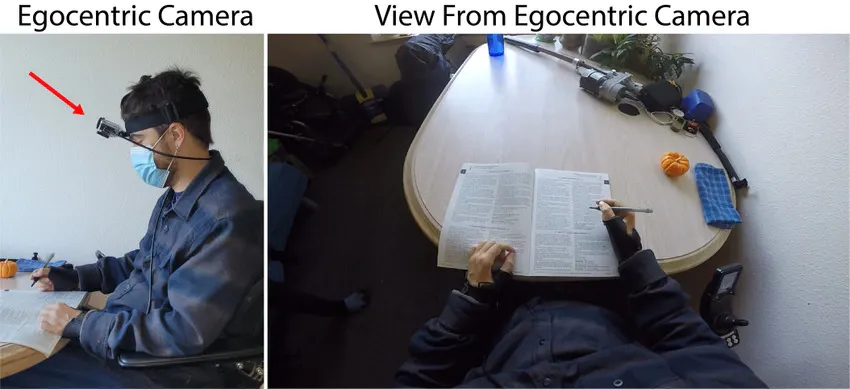
Egocentric data is video and sensor data captured from a first-person point of view, usually from a camera mounted on the head, chest, or wrist of a person performing a task, or on the robot itself.
Unlike third-person or overhead footage, egocentric data shows:
- What the hands are doing, not just where they are in a room
- The exact approach angle and grip a robot's own camera will see at deployment
- Contextual detail, object position, occlusion, lighting, from the operating viewpoint, not a bystander's
Because it mirrors the robot's own sensor position, egocentric data removes a translation step that third-person footage forces the model to make: converting an outside view into a first-person decision. That translation step is where a lot of manipulation errors, a missed grip, an early release, a bad approach angle, come from.
Why egocentric video data alone isn't enough
Raw first-person video tells a model what a task looks like. It doesn't tell the model:
- How hard a grip needs to be
- How far away an object actually is
- What the hands are doing at the exact moment of contact, if they're occluded
- What happened just before or after the frame
That's why production-grade egocentric datasets are multimodal by default, not video-only. The video is the anchor. Everything else fills in what video can't capture on its own.
The Core Data modalities in a training-ready egocentric dataset
| Modality | What it captures | Why it matters |
| RGB video | The primary first-person view, usually head- or wrist-mounted | Foundation layer for object recognition and scene understanding |
| Depth (RGB-D) | Distance between the camera and objects in frame | Lets a model judge proximity, not just position in a 2D frame |
| Motion / IMU data | Head, wrist, and body movement, frame by frame | Fills in trajectory and orientation during occluded moments |
| Audio | Ambient sound, tool contact, spoken instruction | Surprisingly rich context signal, a knife hitting a board, a person speaking nearby |
| Hand / eye tracking | Grip aperture, finger position, gaze direction | Critical for fine manipulation and intent modeling |
| Tactile / force data | Grip pressure, contact force | The layer video can never capture, whether a grip is too tight, too loose, or slipping |
A dataset doesn't need every layer for every use case. But the layers you skip should be a deliberate call based on the policy you're training, not a gap that shows up after deployment.
The Data Diversity Dimensions that actually move model-performance
This is the part most teams underinvest in. Collecting more egocentric footage from the same three operators, in the same test kitchen, doesn't fix generalization. Collecting diverse footage does.
1. Environment diversity
Kitchens, warehouses, offices, industrial floors, retail aisles, clinical settings. A model trained in one environment type learns that environment's lighting, clutter, and layout, not the task.
2. Operator and demographic diversity
Different body sizes, hand shapes, dominant hands, and skill levels. A grip that works for one operator's hand geometry may not transfer to another's.
3. Embodiment and hardware diversity
Head-mounted, chest-mounted, wrist-mounted, and robot-native camera positions all produce meaningfully different training signals. Field of view, mounting angle, and depth quality all shift what a model actually learns to expect.
4. Task and scenario diversity (including failure cases)
Unscripted "natural activity" footage clusters around common actions and rarely captures the edge cases that break a model in deployment. Scripted scenarios that deliberately cover failure and recovery sequences, a dropped object, a missed grasp, an occluded reach matter as much as the "happy path."
5. Modality and sensor diversity
Not every clip needs every sensor stream, but a dataset that only ever pairs video with nothing else will always underperform one that pairs video with depth, motion, and where the task calls for it, force data.
How the data maps to training stages
Different layers of egocentric data train different parts of a robotics model. It's useful to think of this as a stack rather than a single dataset:
| Layer | What it captures | What it trains |
| Human understanding | Everyday human activity, unscripted | Foundational perception, how people move, hold, and switch between tasks |
| Task execution | Manipulation trajectories, grips, joint states | Motion control and skill repetition |
| Instruction following | Vision + language instruction + resulting action | Vision-language-action (VLA) models |
| Workflow completion | Long, multi-step tasks with exceptions | Long-horizon reasoning and recovery when something goes wrong |
Most production programs pull from more than one layer. A humanoid learning to unload a dishwasher, for example, typically needs human demonstration data, fine manipulation data, and step-by-step task structure, not just one of the three.
This is close to how Encord structures Physical AI data collection in practice, across embodiment-specific data, teleoperation data, egocentric data, and UMI (handheld gripper) data, each mapped to a different stage of model training, from broad pretraining to embodiment-specific fine-tuning.
A practical framework for collecting diverse egocentric data
Collecting egocentric data well is a process, not a single shoot day. Here's the sequence that holds up in production:
1. Design the protocol before anyone goes into the field Define the task, the hardware configuration, and the quality bar in a controlled environment first. Fixing a bad protocol after a week of field capture costs far more than fixing it before day one.
2. Pilot in a controlled setting Run the protocol in a lab or studio environment before scaling. This is where camera placement, lighting, and scenario scripting get stress-tested cheaply.
3. Scale with a diverse operator network, across environments Once the protocol holds up, scale capture across multiple real-world environments and a demographically varied operator pool, not just the location and people that were easiest to book.
4. Synchronize and validate at ingestion, not after Video, depth, IMU, and audio streams need to be time-aligned to a shared clock. A drift of even a few dozen milliseconds between streams can teach a model the wrong cause and effect.
5. Route data into annotation with full context, not in isolation Sub-action segmentation, hand pose, object state, and failure flags all need frame-accurate alignment to the source video, not bolted on after the fact.
6. Close the loop with deployment feedback When a model fails in the field, that failure is itself a data point. Capturing it, through remote teleoperation or human review, and feeding it back into the next collection round is what actually closes the gap between lab performance and field performance.
This is the same collection loop Encord runs for Physical AI teams: protocol design at dedicated facilities, an in-field operator network across kitchens, warehouses, offices, and industrial settings, and a deployment feedback loop that updates the next round of collection based on what's actually failing in the field.
What makes egocentric data model-ready?
Whether you're building a collection program in-house or evaluating a data partner, five things separate egocentric data that trains a model well from data that just looks right:
- Annotation depth: Not just bounding boxes, but hand poses, object states, sub-action segments, and failure flags, all aligned to the right frame.
- Sensor calibration and sync: Video, depth, audio, and motion streams need to describe the same moment, not five slightly different ones.
- Edge-case coverage: Low light, occlusion, crowded scenes, and rare events, the situations lab data quietly skips.
- Consent and compliance: First-person video is sensitive by definition, it often captures faces, workspaces, and identifying details of people other than the operator. A defensible collection program needs documented consent, environment preparation, and alignment with frameworks like GDPR.
- Sim-to-real readiness: Real-world footage that pairs cleanly with synthetic data, so teams can scale scenario coverage without losing the grounding that makes a model reliable in deployment.
Common challenges in egocentric data collection
Hand and object occlusion
Fingers disappear from frame exactly when their position matters most, at contact and grasp. Multi-angle capture (rather than relying on a single camera) is the most reliable mitigation.
Operator fatigue over long sessions
The first hour of a capture session tends to produce clean, deliberate movement. The last thirty minutes of a long session brings shortcuts and sloppier task completion. Structured, shorter sessions with built-in review outperform long unbroken capture blocks.
Privacy and consent
Egocentric footage is biometric data under frameworks like GDPR. A defensible program needs written operator consent, consent from anyone else who might appear on camera, and environment preparation, removing identifying items before capture, rather than trying to anonymize footage after the fact.
Why Encord is the best choice for egocentric data collection
Most providers on the list above specialize in one stage: capture, or annotation, or labeling infrastructure. Encord is built to run the whole loop.
- One platform, not a handoff between vendors. Egocentric video collected in the field or at Encord's Bay Area facilities flows directly into the same platform used for curation and annotation, no re-ingestion, no format conversion, no lost context between stages.
- Protocol design happens before field deployment. Tasks, hardware configuration, and quality criteria are defined and piloted at Encord's facilities first, so cost and time aren't spent recollecting data that doesn't match the training objective.
- Diversity is designed in, not left to chance. Environments, lighting, operator demographics, embodiments, and task variation are specified upfront as part of protocol design, across a network of thousands of trained operators spanning kitchens, warehouses, offices, vehicles, and industrial settings.
- Standardized, sync-ready hardware. Base kit includes RGB-D stereo depth cameras with IMU and multi-camera synchronization, paired with UMI grippers, with higher frame rate and multi-finger capture hardware available for more demanding manipulation tasks.
- A genuine deployment feedback loop. When a model fails in the field, that failure mode is captured through remote teleoperation and human review, then fed directly back into collection and annotation policy, closing the loop between deployment and the next round of data.
Pickle Robot, a Physical AI company automating truck unloading and warehouse logistics, partnered with Encord to consolidate data curation and annotation for its robotic grasping models. The result: a 30% improvement in annotation accuracy, 60% faster model iteration cycles, and a 15% improvement in robotic grasping accuracy.
Key takeaways
- Egocentric data works because it matches the viewpoint a robot's own camera will use in deployment, removing a translation step that causes manipulation errors.
- Video alone isn't enough. Production-ready egocentric datasets pair video with depth, motion, audio, and sometimes tactile data.
- Diversity beats volume. Environment, operator demographics, embodiment, and scripted failure scenarios matter more than raw hours of footage.
- Collection is a process, protocol design, piloting, scaled field capture, sync validation, annotation, and a deployment feedback loop, not a single capture event.
- When evaluating a data partner, look for end-to-end coverage (collection through deployment feedback), not a single-stage point solution.
Frequently asked questions
Third-person video shows a scene from the outside. A robot acts from its own viewpoint. Training on footage that matches that viewpoint removes a translation step that otherwise introduces manipulation errors, missed grips, early releases, bad approach angles.
RGB cameras as the foundation, typically paired with depth sensors, IMU-based motion tracking, and audio. Hand and eye tracking are common additions for fine manipulation tasks, and tactile or force sensors are increasingly used for grip-sensitive tasks.
It depends far more on diversity than raw volume. A smaller, well-diversified dataset covering multiple environments, operators, and failure scenarios typically outperforms a larger dataset collected from a single narrow setting.
It depends on whether your bottleneck is collection capacity, annotation quality, or both. Teams without an existing operator network or lab facility usually move faster with a partner that handles the full pipeline rather than assembling capture, sync, and annotation tooling separately.
Mecka AI's model pays operators to record everyday tasks like cooking or repairs using body sensors and a smartphone, quickly building volume without building a lab or operator network from scratch. The tradeoff is less control over the environment and demographic diversity, since operators are self-directed rather than working from a designed protocol, and less control over hardware consistency across sessions.
Not by default. Both are built around capture: Mecka around egocentric volume, XDOF across teleoperation and egocentric tiers. Sync validation, sub-action segmentation, and hand/object annotation are typically a separate step after collection, which means the data has to move to another platform before it's actually usable for training.