TL;DR: Egocentric data is sensor data captured from the first-person perspective of the agent performing a task, a robot, a human demonstrator wearing a camera rig, or a head-mounted device, as opposed to exocentric (third-person) data recorded by an external observer. It matters because physical AI systems perceive and act from their own viewpoint, so first-person training data transfers far better to real-world deployment.
Most physical AI systems don't get a view from above. A robot operating in the real world sees the world through its own onboard cameras and sensors, never from the perspective of a bystander watching it work. That mismatch is the core reason egocentric data exists as a category: if you train a robot on footage shot from across the room, then deploy it on a robot that only has access to its own first-person view, you've built in a perspective gap the model was never trained to close.
Egocentric data closes that gap by capturing the world the way the agent actually experiences it. In practice, that means first-person video from head-mounted or chest-mounted cameras, synchronised sensor streams from a robot's own hardware during task execution, or large-scale human demonstration footage used to teach robots by example. Canonical datasets like Ego4D and wearable platforms such as Aria-style smart glasses exist precisely because this first-person signal is what imitation learning and Vision-Language-Action model training pipelines need most.
Egocentric Data vs Exocentric Data
The distinction comes down to where the camera sits relative to the agent:
- Egocentric (first-person): Captured from the agent's own sensors; what the robot or the wearer sees as they perform the task.
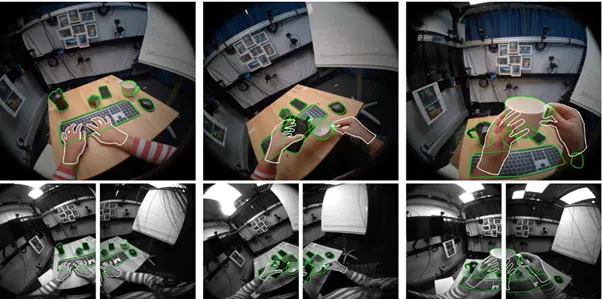
Perspective of Egocentric Data (Source)
- Exocentric (third-person): Captured from an external camera observing the agent; what a bystander watching from across the room would see.
Exocentric video generation
Why Egocentric matches deployment conditions?
A robot in the field only ever has access to its own onboard sensors, so training data captured from the same viewpoint transfers far more reliably to inference. The model learns to act on the exact kind of input it will receive in production.
Why exocentric data is still useful?
Third-person capture is easier to scale and excellent for understanding behaviour, scene context, and ground-truth object positions. But used on its own it creates a perspective gap at inference time — the model is trained on a viewpoint it will never actually have. In most production pipelines the two are complementary, not competing.
Types of Egocentric Data
- Egocentric video: First-person video from head-mounted or chest-mounted cameras. Ego4D is the canonical large-scale dataset for this category.
- Egocentric robot sensor data: Camera, depth, LiDAR, and IMU streams recorded from a robot's onboard sensors during task execution.
- Egocentric demonstration data: First-person video of humans performing tasks, used for imitation learning and VLA training.
- Multi-sensor egocentric streams: Synchronised camera, depth, IMU, and audio from wearable rigs or robot platforms, used for grounded perception tasks where the alignment between modalities carries the signal.
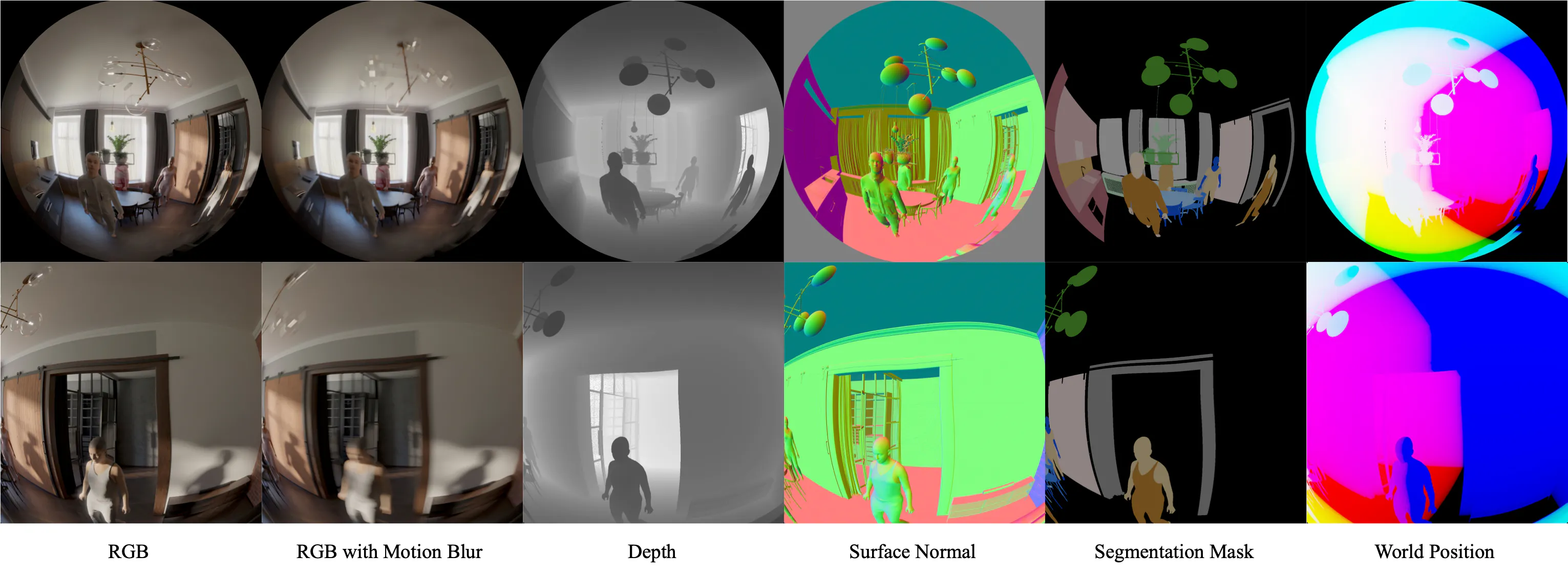
How Egocentric Data is captured
Egocentric data comes from three main sources, each trading off scale, fidelity, and how closely it matches the target embodiment:
- Wearable camera rigs: Head-mounted action cameras, Aria-style smart glasses, and chest-mounted cameras. The workhorse for capturing human demonstrations at scale, since a person wearing a rig can generate hours of varied first-person footage cheaply.
- Robot onboard sensors: Cameras and depth sensors mounted on the robot itself, recording during teleoperation or autonomous operation. This is the highest-fidelity source because the perspective matches deployment exactly.
- Simulated egocentric capture: Virtual cameras attached to simulated agents inside physics simulators, producing synthetic egocentric data with full ground truth. Scales almost infinitely, but inherits the sim-to-real gap.
How to annotate Egocentric Data
Egocentric annotation is meaningfully harder than third-person annotation, for reasons specific to the first-person viewpoint: rapid camera motion, motion blur, partial occlusion of the agent's own hands or end-effector, the need to track gaze, and the requirement to label actions and intents alongside the raw visual content. A third-person clip can often be labelled frame by frame as a static scene; an egocentric clip has to be labelled as an unfolding action sequence.
Common label types include:
- Action segments (what the agent is doing across a span of frames)
- Object interactions (which objects the agent engages with)
- Hand–object contact points (the precise moment and location of grasp or release)
- Gaze fixation (where the wearer is actually looking).
Common challenges with Egocentric Data
- Motion blur and camera shake: First-person capture is inherently unstable; the camera moves with the agent's head or body, so frames are far noisier than fixed-camera footage.
- Partial visibility: The agent's own body, hands, or end-effector routinely occlude parts of the scene, hiding exactly the interactions you most want to label.
- Scale of collection: Capturing diverse first-person demonstrations across many tasks and environments is expensive and slow, especially when each requires a human operator or physical hardware.
- Annotation complexity: Labelling actions, intents, and hand–object contact at frame level is significantly slower than standard video annotation, and harder to keep consistent across annotators.
- Domain gap: Egocentric data from humans wearing cameras doesn't transfer perfectly to robots with different embodiments; a human hand and a parallel-jaw gripper see and interact with the world differently. Every one of these challenges traces back to the same root: egocentric data is only trainable when fast-moving, multi-stream, frame-level footage stays synchronised and consistently labelled.
Every one of these challenges traces back to the same root: egocentric data is only trainable when fast-moving, multi-stream, frame-level footage stays synchronised and consistently labelled.
 💡 With Encord, teams in Physical AI overcome these challenges. Label egocentric data with Encord
 Encord for Egocentric Data workflows
Encord supports egocentric data workflows end to end: native multi-sensor ingestion (camera, depth, and IMU streams synchronised in a single workflow), temporal annotation at scale, action and interaction labelling tools built for unstable first-person footage, and curation across large egocentric datasets.
That combination is what makes it suitable for VLA and humanoid training pipelines, where the data is first-person, multimodal, and only useful when every stream stays aligned
More resources
Informational Guides:
- Gemini Robotics — Advancing Physical AI with VLA Models
- Accelerating Robotics VLA Segmentation with SAM 3
Technical Documentation:
Webinars and video content:
Frequently asked questions
- Egocentric data is captured from the first-person perspective of the agent performing a task — what the robot or wearer sees. Exocentric data is captured from an external camera observing the agent, like a bystander watching from across the room. Egocentric data matches deployment conditions because a deployed robot only has access to its own onboard sensors.
- Because robots perceive and act from their own viewpoint, not from above. Training a policy on first-person data means the model learns from the exact kind of input it will receive at inference, which transfers far more reliably than third-person footage.
- Ego4D is the canonical large-scale egocentric video dataset — thousands of hours of first-person footage of people performing everyday tasks, widely used as a benchmark for egocentric perception and as pretraining data for imitation learning and VLA models.
- First-person footage suffers from rapid camera motion, motion blur, and frequent self-occlusion from the agent's own hands or end-effector. On top of that, it has to be labelled as an unfolding action sequence — with actions, intents, and hand–object contact tracked over time — rather than as a static scene, which makes annotation slower and harder to keep consistent.