Robotics Data Annotation: From Simulation to Real-World Deployment

TL;DR: Robotics models depend on multi-modal data, RGB, depth, LiDAR, force-torque, joint state, tactile, captured and labeled in tight temporal sync, which breaks most traditional annotation tools. This guide covers the data modalities robotics teams work with, the challenges of annotating temporal action sequences and synchronised sensor streams, what's required for clean sim-to-real transfer (domain randomisation, edge-case coverage), and the quality metrics that separate datasets that ship working robots from datasets that don't.
Robotics is one of the hardest applications of AI, and the bottleneck is rarely the model; it's the data. Modern robotic systems take in synchronised streams from cameras, depth sensors, LiDAR, force-torque sensors, and joint encoders, and they have to act on all of it in real time. The quality and diversity of that training data directly determine whether a model deployed on a physical robot will actually work outside the lab.
This guide covers the critical aspects of robotics data annotation, from labeling multi-modal sensor streams to closing the gap between simulation and real-world deployment.
What is Robotics Data Annotation?
Robotics data annotation is the process of labeling sensor data collected from robotic systems, including RGB camera feeds, depth maps, LiDAR point clouds, and force-torque readings, so machine learning models can learn to perceive environments, plan actions, and execute physical tasks. Unlike standard image annotation, robotics annotation requires synchronising labels across multiple data streams, capturing temporal action sequences, and covering enough domain variation to bridge the gap between simulated training environments and real-world deployment.
How is Robotics Data Annotation different from Computer Vision Labeling?
The intersection of robotics and AI creates unique challenges in data preparation. Modern robotic systems rely on multiple data streams, visual inputs, sensor data, and temporal information, and the quality and diversity of how that data is annotated directly impact real-world performance. Three properties in particular separate robotics annotation from standard computer vision labeling: The multi-modal nature of the data, the temporal dependencies in robotic action, and the gap between simulated training environments and physical deployment.
1. Multi-Modal Sensor Streams
Robotic systems typically process multiple data streams simultaneously, which requires sophisticated annotation approaches that go well beyond traditional image labeling. Visual data from cameras provides spatial awareness, while sensor data offers precise measurements of force, pressure, and position. A single training sample isn't one image, it's a synchronised bundle that combines:
- RGB camera feeds for visual perception
- Depth maps for spatial understanding
- Force-torque sensor readings
- Joint positions and velocities
- LiDAR point clouds for 3D mapping
- Tactile sensor data
Traditional image labeling tools often fall short when dealing with synchronised sensor data, because they were designed to handle one modality at a time. Encord's annotation platform addresses this by providing specialised tools for handling synchronised multi-modal data streams, and Encord's physical AI solutions are built specifically to handle the complexity ofك
2. Temporal Dependencies and Action Sequences
Robotics applications frequently require understanding and replicating complex action sequences, which means labels can't be applied frame by frame in isolation. Our research on VLA model training has shown that temporal annotations are crucial for teaching robots to perform tasks effectively. A label on a single moment captures what's happening at that instant, but not the motion leading up to it or the outcome that follows.
Breaking down complex actions into annotatable sequences requires identifying key motion primitives, marking transition points between actions, capturing temporal dependencies, annotating success and failure conditions, and documenting environmental interactions. This is closer to action recognition in video annotation than to object detection in image annotation, but with stricter requirements: annotation has to describe what the robot is doing, why, and whether it worked, all across synchronised sensor streams, frame by frame.
3. The Sim-to-Real Gap
Most robotics training happens in simulation because it generates large volumes of data quickly and safely, but models trained only on simulated data tend to fail on physical hardware. Small mismatches in visual textures, lighting, sensor noise, and physics accumulate into a model that doesn't generalise to the real world.
Annotation plays a direct role in closing this gap. As demonstrated in our Physical AI suite, successful sim-to-real transfer depends on diverse training data that covers variation in lighting, object appearances, environmental factors, robot configurations, and task parameters. Domain randomisation and active learning are what surface the samples that most improve real-world performance.
The Six Core Data Modalities in Robotics
Robotic systems rely on synchronised streams from multiple sensors to perceive and act in the physical world. With over 4.66 million industrial robots in operational use worldwide as of 2024, and that number growing year over year, the demand for high-quality multimodal training data has scaled with them. Each modality captures something the others can't, and each requires a different annotation approach
{table(Core Data Modalities in Robotics)}
1. RGB Camera Feeds
RGB feeds are the most common input for robotic perception, giving the robot the visual context it needs to identify objects and understand scene layout. Annotation uses standard CV primitives, bounding boxes, polygons, and segmentation masks, but applied across synchronised frames rather than isolated images.
2. Depth Maps
Depth maps add what RGB lacks: how far away things are. They're critical for manipulation, where the difference between a successful grasp and missed contact is often a few millimetres. Annotation focuses on pixel-level depth values and object boundaries, labeled in tandem with the paired RGB frame.
3. LiDAR Point Clouds
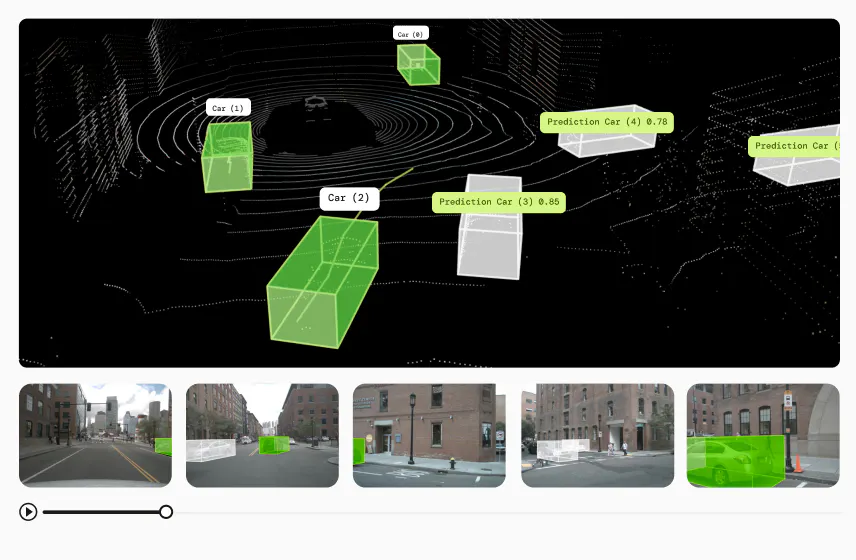
LiDAR generates dense 3D point clouds that capture geometry at scale, making it foundational for autonomous vehicles, drones, and mobile robotics. Annotation involves 3D cuboids, polylines, polygons, masks, and keypoints with track-ID management for temporal consistency. With scenes regularly containing millions of points, specialized 3D tooling is non-negotiable.
4. Force-Torque Sensor Readings
Force-torque sensors measure contact dynamics: how hard the robot is gripping, what resistance it's hitting, and when something's gone wrong. The data is continuous and event-driven, so annotation focuses on tagging moments of contact, transition, and failure rather than spatial regions.
5. Joint Positions and Velocities
Joint data describes the robot's own pose and motion state, the proprioceptive layer that tells the model where its arms, wheels, or legs are at any given moment. Annotation is time-series based, often tied to motion primitive tags that mark action phases (approach, grasp, retract).
6. Tactile Sensor Data
Tactile sensors capture surface-level interaction data, texture, slip, pressure, and vibration. Less common than vision and depth, but increasingly important for dexterous manipulation, where touch tells the model what vision can't. Annotation is event-based, labeling state changes (contact made, slip detected, object released).
How to Annotate Action Sequences in Robotics Data?
Most robotic tasks are sequences, not single moments. Picking up a cup, opening a drawer, and welding a seam are not captured by labeling a single frame. To train a robot to replicate a task reliably, annotation has to break the full action into structured pieces that the model can learn from. There are three steps to doing this well.
Step 1: Breaking Actions into Motion Primitives
A motion primitive is the smallest unit of robotic action that still carries meaning. For a pick-and-place task, the primitives might be approach, align, grip, lift, move, lower, and release. Annotators tag each primitive across the video frames where it's happening, giving the model a structured vocabulary of sub-actions it can recombine for new tasks. The granularity matters here. Too coarse and the model misses important sub-steps. Too fine and the annotation cost increases without improving outcomes.
Step 2: Marking Transition Points Between Actions
Between every motion primitive, there's a transition. The moment a robot stops approaching and starts gripping. The moment it lifts cleanly versus the moment it slips. These transition points are where action sequences either succeed or break, so they need explicit timestamps in the annotation. Labels on transitions help the model learn not just what to do, but when to switch between behaviours, which is often the harder problem in real-world deployment.
Step 3: Labeling Success and Failure Conditions
A sequence isn't complete without an outcome. Did the robot grasp the object or drop it? Did the assembly hold or fall apart? Annotating success and failure conditions gives the model a feedback signal it can use to distinguish good executions from bad ones, which is essential for both reinforcement learning workflows and post-deployment evaluation. Failure labels are often more valuable than success labels here, because they surface the edge cases that most need additional training data.
How does Sensor Fusion Work in Robotics Annotation?
Modern robotic systems rely on multiple sensors and cameras working in concert. A self-driving car combines RGB feeds, LiDAR, and radar. A surgical robot blends visual input with force feedback. A warehouse robot fuses depth maps with joint state data. None of these works if the streams aren't properly aligned, and none of them can be annotated effectively with single-modality tools.
Encord's multimodal AI capabilities handle this by integrating data sources into one annotation environment while preserving the temporal and spatial relationships between them.
Three areas discussed below decide whether sensor fusion annotation succeeds or breaks:
1. Temporal Alignment Across Streams
Every sensor in a robotic system samples at its own rate. For the data to be useful, each frame, sweep, and reading has to be aligned to a shared timeline so the model sees a coherent moment rather than a jumble of unrelated signals.
Effective temporal alignment annotation covers:
- Camera feed synchronization across multiple viewpoints
- Sensor data alignment to a common clock
- Validation that timestamps actually line up before labeling begins
When alignment is off, the model learns the wrong correlations. A force spike paired with the wrong RGB frame teaches a robot to associate gripping with whatever the camera happened to be showing at that moment, which is rarely what the engineer intended.
2. Cross-Modal Consistency
A label applied to one stream needs to make sense in the others. If an annotator marks an object as "graspable" in the RGB frame, the depth map needs to show it within reach, the LiDAR sweep needs to confirm it's a solid object, and the force reading at the moment of contact needs to match a successful grip event.
Cross-modal consistency annotation involves:
- Cross-modal relationship mapping between paired labels
- Cross-modal consistency checks to flag contradictions
- Data completeness monitoring so no stream is silently missing
Without these checks, datasets accumulate contradictions that degrade model performance in ways that are hard to surface later.
3. Calibration and Metadata Preservation
Sensors only produce useful data if the system knows where they are and how they're oriented. Calibration parameters (the position and rotation of each sensor relative to the robot frame) need to travel with the annotations, not sit in a separate file that someone forgets to update. The same applies to metadata like capture time, environmental conditions, and hardware configuration.
Preservation requirements include:
- Temporal metadata preservation across the full pipeline
- Calibration data integration into the annotation record
- Sensor calibration verification at ingest
Treating calibration as a first-class part of the annotation, not an afterthought, is what makes a dataset reusable when the hardware setup changes or when models need to be retrained on new data.
How does Annotation Supports Sim-to-Real Transfer?
Bridging the gap between simulation and real-world deployment is one of the hardest problems in robotics. Simulators produce huge volumes of cheap, safe training data, but small differences in visual textures, lighting, sensor noise, and physics mean that a model trained purely on simulated data often fails on physical hardware.
As demonstrated in our Physical AI suite, successful sim-to-real transfer depends on annotation that builds in enough variation and edge case coverage to close that gap.
Domain Randomization
Domain randomization is the practice of deliberately varying conditions in the training data so the model learns features that hold up across environments rather than overfitting to a specific simulated look. Effective domain randomization requires annotating variations in:
- Lighting conditions, from bright outdoor scenes to low-light indoor settings
- Object appearances, including color, texture, and material differences
- Environmental factors such as weather, backgrounds, and clutter
- Robot configurations across different hardware setups
- Task parameters that change the goal or constraints of an action
The more variation captured in the annotation, the less work the model has to do at deployment time to figure out which features actually matter.
Edge Case Identification
The samples that most improve a robotics model are rarely the average ones. They're the edge cases: the unusual lighting, the rare object orientation, the failure mode no one anticipated in simulation. Annotation workflows need a structured way to find and prioritize these samples instead of treating every frame as equally valuable.
Encord's active learning system helps surface and prioritize edge cases through:
- Automated anomaly detection that flags unusual samples
- Performance-based sample selection that targets data the model gets wrong
- Diversity-driven data collection to broaden coverage
- Failure mode analysis to study what's actually breaking
- Corner case synthesis for scenarios that are hard to capture in the wild
Edge case work is where the sim-to-real gap usually closes. A model that handles the long tail of unusual inputs is the one that actually deploys
How to Measure Quality in Robotics Annotation
Annotation quality is what separates a dataset that trains a working robot from one that produces a model nobody can deploy. The complexity of robotics data (multi-modal, temporal, safety-critical) makes quality harder to measure than in standard computer vision, where a single IoU score can tell you most of what you need to know.
Encord's quality metrics provide validation frameworks built for this complexity, combining annotation-level checks with dataset-level performance signals.
Annotation Quality Assurance
Annotation QA looks at the labels themselves: whether they're accurate, consistent, and complete across the dataset. Key metrics include:
- Temporal consistency scores that track whether labels stay accurate across frames in a sequence
- Cross-modal alignment accuracy to confirm labels agree across RGB, depth, LiDAR, and sensor streams
- Annotation precision metrics for the geometric accuracy of bounding boxes, cuboids, and masks
- Coverage analysis to surface gaps in object classes, environments, or task types
- Edge case representation to confirm the dataset includes the rare samples that matter most
Strong QA catches problems early, before they get baked into the model and surface as failure modes in deployment.
Performance Validation
Performance validation looks at whether the annotated dataset actually produces a model that works. It's the layer above QA, focused on whether the data is fit for purpose rather than whether individual labels are correct. Validation processes should verify:
- Action sequence completeness, so every task the robot needs to learn is fully captured
- Sensor data integrity across all modalities in the dataset
- Temporal alignment accuracy at the dataset level, not just within individual samples
- Environmental variation coverage that matches the conditions the robot will encounter
- Edge case representation across the full range of expected failure modes
Annotation quality and dataset quality are different problems. A dataset can have perfectly labeled samples and still fail at performance validation if it doesn't cover the right scenarios.
Robotics Data Annotation Use Cases by Industry
Robotics annotation looks different depending on what the robot has to do. A self-driving car has different data needs than a warehouse picker, and a surgical robot has different quality requirements than a delivery drone. Here are the verticals where robotics data annotation matters most, and what's specific to each.
ADAS and Autonomous Vehicles
Self-driving and advanced driver-assistance systems train on massive, multi-format datasets collected across thousands of multi-hour trips. The annotation challenge is surfacing high-signal edge cases across 3D, video, and sensor data within complex driving scenes, then accurately identifying objects like pedestrians, obstacles, and signs in diverse conditions.
Key annotation requirements:
- 3D cuboids and segmentation for LiDAR point clouds
- Object tracking across long driving sequences
- Edge case identification for rare scenarios (poor weather, unusual road layouts, occluded pedestrians)
- Ground truth validation across diverse driving conditions

Warehouse and Logistics Robotics
Warehouse robots need to identify products, navigate aisles, and manipulate items at high speed without dropping or damaging anything. Annotation focuses on object detection across cluttered shelves, depth-based pick point estimation, and the manipulation feedback loops that distinguish a clean grasp from a slipped one.
Key annotation requirements:
- Object detection across high-variance product catalogs
- Depth and 6DoF pose estimation for pick-and-place
- Manipulation success and failure labels tied to force-torque data
- Environment annotation for navigation in dynamic warehouse layouts
Humanoid Robots and VLA Models
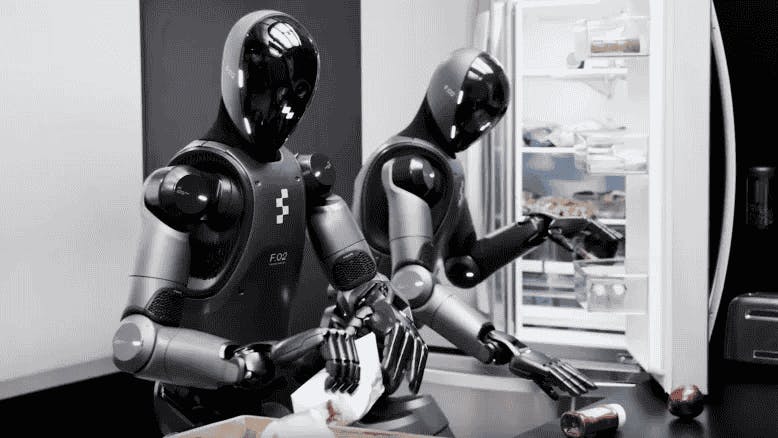
Humanoids and Vision Language Action (VLA) models combine perception with language understanding, learning to interpret human instructions and act on them. Annotation here goes beyond labeling what's in the scene — it connects physical objects to language descriptions, enabling foundation models that can follow nuanced commands.
Key annotation requirements:
- Object-language pairing across video sequences
- Action sequence decomposition for complex tasks
- Temporal captions that describe what the robot is doing and why
- Multi-modal alignment across vision, language, and motion data
Drones and UAVs
Drone teams work with vast multi-sensor datasets including 3D LiDAR point clouds, RGB, thermal, and multispectral imagery. The annotation challenge is efficient labeling across long aerial sequences in diverse environments and weather conditions, supporting applications like infrastructure inspection, precision agriculture, construction, and environmental monitoring.
Key annotation requirements:
- 3D point cloud annotation for aerial LiDAR sweeps
- Multispectral and thermal imagery labeling
- Long-sequence object tracking across changing terrain
- Environmental variation coverage for all-weather operation
Surgical Robotics
Surgical robots operate in safety-critical environments where annotation accuracy directly affects patient outcomes. Datasets typically combine endoscopic video with force feedback and instrument tracking, requiring frame-level precision that standard CV annotation tools weren't built to handle.
Key annotation requirements:
- Anatomical structure segmentation at pixel-level precision
- Surgical instrument tracking across video frames
- Phase and event labeling for procedural understanding
- Inter-annotator agreement metrics for clinical-grade quality control
Key Takeaways: Data Annotation for Robotics
Robotics data annotation is the foundation of every working physical AI system, and it is a fundamentally different problem from standard computer vision labeling. We covered how robotics data differs from standard CV, with multi-modal sensor streams, temporal action sequences, and the sim-to-real gap shaping every annotation decision.
We walked through the six core data modalities (RGB, depth, LiDAR, force-torque, joint state, and tactile), how to annotate temporal action sequences, what sensor fusion requires, and how annotation supports clean sim-to-real transfer. We also covered the quality metrics that separate datasets that ship working robots from those that stall, the verticals where robotics annotation matters most (ADAS, warehouse, humanoids and VLA, drones, surgical), and the criteria worth weighing when choosing a platform.
Take the next step in your robotics development journey with Encord's specialized tools and expertise. Our platform offers comprehensive support for all aspects of robotics data annotation, from temporal sequences to multi-modal sensor fusion. Start accelerating your robotics development today or get in touch to request a trial of Encord.
Explore more resources
Guides:
- Video Annotation Guide on How to annotate temporal sequences in video
- Data annotation guide The end-to-end workflow for labeling training data, from setup to quality control.
- Quality metric guide The annotation and dataset metrics that separate deployable models from ones that stall.
- Physical AI suite see how Encord supports sim-to-real transfer and multi-modal sensor data for robotics teams.
- Automating captioning for VLA models with GPT-4o — Our research on generating temporal captions that teach robots what they're doing and why.
Industry Deep-Dives:
- ADAS and autonomous vehicles Annotating 3D, video, and sensor data to surface high-signal edge cases in driving scenes.
- Warehouse and intralogistics Object detection, pick-point estimation, and manipulation feedback loops for warehouse robots.
- Surgical robotics Frame-level annotation of endoscopic video, force feedback, and instrument tracking for safety-critical systems.
- Vision-based localization for drones Labeling multi-sensor aerial data across LiDAR, RGB, thermal, and multispectral imagery.
Video Content:
VLA robotics masterclass A walkthrough of how vision language action models combine perception, language, and motion.
Explore the Platform:
Physical AI Encord's solution for curating and labeling synchronized multi-modal robotics data.
Multimodal annotation Annotate RGB, depth, LiDAR, and sensor streams in one environment with temporal alignment preserved.
LiDAR annotation 3D cuboids, polylines, and keypoints with track-ID management for point cloud data.
Active learning Surface and prioritize the edge cases that most improve real-world model performance.