TL;DR: Robotics data is the multimodal, time-synchronised record of what a robot perceives and how it acts, including camera, LiDAR, radar, IMU, depth, and force/torque streams paired with the corresponding control actions or demonstrations. Unlike text and image datasets scraped from the web, every meaningful robotics dataset has to be physically collected, and it is only useful when observations and actions are aligned tightly enough to train a policy. It is the foundational training fuel for Physical AI and Embodied AI systems.
What is Robotics Data?
Robotics data is any data generated by or for a robot that pairs sensor observations with the actions, commands, or outcomes that follow them. A single training example typically bundles synchronised streams from multiple sensors alongside the control signal that the robot produced in response.
The different data streams that make up a robotics dataset usually include:
- RGB camera: visual scene understanding
- LiDAR: 3D spatial geometry via point clouds
- Radar: velocity and depth in poor visibility
- IMU: orientation, acceleration, and angular velocity
- Depth sensors: per-pixel distance information
- Force/torque sensors: contact forces during manipulation
Proprioceptive state: joint positions, gripper state, motor commands
The observation–action pairing is what makes the data trainable for control rather than just perception. A language model learns from text already on the open web; a robot has to learn from data that someone physically collected on hardware or generated in simulation.
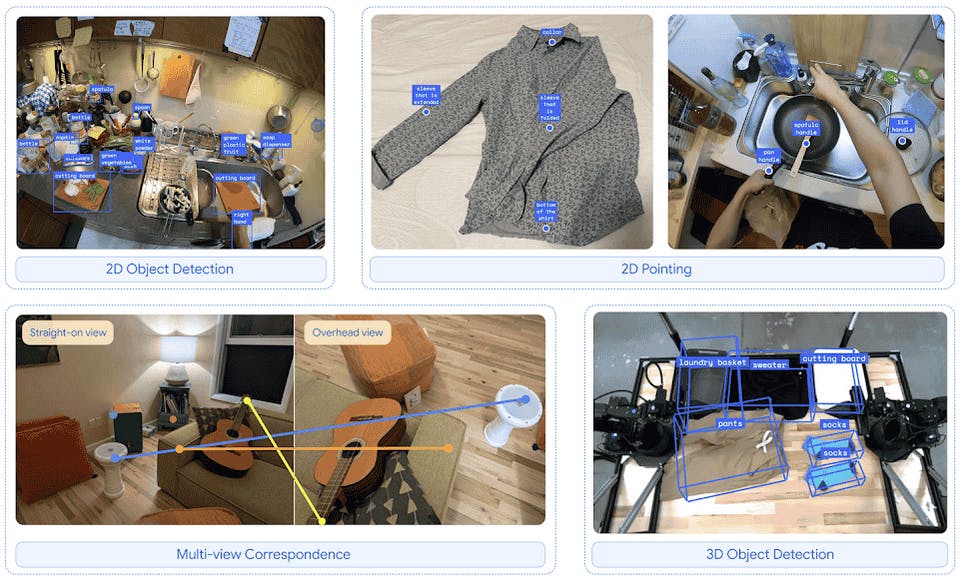
How is robotics data different from other AI training data?
Three structural properties separate robotics data from the datasets that train language models or image classifiers:
- Robotics data is proprietary by necessity: There is no public corpus of robot demonstrations comparable to Common Crawl or LAION. Every dataset of meaningful size has to be collected by the team that uses it, which makes robotics data one of the most defensible assets in the AI stack.
- The data is Multimodal and synchronised: A single frame typically combines several sensor streams that are only useful if they align at millisecond resolution. A desynchronised dataset cannot be used to train robots regardless of its size.
- Data is Action-paired: The data captures not just what the world looked like at time t, but what the robot did in response, the command issued, the trajectory taken and the outcome that followed. This coupling is what lets a model learn behaviour rather than just master recognition.
The four types of Robotics data
Sensor data: raw streams from cameras, LiDAR, radar, IMU, and depth sensors, often represented as images, point clouds, or fused tensors.
Demonstration and teleoperation data: recordings of humans driving a robot through a target task, producing clean observation–action trajectories. The dominant approach for training manipulation policies today.
Synthetic and simulation data: generated in physics simulators with perfect ground truth, then transferred to real hardware via sim-to-real techniques such as domain randomisation.
Egocentric and first-person data: captured from a head-mounted or robot-mounted viewpoint, used to learn manipulation and navigation behaviours from human activity at scale.
How robotics data is collected?
There are three dominant collection methods, and most high-intensity robotics programmes use all three in combination :
- Real-world deployment: robots operating in the field (warehouses, factories, roads, homes) logging sensor and telemetry data as they go. Highest accuracy with no reality gap, but quite an expensive and slow method.
- Teleoperation sessions: skilled human operators driving robots through target tasks to generate aligned demonstration data. Real sensors and real physics, but bounded by how many hours operators can log.
- Simulation: synthetic environments producing high-volume data with perfect ground truth at very low cost. Fast and cheap, but robots trained purely in sim often degrade on contact with real enviorments, which is what makes sim-to-real transfer a critical step in the pipeline.
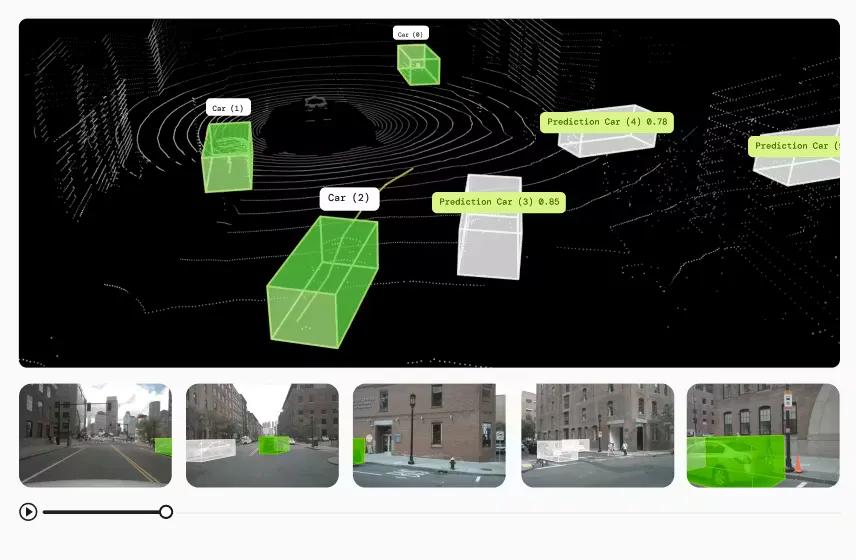
How robotics data is Annotated?
Annotating robotics data goes well beyond drawing boxes on 2D images. The annotation layer typically includes:
- Temporal consistency: an object tracked at t=0 must keep the same identity at t=100, across thousands of frames.
- Cross-sensor labels: a single object may need a 2D box in the camera view, a 3D cuboid in the LiDAR point cloud, and a matching ID in the radar return.
- Action and grasp labels: what the robot was instructed to do, what it actually did, and how it did it (grasp type, contact point, approach trajectory).
- Task-stage segmentation: splitting a demonstration into discrete phases (approach, grasp, transfer, release).
- Success and failure flags: outcome labels that let a model learn from negative examples as well as positive ones.
The end goal of data annotation in robotics is to train a robot to successfully execute tasks rather than learn to simply classify. The annotation schema has to capture both the intent and outcome of an action.
Which is why robotics annotation is typically of higher magnitude and more expensive than equivalent 2D image or video annotation.
The common challenges in working with robotics data
Robotics data is uniquely difficult to work with, the problem lies not in the algorithm but in the data itself. Teams building Physical AI models routinely spend more engineering effort on data collection, synchronisation, and labeling than on model architecture, because the quality of the dataset fed to a model sets the benchmark of what a robot, trained on this data, can achieve.
The five challenges below surface during almost every robotics programme, regardless of form factor or task.
- Multimodal synchronisation: keeping camera, LiDAR, radar, and IMU streams aligned at millisecond resolution across long sessions. Even slight misalignment can quietly derail training.
- Scale and storage: A single robot session can generate terabytes of raw sensor data; a fleet generates petabytes.
- Distribution shift: Training data rarely covers every real-world edge case, and robots routinely encounter conditions outside their training distribution.
- Sim-to-real gap: Robots trained entirely in simulation often fail on first contact with real physics, lighting, and sensor noise.
- Annotation cost: 3D, temporal, and multi-sensor labeling demands specialist talent that the broader annotation market does not yet supply at scale.
Solving any one of these in isolation is tractable. Solving all five together, at the scale and consistency needed to train a production robot, is what separates teams that ship high-quality robotics from teams that simply demo them.
It's also why most Physical AI teams Invest heavily in their data infrastructure as they do in their model stack.
Encord for robotics
Encord's Physical AI suite is built for the multimodal, synchronised, action-paired nature of robotics data. LiDAR, point cloud, camera, and radar streams are labelled together with full temporal alignment, so annotations stay consistent across sensors and across time.
Teams use it to:
- Turn raw robot logs and teleoperation sessions into training-ready datasets
- Add timestamped action captions for VLA training
- Maintain consistent labelling standards across large demonstration datasets
- Surface edge cases through active learning before they reach production
💡Explore Encord for Physical AI
💡Explore Annotation and Labeling with Encord
💡Book A demo to speak with one of our AI experts
Related Resources:
Informational Guides:
- Full Guide to robotics annotation
- Top data labeling tools for Robotics
- Top Video Annotation for Robotics
Webinars and Videos:
Frequently asked questions
- Any data generated by or for a robot that pairs sensor data with actions or outcomes. This includes raw sensor logs, teleoperation recordings, simulation rollouts, and egocentric footage used to train robot policies. The defining feature is the observation–action pairing, not the sensor modality.
- Robots require observation–action paired data. The internet contains billions of images of someone picking up a mug, but almost none are paired with the joint torques, gripper commands, and proprioceptive state that a robot needs to learn the action itself. Robotics data has to be physically collected.
- Not yet. Simulation is essential for scale and safety, but the sim-to-real gap means most production systems combine synthetic pretraining with real-world or teleoperated fine-tuning. Sim is a force multiplier, not a replacement.