Advanced Driver Assistance Systems (ADAS): Types, Levels & Examples

Head of Forward Deployed Engineering at Encord
TL;DR: Advanced driver assistance systems (ADAS) are electronic systems that help a vehicle sense its surroundings, warn the driver, and in some cases take action, using cameras, radar, LiDAR, and ultrasonic sensors. Common examples include automatic emergency braking, adaptive cruise control, lane keeping assist, blind spot detection, and parking assistance. ADAS maps to the lower SAE levels of driving automation (Levels 1 to 2) and is the foundation on which autonomous driving (Levels 3 to 5) is built. These systems work only as well as the data behind them; every feature depends on AI models trained on large volumes of accurately labeled sensor data. That data layer is where Encord supports ADAS and AV teams: curating, annotating, and validating multimodal sensor data.
The automotive world is moving fast. From adaptive cruise control to fully self-driving cars, vehicles are becoming smarter every day. At the heart of this transformation are Advanced Driver Assistance Systems (ADAS), which are designed to make driving safer, easier, and more efficient. ADAS is more than just a safety feature; it’s the foundation for autonomous vehicle (AV) development, helping cars perceive their environment, respond to hazards, and assist drivers in complex situations.
This ability doesn’t come from sensors alone. Instead, it comes from labeled and validated data. As ADAS systems grow more advanced, the quality of the data behind them becomes critical. Platforms like Encord are accelerating this progress by providing tools for high-quality data annotation and model evaluation, which are critical for building reliable ADAS and AV systems.
What are Advanced Driver Assistance Systems (ADAS)?
Advanced driver assistance systems (ADAS) are electronic systems that help a vehicle sense its environment, warn the driver of hazards, and, in some cases, take corrective action, such as braking or steering. They combine sensors (cameras, radar, LiDAR, and ultrasonic), onboard compute, and AI perception models to monitor the road in real time, adding a layer of intelligence between the driver and the vehicle.
Picture driving down a busy highway. Your car is continuously scanning the road, tracking other vehicles, monitoring lane markings, and watching for pedestrians. When the car ahead brakes suddenly, your vehicle can warn you to slow down or apply the brakes itself to avoid a collision. That is ADAS in practice.
ADAS is designed around three goals:
- Safety: Helping drivers avoid accidents or reduce their severity
- Convenience: Cutting the mental load of long commutes and heavy traffic
- Efficiency: Smoothing speed and braking to save fuel and ease congestion.
It is also the foundation on which autonomous driving is built. The same perception stack that assists a driver today is what will eventually replace the need for one.
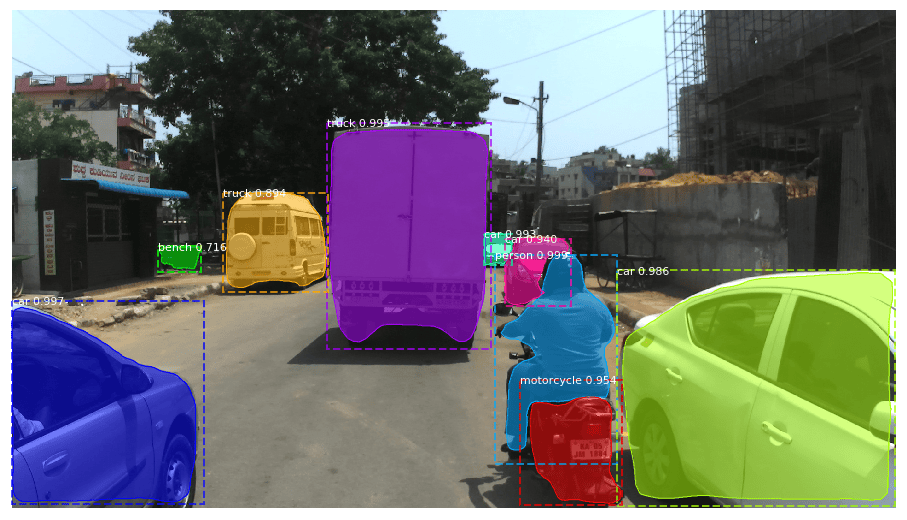
How does Advanced Driver Assistance Systems (ADAS) work?
ADAS works through a perception-to-action pipeline that runs continuously while the vehicle is moving. It has four stages.
- Sensing its surroundings: A vehicle has a suite of sensors, cameras, radar, LiDAR, and ultrasonic captures a constant stream of data about the road, other vehicles, pedestrians, lane markings, and obstacles.
- System perceives what that data means: AI perception models process the sensor feeds to detect and classify objects, track their movement across frames, estimate distances, and read lane geometry and traffic signs. This is where machine learning does the heavy lifting, and where the quality of training data directly determines how reliably the system recognises the world.
- Decides on action: Control logic combines the perceived scene with the vehicle's own state (speed, steering angle, position) to assess risk and choose a response: hold course, alert the driver, or intervene.
- It Acts: The system either communicates with the driver through sounds, visual cues, or seat vibrations, or it takes direct action such as braking or making a steering correction.
The entire loop runs in milliseconds, many times per second. The accuracy of each stage depends on the one before it, which is why perception, and the labeled data behind it, is the part that makes or breaks an ADAS feature.
Types and examples of ADAS features
ADAS features range from simple alerts to active interventions. They fall into two broad groups: systems that warn the driver, and systems that take action on the driver's behalf.
The most common examples include:
| Feature | What it does | Type |
| Forward collision warning | Alerts the driver to an imminent front-end collision | Warning |
| Automatic emergency braking (AEB) | Applies the brakes automatically to prevent or reduce a collision | Intervention |
| Adaptive cruise control (ACC) | Maintains a set speed and a safe following distance | Intervention |
| Lane departure warning | Warns when the vehicle drifts out of its lane | Warning |
| Lane keeping assist | Steers gently to keep the vehicle centered in its lane | Intervention |
| Blind spot detection | Flags vehicles in the driver's blind spot | Warning |
| Traffic sign recognition | Reads and displays road signs such as speed limits | Warning |
| Rear cross-traffic alert | Warns of approaching traffic when reversing | Warning |
| Parking assistance | Guides or automates parking maneuvers | Intervention |
Beyond assisting the driver, each of these features generates data. Every mile driven produces sensor footage that, once labeled, teaches AI models to recognize objects, predict behaviour, and make better decisions. That feedback loop is how ADAS improves over time.
What sensors do ADAS use?
ADAS relies on a suite of complementary sensors because no single sensor type is reliable in every condition. The system fuses their inputs to build a complete picture of the environment.
- Cameras capture rich visual detail and colour, which makes them essential for reading lane markings, traffic signs, and traffic lights, and for classifying objects. They struggle in low light, glare, and bad weather.
- Radar measures the distance and speed of objects using radio waves and performs well in rain, fog, and darkness. It powers features like adaptive cruise control and forward collision warning, but its spatial resolution is coarse.
- LiDAR builds a precise 3D map of the surroundings using laser pulses, giving accurate depth and shape information that is central to higher levels of automation. For how teams label this data, see our LiDAR annotation page.
- Ultrasonic sensors detect nearby objects at low speed and short range, which makes them ideal for parking assistance and close-quarters maneuvering.
Combining these inputs is called sensor fusion. It is what keeps an ADAS system reliable when any one sensor is degraded, and it is also one of the harder data problems in the field, because the inputs have to be synchronized and labeled consistently across modalities.
ADAS and the levels of driving automation (SAE Levels 0 to 5)
The industry classifies driving automation using a six-level scale defined by SAE International in its J3016 standard, running from Level 0 (no automation) to Level 5 (full automation). ADAS covers the lower rungs, Levels 1 and 2, where the human driver stays responsible, and the system assists. Levels 3 and above shift driving tasks to the vehicle itself.
| Level 0 | No automation - driver performs all tasks |
| Level 1 | Driving assistance - system assists (ex: cruise control) |
| Level 2 | Partial automation - system controls both steering and braking/acceleration with driving monitoring |
| Level 3 | Conditional automation - system handles driving tasks under specific conditions but driver must be able to take over |
| Level 4 | High driving automation - system can drive itself within defined domains without driving monitoring |
| Level 5 | Full driving automation - system can perform all driving functions without human intervention |
It is worth being precise about what today's systems actually deliver. Research from the Insurance Institute for Highway Safety has found that Level 2 partial automation behaves more like a convenience feature than a proven safety technology, with the clearest crash reductions coming from individual features rather than bundled "self-driving" packages. The distinction matters for how teams test, validate, and market these systems.
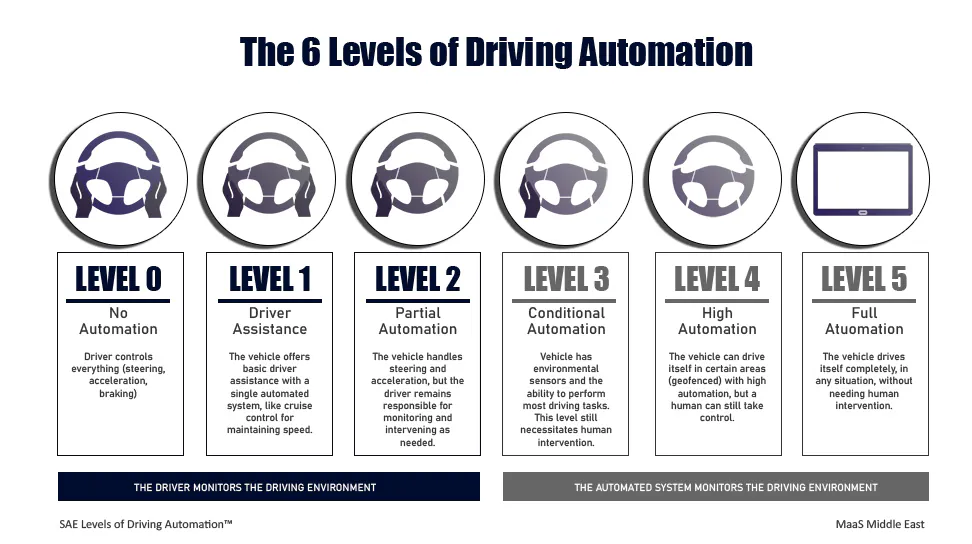
Source: MaaS MiddleEast
Advanced Driver Assistance Systems (ADAS) vs Autonomous Driving: what's the difference?
The difference between ADAS and autonomous driving comes down to who is responsible for the drive. ADAS assists a human driver who remains in control at all times (SAE Levels 1 to 2).
Autonomous driving takes over the driving task itself, with the system responsible within its operating conditions (Levels 3 to 5).
In other words, ADAS is not self-driving. Adaptive cruise control and lane keeping assist make driving easier, but the driver must stay engaged and ready to take over. True autonomy, where the vehicle handles everything within a defined domain, begins at Level 3 and is still limited to specific conditions and geographies. ADAS is the stepping stone: the same sensors, perception models, and data pipelines that assist drivers today are what autonomous systems are being built on.
What is ADAS calibration?
ADAS calibration is the process of aligning a vehicle's sensors, cameras, radar, and LiDAR, so the system interprets their inputs accurately. If a sensor is even slightly out of position, the data it feeds the AI models will be off, and features like automatic emergency braking or lane keeping can misjudge distances or miss objects.
Calibration usually becomes necessary after events that disturb sensor position: a windshield replacement (front-facing cameras are often mounted there), bumper or mirror repairs, a wheel alignment, or a collision. There are two main approaches. Static calibration is done in a workshop using fixed targets and a controlled setup. Dynamic calibration is done by driving the vehicle under specific conditions while the system recalibrates itself. Many vehicles need both.
For the engineering teams building these systems, calibration is also a data consistency problem. Sensor positions and calibration parameters have to be tracked and accounted for when labeling data, or the same real-world object can appear in different places across sensor feeds and corrupt the training set.
Benefits of Advanced Driver Assistance Systems (ADAS)
The impact of ADAS is already measurable. By stepping in faster than a human can react, these systems prevent crashes and reduce their severity. The evidence is strong: according to research, automatic emergency braking cuts police-reported rear-end crashes by roughly 50% (Insurance Institute of Highway Safety)
In sum, ADAS benefits include:
- Fewer accidents caused by human error
- Safer roads for drivers, passengers, and pedestrians
- Less driver fatigue and stress, especially on long drives and in heavy traffic
- More efficient driving, with optimized fuel consumption
- Smoother traffic flow and reduced congestion
- Easier regulatory compliance, as ADAS features align with global safety standards
Why ADAS depend on high-quality training data?
Every ADAS feature is, underneath, an AI model, and that model is only as good as the data it was trained on. A lane keeping system that has never seen faded markings, a pedestrian detector that has never seen someone in unusual clothing at night, an Automated Emergency Braking model that has not learned rare obstacles, these are data gaps, not algorithm gaps. In safety-critical driving, the edge cases are exactly where failures happen, and exactly where high-quality labeled data matters most.
Building reliable ADAS therefore, depends on a strong data engine: collecting multimodal sensor data, annotating it accurately and consistently across cameras, radar, and LiDAR, curating it to surface the rare and difficult scenarios, and validating model performance against it.
As the number of features and the level of automation grow, the volume and complexity of this data grows with them, and data quality becomes the real bottleneck to progress.
How Encord supports ADAS and AV development
As automation advances, ADAS and AV teams face one persistent question: how do you keep these systems reliable and safe as they scale? The answer lives in the data pipeline.
Encord gives ADAS and AV teams a single platform to curate, annotate, and evaluate multimodal sensor data, whether it comes from cameras, radar, or LiDAR, so AI models learn from high-quality, accurately labeled information.
With sensor fusion support, temporal tracking across video, AI-assisted labeling with human-in-the-loop (HITL) review, and built-in model evaluation, engineering and ML teams can move faster while holding the line on safety.
The result is better model accuracy, fewer errors, and a shorter path from data to deployment.
It is the same data infrastructure used across Physical AI and robotics, where the same perception challenges apply.
💡Read how Pickle Robot sped up model iteration by 60%
💡Explore Physical AI data services for managed sensor data collection and annotation.
Key takeaways
- Advanced driver assistance systems (ADAS) help vehicles sense their environment, warn drivers, and intervene, using cameras, radar, LiDAR, and ultrasonic sensors plus AI perception models.
- Common examples include automatic emergency braking, adaptive cruise control, lane keeping assist, and blind spot detection.
- ADAS sits at Levels 1 to 2 of the SAE driving-automation scale. It assists the driver; it is not self-driving. Autonomy begins at Level 3.
- The safety benefits are real but feature-specific: AEB alone cuts rear-end crashes by about half, while bundled Level 2 "automation" shows weaker evidence as a safety technology.
- ADAS performance is a data problem. Every feature depends on accurately labeled multimodal sensor data, and edge cases are where data quality decides safety.
- Encord provides the data layer, curation, annotation, and evaluation that ADAS and AV teams use to build reliable perception models.
Explore more resources
- What is Physical AI? The broader AI paradigm behind autonomous vehicles, robots, and drones.
- LiDAR annotation How teams label 3D point clouds and sensor fusion data for AV perception.
- Data labeling platforms for physical AI and robotics A comparison of the tools used to build perception datasets.
- Pickle Robot customer story How a physical AI team scaled annotation accuracy and model iteration with Encord.
- Physical AI data services Managed collection and annotation of multimodal sensor data.
Frequently asked questions
ADAS are electronic systems in vehicles designed to enhance safety, convenience, and efficiency. They use sensors like cameras, radar, LiDAR, and ultrasonic devices to monitor a vehicle’s surroundings, alert drivers to potential hazards, and sometimes take automated actions such as braking or lane correction. ADAS is the foundation for autonomous vehicle development, helping cars perceive and respond to the road in real time.
ADAS reduces accidents by assisting drivers in critical moments. Systems like forward collision warnings, lane departure alerts, and automatic emergency braking can prevent collisions or reduce their severity. By monitoring the road continuously and responding faster than a human can, ADAS acts as a digital co-pilot, improving overall road safety.
ADAS features range from alerts to automated interventions. Common examples include:
Driver Alerts: Forward collision warning, lane departure warning, blind spot detection, traffic sign recognition.
Automated Actions: Automatic emergency braking, adaptive cruise control, lane keeping assist, parking assistance.
These systems not only assist drivers but also generate valuable data used to train AI models for autonomous driving.ADAS represents the early levels of vehicle automation (Levels 0–2), where the driver remains in control but receives assistance from technology. As automation progresses to Levels 3–5, vehicles rely on sensor fusion, AI perception, and predictive modeling to perform more driving tasks autonomously. In essence, ADAS is the bridge from assisted driving to full autonomy.
Encord provides a robust data annotation and evaluation platform for AV and ADAS teams. It allows engineers to curate and label sensor data from cameras, radar, and LiDAR efficiently, ensuring AI models learn from high-quality, accurate information. Its collaborative tools streamline workflows, reduce errors, and accelerate development cycles, helping companies build safer and smarter vehicles faster.