What is Teleoperation?
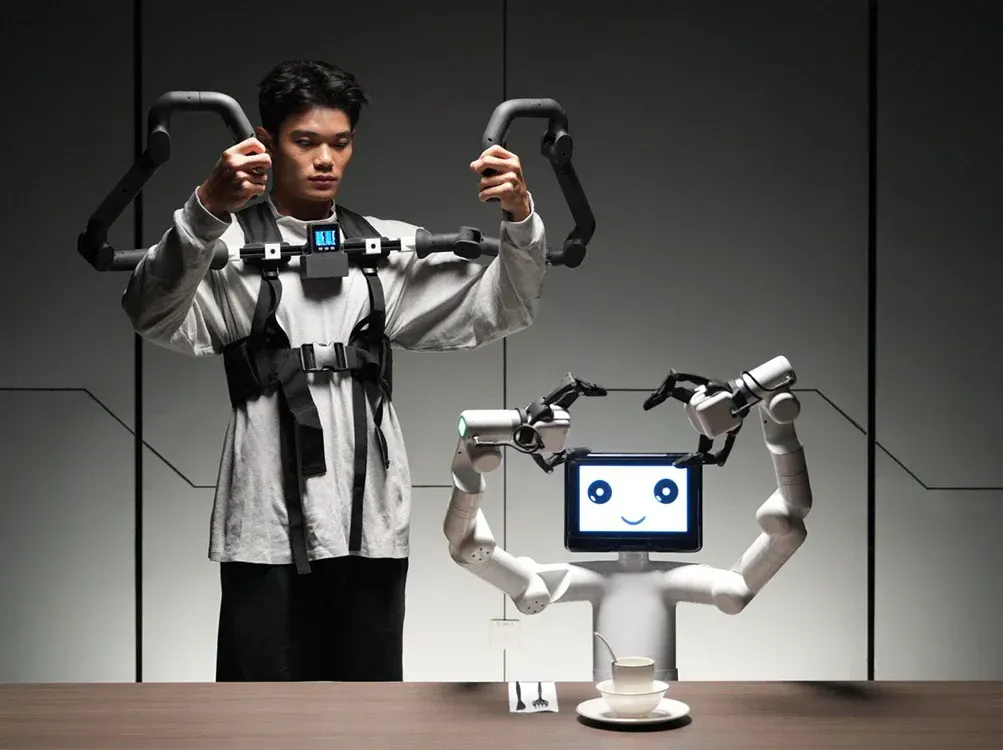
Teleoperation, in the context of data collection, is the practice of a human operator remotely or directly controlling a robot's movements to generate the action and sensor data used to train machine learning models, most commonly imitation learning and reinforcement learning policies for robotic manipulation. Rather than programming a robot's behavior by hand, teleoperation captures how a human actually solves a task, recording synchronized streams of robot actions (joint angles, end-effector poses, gripper commands) alongside sensory observations (RGB and depth camera feeds, force/torque readings, proprioception) at every timestep.
This data becomes the training signal for policies that let robots generalize a skill, picking, placing, folding, assembling beyond the exact demonstration.
Why does Teleoperation Data Collection Matter?
Robot learning has the same bottleneck that internet-scale language and vision models didn't: there is no equivalent of "the internet" for robot actions. A model can be pretrained on billions of scraped images or text tokens, but there is no comparably vast, naturally occurring dataset of robots successfully manipulating the physical world. Teleoperation is currently the most direct way to close that gap, because it produces paired action-observation data grounded in real physics, real friction, real contact dynamics, real sensor noise, rather than a simulator's approximation of them.
This is why teleoperated demonstrations sit at the centre of most modern robot foundation model efforts, from tabletop manipulation to bimanual and humanoid platforms (Aldaco et al., 2024; Zhao et al., 2023).
How Teleoperation Data Collection Works
A typical teleoperation data collection pipeline follows the same broad sequence regardless of hardware:
- Interface setup : The operator uses a control interface (a joystick, VR headset and controllers, a leader-follower arm rig, an exoskeleton, or a motion-capture glove) that maps human motion to robot commands.
- Task demonstration: The operator performs the target task (e.g., "pick up the mug and place it on the shelf") one episode at a time, either driving the robot directly or through a kinematically matched leader device.
- Synchronized logging : The system timestamps and records robot state, commanded actions, and all sensor streams at a fixed control frequency, typically producing an episode as a sequence of (observation, action) pairs.
- Episode curation : Failed, ambiguous, or low-quality episodes are flagged and either discarded or relabeled, since imitation learning models are highly sensitive to noisy or suboptimal demonstrations (Belkhale, Cui and Sadigh, 2023).
- Dataset assembly : Episodes are aggregated into a structured dataset (often in formats like RLDS or LeRobot) with metadata on task, embodiment, and success/failure, ready for policy training.
Types of Teleoperation Systems
- Unilateral (direct) control. The operator sends commands to the robot with no force feedback, so the robot cannot "talk back" to the operator. Common for simple pick-and-place tasks using joysticks or spacemouse-driven arms.
- Bilateral / shared-control. Robot state and contact forces are reflected back to the operator, enabling corrective, force-aware demonstrations and real-time human intervention during data collection (Zhang et al., 2025). Best suited to contact-rich or precision manipulation.
- Leader-follower arms. A kinematically matched "leader" arm is physically moved by the operator, mirroring motion to a "follower" robot arm, the basis of many low-cost bimanual manipulation systems (Zhao et al., 2023).
- VR / immersive control. The operator wears a headset and uses hand controllers or hand tracking to drive the robot, with visual feedback from onboard cameras (Iyer et al., 2024). Well suited to dexterous, fine-grained hand manipulation tasks.
- Exoskeleton / motion-capture. The operator wears a wearable rig or mocap gloves that directly track limb and hand pose, used for whole-body and dexterous hand data collection.
- Handheld / robot-free capture. Operators use a handheld gripper device with no physical robot present, recording demonstrations that are later mapped onto a robot embodiment, a useful way to scale data collection outside lab environments.
Teleoperation vs. Simulation vs. Autonomous Collection
Teleoperation, simulation, and autonomous or scripted collection each trade off realism against scale in different ways.
Teleoperation: produces real contact dynamics and real sensor noise, but it's bottlenecked by operator time and specialized hardware, and each episode is comparatively expensive to collect. Its strength is task diversity: a human operator can improvise, recover from mistakes, and adapt mid-task in ways that are hard to script, which makes teleoperation the best source of ground-truth data for contact-rich or dexterous tasks. The main data-quality risk is that human demonstrations can be suboptimal or biased, which is why imitation learning is often combined with reinforcement learning to correct for it.
Simulation: Produces highly scalable and parallelizable, and it's cheap per episode once the simulator is set up. It carries no human-bias risk, but it does carry a sim-to-real gap, and simulator artifacts can propagate into a trained policy if left unchecked. Simulation is best used for pretraining, domain randomization, and generating edge cases that would be rare or dangerous to collect in the real world.
Autonomous collection: Real-world and low-cost per episode after the initial task engineering, and it produces consistent data. But task diversity is low, it struggles with unstructured or novel scenarios, so it's best suited to high-volume repetition of well-defined tasks rather than open-ended skill learning.
In practice, most Physical AI teams treat these as complementary rather than competing: teleoperation supplies the ground-truth signal, simulation supplies scale and edge-case coverage, and generation methods are increasingly used to expand a small teleoperated seed dataset into a much larger training set by building on teleoperated pre-manipulation trajectories.
Key Challenges in Teleoperation Data Collection
- Operator skill and hardware dependency. High-quality demonstrations require trained operators and often expensive or purpose-built hardware, which limits how quickly datasets can scale.
- Embodiment gap. Policies trained on one robot's teleoperated data frequently fail to transfer to a different robot due to differences in kinematics and control interfaces (Wong et al., 2022).
- Lack of feedback in unilateral systems. Operators without force or haptic feedback can struggle with contact-rich tasks, since they cannot feel when the robot is applying too much or too little force (Zhang et al., 2025).
- No unified benchmark. Because teleoperation datasets span different robots, tasks, and control interfaces, comparing results across systems remains difficult, motivating recent efforts toward shared evaluation environments.
- Demonstration quality control. Not every recorded episode reflects an optimal or even successful strategy, and curation is required to prevent models from learning suboptimal behavior (Belkhale, Cui and Sadigh, 2023).
Best Practices for Teams Collecting Teleoperation Data
- Log everything, synchronized. Capture actions and all relevant sensor modalities (vision, force/torque, proprioception) at a consistent control frequency so downstream annotation and training pipelines don't have to reconstruct alignment after the fact.
- Curate for quality over volume. Flag and remove failed or ambiguous episodes rather than assuming policy training will "average out" bad demonstrations.
- Use bilateral or haptic feedback for contact-rich tasks. Force feedback measurably improves demonstration quality for tasks involving contact, insertion, or delicate manipulation.
- Standardize metadata from day one. Task label, embodiment ID, operator ID, and success/failure flags should be attached at collection time, not reconstructed later.
- Pair teleoperation with generation methods. Use a smaller set of high-quality teleoperated "seed" demonstrations to bootstrap larger synthetic or simulation-augmented datasets rather than relying on teleoperation alone to reach training-scale volumes.
Explore More
Frequently asked questions
- Teleoperation includes remote control but is broader, it also covers direct, co-located control (an operator standing next to the robot using a leader arm or VR rig) as long as a human is driving the robot's motion in real time for the purpose of generating training data.
- Teleoperation data comes from a real robot operating in the real world, capturing genuine contact dynamics and sensor noise. Simulation data is generated in a physics engine and is faster and cheaper to scale, but carries a sim-to-real gap that teleoperated data does not have.
- Most commonly imitation learning policies (behavioral cloning, diffusion policies) and, increasingly, reinforcement learning approaches that use teleoperated demonstrations as a warm start or as intervention data during online training.
- Not always. Handheld and robot-free capture devices let operators record demonstrations that are later retargeted onto a specific robot embodiment, reducing hardware cost while preserving much of the value of human-driven demonstration.