The Complete Guide to Data Labeling for Robotics

Co-CEO at Encord
TL;DR: Data labeling for robotics is the process of annotating the multimodal sensor streams, action data, and language instructions that robots produce and consume into structured training data for perception models, motion robotics, and Vision-Language-Action (VLA) systems. This guide covers what robotics labeling is, the modalities and annotation types involved, the pipeline from raw collection to a working data flywheel, the use cases it powers, and what to look for in a labeling platform.
The Physical AI shift is real, and it's running into a wall. VLAs, humanoids, autonomous vehicles, warehouse robots, surgical systems, each one is bottlenecked by the same problem: data. Specifically, multimodal data with action grounding, temporal alignment, and labels accurate enough to train a model that will be reliable in production. Every robot is only as good as the dataset behind it, and that dataset is only as good as the labels attached to it.
What is Data Labeling for Robotics?
Data labeling for robotics is the practice of annotating multimodal sensor data and action sequences so that machine learning models can learn to perceive, plan, and act in physical environments. It sits at the heart of the data-centric AI approach. In computer vision, that means cleaner image labels and better dataset curation. In robotics, it means something more demanding.
A robotics labeling problem is distinct from generic image or video annotation in three ways. First, it's multimodal: a single training example must combine RGB frames from multiple cameras, a LiDAR point cloud, sensor data, depth maps, microphone input, and a natural-language instruction, all captured within the same window. Second, it's temporal in a way that matters at sub-second granularity: an action like "grasp the mug" has a beginning, a build-up, a contact event, and a release, and a model that can't see those boundaries can't learn them. Third, it's action-grounded: the labels often need to describe not just what the world looked like, but what the robot did and what happened as a result. That last property is what separates a perception dataset from a accurate dataset, and it's the property that current image-first annotation tools tend to handle poorly.
For A deeper understanding of Data Labeling, read our comprehensive Guide on 'What is Data Labeling'
How Robotics Labeling Differs From Standard Image and Video Annotation
Four properties make robotics annotation its own discipline rather than a subset of computer vision labeling.
- Sensor diversity. A standard video annotation job has one or two video streams. A robotics job might have eight: stereo cameras at three viewpoints, a roof-mounted LiDAR, two short-range radars ect. Every one of those streams has its own coordinate frame, sample rate, and noise characteristics, and the labels often need to be consistent across all of them.
- Temporal alignment. It's not enough that the streams exist. They have to be aligned to within milliseconds, because a label like "object enters gripper" only makes sense if the camera frame, the joint state, and the force-torque reading at that timestamp are all describing the same instant.
- Action grounding. Annotating "the robot picked up the cup" requires more than a bounding box around the cup. It requires marking when the action started, when contact occurred, when the lift completed, and ideally what the gripper command was at each step. This is the labeling primitive that VLA training depends on.
- Embodiment. Annotations often need to encode the robot's own state, joint positions, end- pose, base velocity, because the same visual scene means something different depending on where the robot is and what it's holding. A label that ignores embodiment will produce a model that ignores it too.
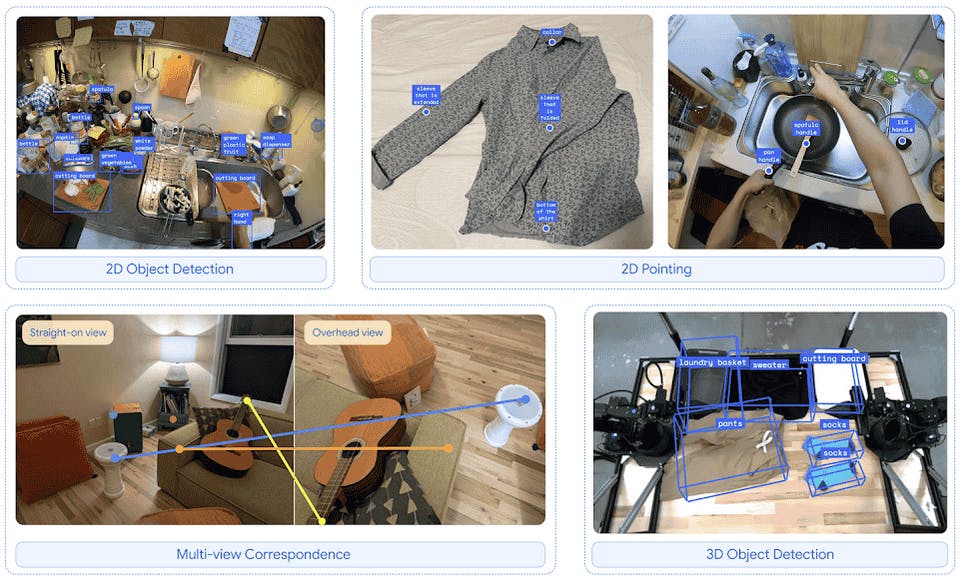
What is the Goal of Data Labeling in Robotics?
The end goal is a model does what it is designed to do in the physical world, perceive an environment, plan a path, control machinery, or follow a natural-language instruction. Good labels are what get you there. They define what the model is supposed to predict, and they're the only signal the model has about what "correct" looks like.
In practice, the goal depends on what kind of model you're training.
- Perception models: Require labels that describe the environment: object identities, positions, segmentations, distances.
- Planning and control models: Require labels that describe motion and outcomes: trajectories, contact events, success/failure flags, reward signals.
- Vision-Language-Action models: Require all of the above plus natural-language descriptions of intent and observation-action pairs that ground language in physical behavior.
A well-built dataset usually supports more than one of these because the underlying recordings are the same, what changes is the ontology and the annotation layer on top.
The other axis is manual versus automated data labeling. A few years ago this conversation was binary: humans labeled everything, slowly. Today it's a spectrum. Foundation models can pre-label most of a typical scene, SAM 3 for segmentation, Grounding DINO for detection, video-language models for action captioning and human reviewers focus on edge cases, corrections, and the categories where models still fail.
The humans-in-the-loop pattern isn't going away; it's becoming more selective. The win is in routing the right examples to the right reviewers, not in trying to automate the human away.
Core Tasks in Data Labeling for Robotics
Robotics annotation isn't a single task, it's a set of related ones, and production datasets almost always combine them.
Getting the mix right shapes everything downstream: project scope, tool choice, team structure. Here are the six core tasks that make up the robotics annotation stack:
Perception labeling (object detection, segmentation, depth)
This is the closest to traditional computer vision labeling. The goal is to teach the model what's in the scene: bounding boxes around objects, segmentation masks at pixel or instance granularity, depth annotations from LiDAR. In a warehouse picking robot, this is what tells the model "this is a box, this is the floor, this is a person." It's the foundation layer most other annotations depend on.
3D scene understanding and sensor fusion (LiDAR + camera + radar)
When the robot moves in three dimensions or needs accurate distance estimates, 2D boxes aren't enough. You need 3D cuboids in the LiDAR frame, segmentation in point clouds, and labels that are consistent across the camera and LiDAR views of the same scene. Sensor fusion annotation is where most ADAS and autonomous-vehicle datasets spend their time and budget, because the geometry has to be right before anything else can be.
Action and behavior labeling (action captioning, motion primitives, contact states)
This is the layer that most non-robotics annotation tools don't handle well. Action labels describe what the robot or another agent in the scene is doing, often as temporal segments: "reaching", "grasping", "lifting". Motion primitives are a more constrained version, a fixed vocabulary of low-level actions and Contact states mark the moments where physical contact begins or ends.
Vision-Language-Action (VLA) data labeling (observation-action pairs, instruction grounding)
VLA models learn to map a natural-language instruction and a visual observation to an action. Training them needs paired data: the language ("pick up the red mug"), the observation (the video and sensor streams), and the action (the actual robot commands or end-effector trajectories). The labels here aren't just object identities, they're alignments between language tokens and the visual entities they refer to, plus temporal segmentation of the action sequence.
Teleoperation and demonstration data labeling
Most VLA and imitation-learning datasets start with humans teleoperating the robot or recording demonstrations. The raw recordings are valuable but unstructured: hours of someone driving a robot arm through pick-and-place tasks. Labeling here means segmenting demonstrations into task episodes, tagging successes and failures, annotating language descriptions of what the demonstrator was trying to do, and flagging edge cases worth keeping or discarding.
Pose, trajectory, and keypoint labeling
For locomotion, manipulation, and human-robot interaction, you often need to track specific points over time: the end-effector pose, joint positions of a human in the scene, the trajectory of a moving object. Keypoint and skeleton labeling provides this, usually as a 2D or 3D coordinate per labeled point per frame.
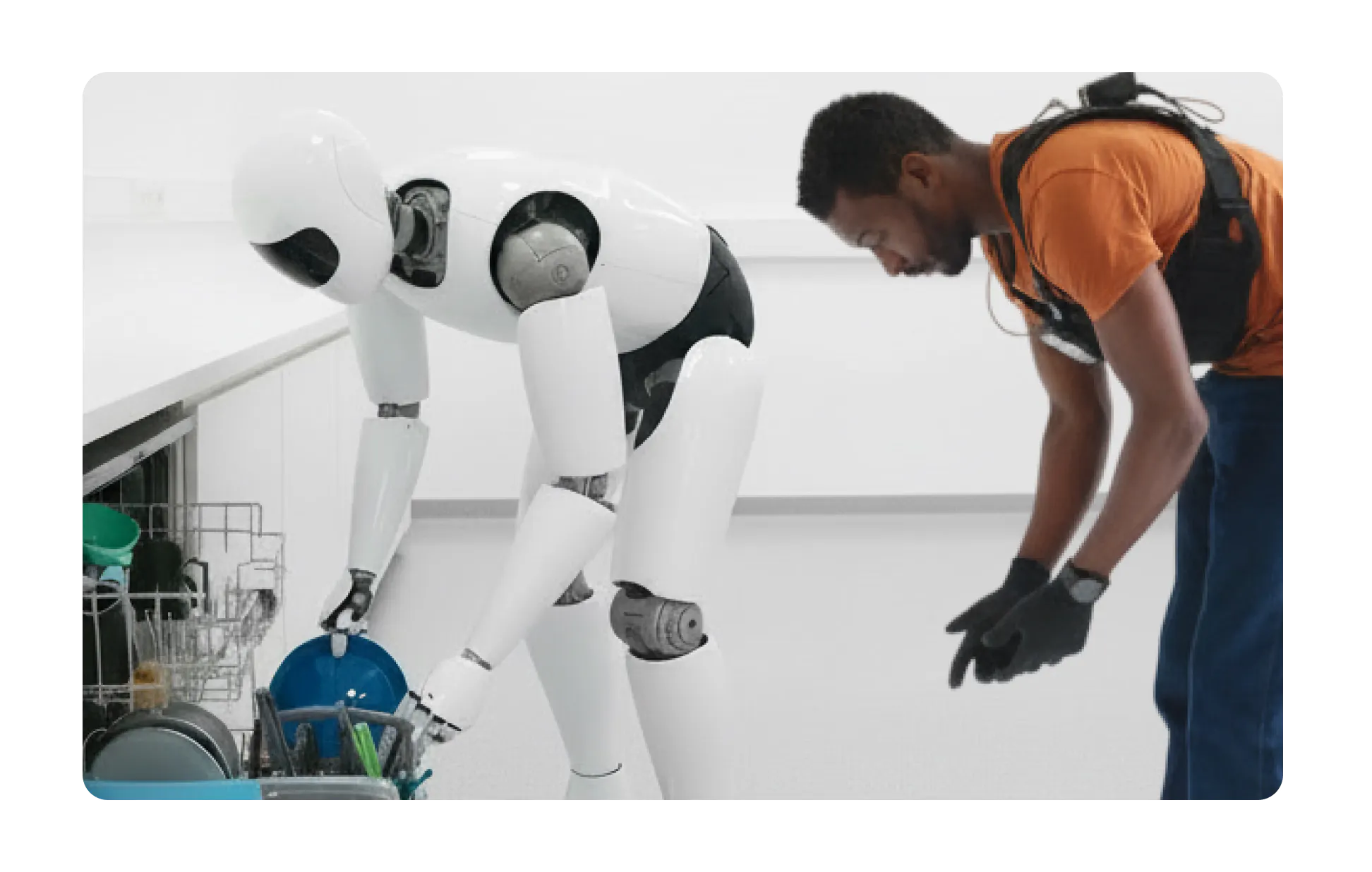
{{table(Data Modalities in Robotics Labeling)}}
Common Types of Annotations Used in Robotics
2D bounding boxes and polygons
The workhorse of perception labeling. Boxes are fast and cheap; polygons are slower but tighter. Both apply to camera streams and are usually the first labels added to a new dataset.
3D cuboids
The 3D analog of bounding boxes, placed in LiDAR or fused-sensor space. They encode object position, dimensions, and orientation in the world frame, and they're the standard annotation for autonomous-driving and many warehouse robotics datasets.
Semantic and instance segmentation (2D and 3D)
Pixel- or point-level labels that assign every element of an image or point cloud to a class. Semantic segmentation distinguishes classes ("road," "vehicle," "pedestrian"); instance segmentation distinguishes individual objects within a class. In 3D, segmentation is applied to point clouds with the same logic.

Semantic segmentation
Keypoints and skeleton primitives
Coordinate-level annotations for tracked points: joint locations on a human, feature points on a tool, end-effector position over time. Skeletons connect keypoints into rigid or articulated structures.
Polylines (lane lines, trajectories)
Connected line segments that describe lane geometry on a road, paths through a warehouse, or trajectories of moving objects. Important for autonomous driving and increasingly for indoor navigation.
Action captions and temporal segments
Time-bounded labels that describe what's happening over an interval. "Robot grasps cup, 12.3s–12.8s." The granularity ranges from coarse task labels to frame-level motion primitives, depending on what the downstream model needs.
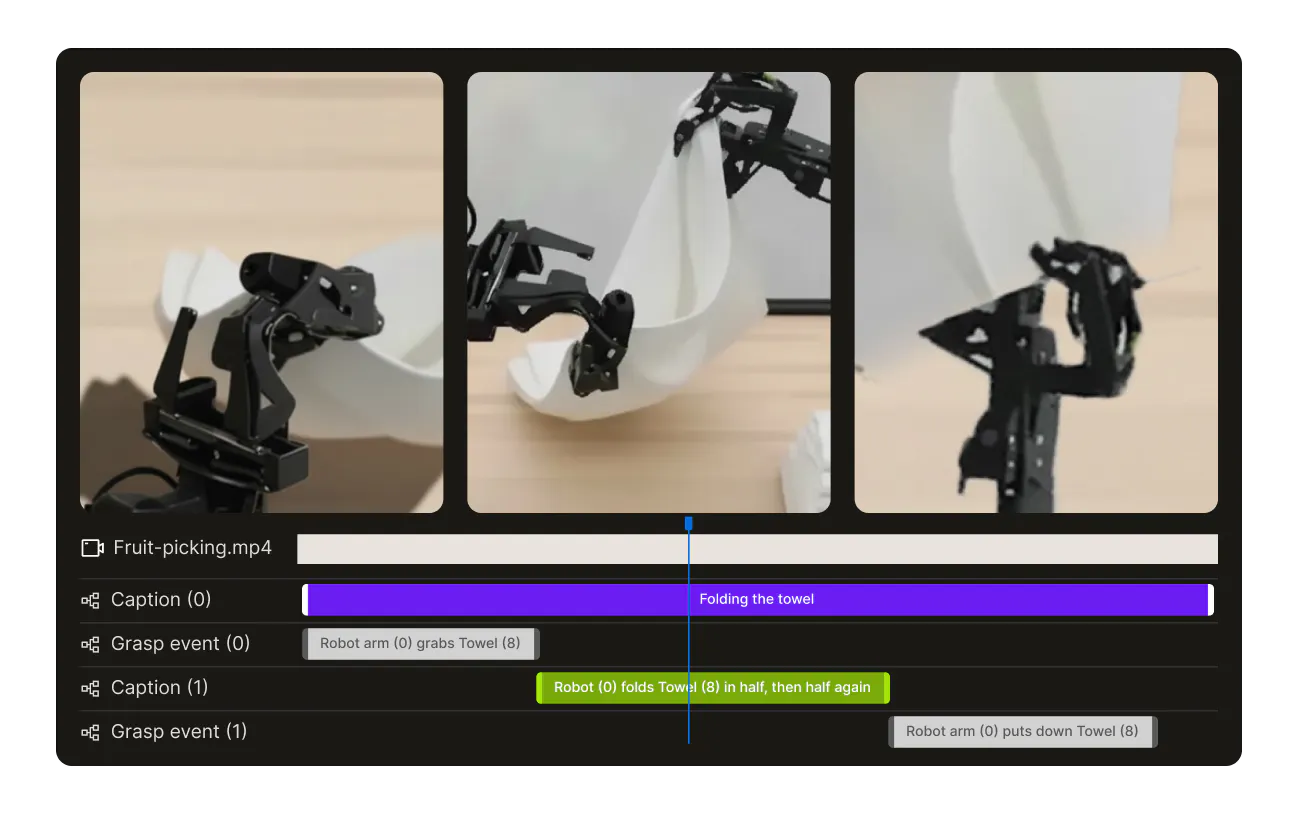
Action Captions
Free-form language labels (for VLA grounding)
Natural-language descriptions of scenes, instructions, or actions, often paired with visual annotations. Crucial for VLA training, and increasingly important as language-conditioned policies move into more domains.

 💡Encord supports every annotation type above. Book A Demo or speak to an AI expert
Robotics Data Labeling Use Cases
The annotation stack changes shape depending on what's being built. Six verticals dominate the Physical AI landscape, and each comes with its own labeling pattern.
Humanoids and VLA models
Humanoid robots and the VLA models that drive them lean heavily on demonstration data, action captioning, and multimodal grounding. Datasets typically include teleoperation recordings, language instructions, and dense action labels.
The priority is temporal precision on action boundaries and tight alignment between language and visual observations.
Autonomous vehicles and ADAS
The most mature robotics labeling vertical, and the one that established most of the 3D cuboid and sensor fusion conventions still in use. AV datasets are large, multi-sensor, and dominated by perception labels, object detection, segmentation, lane lines, drivable area, with growing investment in scenario-level labels (cut-ins, merges, occlusion events) for end-to-end model training.
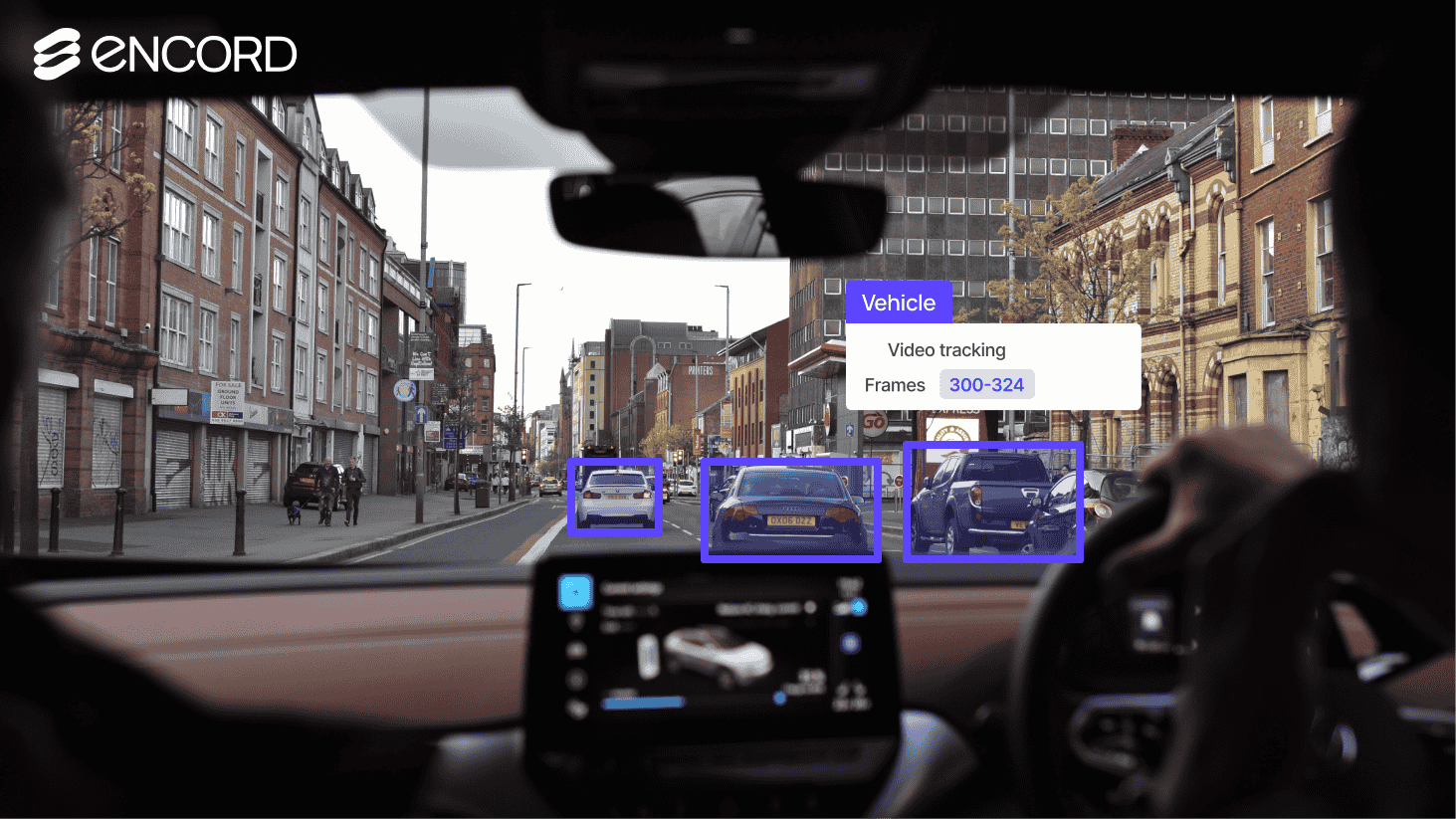
Data labeling for AV applications
Warehouse and logistics robotics
Pick-and-place, mobile fulfillment, and bin-packing systems. Labeling here focuses on object detection and segmentation under heavy clutter and occlusion, plus 6-DoF pose estimation for grasp planning. Action labels are increasingly common as warehouse VLA models start to appear.
Drones and UAVs
Aerial robotics labeling spans inspection (defect detection, anomaly segmentation), mapping (3D reconstruction, semantic segmentation of terrain), and autonomy (obstacle detection, trajectory planning). Drone data tends to be camera-heavy with depth and IMU; LiDAR is common on industrial inspection platforms.
Surgical robotics
A small but high-value labeling domain. Datasets include endoscopic video, instrument tracking, tissue segmentation, and increasingly action labels for procedural steps. The accuracy bar is exceptionally high because the downstream model assists with, or in some research contexts performs, interventions on patients.
Label Robotics Data at Scale with Encord
Encord is the data infrastructure for Physical AI, from the first teleoperation run to a production-ready model. Most labeling platforms started in image classification and added the rest as features. Encord was built around the assumption that multimodal data, 3D, action labels, and a working flywheel are the core problem, not the upgrade path.
Built for Physical AI: VLAs, ADAS, humanoids, drones
The data infrastructure for Physical AI. Encord handles the modalities and annotation types that robotics teams actually use, in workflows that scale from a research pilot to a production fleet.
Multimodal labeling in one platform
Image, video, LiDAR, audio, document, DICOM: a single ontology, a single workflow, a single source of truth. No stitching between three tools to label one recording. No exporting between formats to move from perception labels to action labels. Everything lives in one project.
Action captioning and VLA-ready labels
Structured, timestamped action labels from video demonstrations, exportable in formats VLA models can train on directly. Temporal segments, language alignments, and observation-action pairs as first-class annotation types, not as a workaround on top of a video annotation primitive.
3D scene visualization for sensor fusion
Synchronized LiDAR, radar, and camera in a unified 3D view. Ingest point clouds and full sensor recordings natively, including MCAP containers and ROS and ROS2 bag exports alongside .pcd, .ply, .las/.laz, and .e57 files. Draw a cuboid in the point cloud, see it projected into every camera, or fit 3D cuboids from the camera view with the in-editor Stereo Cuboid Tool. Label in any modality, propagate consistently across the rest.
Model-assisted pre-labeling at scale
SAM 3, foundation models, and custom model integrations for pre-labeling. Reviewers correct rather than create, which is faster, more consistent, and lets human time concentrate on the cases where humans still beat models.
The data flywheel for robotics teams
Route low-confidence model predictions back into labeling queues. Curate with embeddings and natural-language search to smart-sample large fleets of recordings and surface rare scenarios before annotation. Track underrepresented failure modes across the dataset. Tighten the training distribution continuously rather than in once-a-quarter batch labeling pushes. The flywheel is built into the platform, not glued on top.
Encord trusted by Physical AI leaders
Leaders in the industry like Pickle Robot, Thoro, Archetype AI and more build on Encord iterating models up to 60% faster and processing multimodal data at 5x the throughput of legacy tooling.
"For our AI initiatives, rapid iteration is critical. Encord and our ML infrastructure allow us to prototype learning tasks efficiently." — Matt Pearce, Applied ML, Pickle Robot
Pickle Robot
Key Takeaways: Data Labeling for Robotics
Robotics data labeling is a distinct discipline from image or video annotation, defined by multimodal sensor streams, temporal action grounding, and embodiment. Good labels enable perception, planning, control, and VLA training across humanoids, autonomous vehicles, warehouse robotics, drones, surgical systems, and industrial manipulation, and the gap between teams that ship and teams that demo is largely a labeling gap. The pipeline runs from task definition through curation, ontology, pre-labeling, review, versioning, and the data flywheel that routes production failures back into training. The teams that win lock the ontology early, blend automated pre-labels with human review, prioritize edge cases, and treat their dataset like versioned, evolving infrastructure rather than a one-time deliverable. The labeling tool you choose is part of that infrastructure decision: it needs to handle multimodal data natively, support every annotation type from 2D boxes to language, integrate foundation models, and run the flywheel inside the same platform where labeling happens.
Explore more resources
Informational Guides
- Ultimate Guide to what is Data Labeling, its approaches and challenges
- Complete Guide to Robotics Data Annotation
- Data Labeling tools for Physical AI and Robotics
- Data Annotation tools for Physical AI
Webinars and Videos
Frequently asked questions
Data labeling for robotics is the annotation of multimodal sensor data, action sequences, and language instructions used to train robotic VLA models. It differs from standard image annotation because it involves multiple synchronised sensor streams, temporal action boundaries, and labels that reference the robot's own state, not just what's visible in a single image.
The common modalities are RGB camera streams, LiDAR point clouds, radar returns, depth and stereo, IMU and proprioception, audio, and natural-language instructions. A given project typically combines several of these, synchronized to a common timeline.
A Vision-Language-Action model maps a natural-language instruction and a visual observation to a robot action. Training requires paired data: the instruction text, the synchronised observation stream, the action sequence, and, ideally, alignments between language and the visual entities it refers to.
Encord handles image, video, LiDAR, audio, document, and DICOM data in a single platform with a unified ontology, 3D sensor fusion, action captioning, foundation model pre-labeling, and a built-in data flywheel for routing production failures back into training.
By writing a detailed labeling guide with concrete examples per action category, using a constrained motion-primitive vocabulary where possible, double-labeling a sample of data to measure agreement, and routing low-agreement examples to senior reviewers for adjudication.
Yes. Teleoperation recordings can be ingested as multimodal sessions, segmented into task episodes, annotated with language descriptions and action labels, and exported in formats that imitation-learning and VLA training stacks consume directly.