What are Action-Aware Video Embeddings?
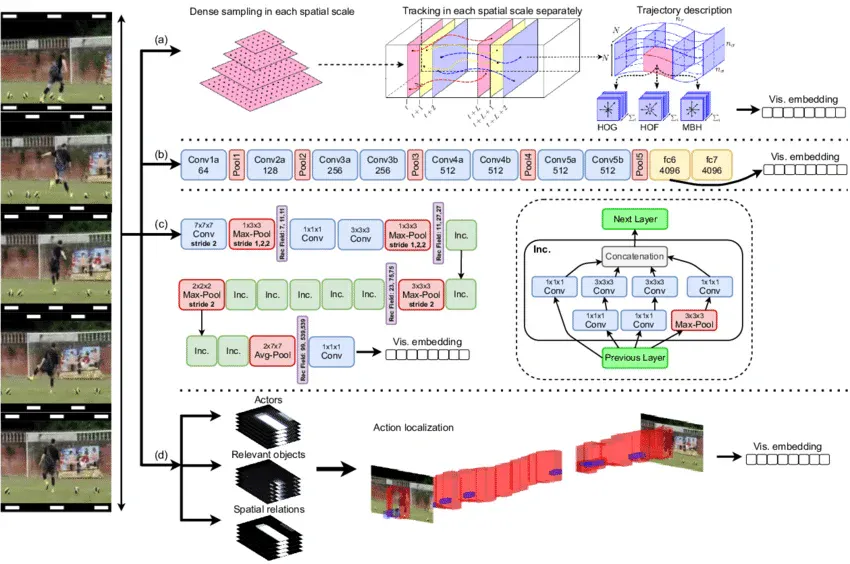
Action-aware video embeddings are vector representations of video that encode not just what appears in a frame, but what is happening across frames: the motion, state change, and task-relevant dynamics that lead from one moment to the next. Unlike standard image or video embeddings, which are optimised to capture visual appearance (objects, scenes, textures), action-aware embeddings are trained so that frames connected by a meaningful action or state transition end up close together in embedding space, even if they look visually different.
This distinction matters most in robot learning and video-language-action (VLA) systems, where a model needs to represent what changed, a hand closing around an object, a drawer moving from open to shut- rather than just what is present in a static frame.
Why do Action-Aware Embeddings Matter?
Standard visual embeddings (from models trained on image classification or image-text contrastive objectives) are good at recognizing objects and scenes, but they were never trained to distinguish "the cup is being picked up" from "the cup is sitting still." For a policy that needs to predict or imitate actions, that distinction is the entire signal. Action-aware embeddings close this gap by pretraining on video, often paired with robot actions, human demonstrations, or unlabeled internet video, so the resulting representation is directly useful as an input to a manipulation or navigation policy, rather than needing to be relearned from scratch on a small robot dataset.
This is part of why action-aware video representations have become a standard pretraining layer in robot foundation models, sitting between raw video and the policy or world model that acts on it.
How are Action-Aware Embeddings Learned?
A few dominant approaches have emerged, each encoding "action-awareness" differently:
- Time-contrastive / temporal objectives. The model is trained so frames close in time (and therefore likely part of the same action) are pulled together in embedding space, while frames from unrelated clips are pushed apart, producing representations sensitive to motion rather than static appearance.
- Reward- or value-implicit pretraining. Embeddings are shaped so that distance in embedding space correlates with progress toward a goal state, giving the representation an implicit sense of task progression.
- Latent action modeling. Rather than predicting raw pixels, the model learns a compact latent code that captures "what action occurred between frame A and frame B," which can then be reused across robots with different physical embodiments.
- JEPA-style predictive pretraining. The model predicts the latent embedding of a future frame (not the future frame itself), which encourages it to encode action-relevant state transitions rather than shortcut on low-level pixel variation.
Action-Aware Embeddings vs. Standard Visual Embeddings
The clearest way to see the difference is to compare what each type of embedding is optimized for, what it takes as input, and what it's actually sensitive to.
Standard visual embeddings (from models trained on image classification or image-text contrastive objectives like CLIP) are optimized for object and scene recognition, and for aligning images with text. They typically take a single image, or independently sampled frames treated as isolated snapshots, as input. Because of this, they're sensitive to what is present in a frame: which objects, what scene, what category. They're well suited to classification, retrieval, and captioning, and are usually trained with a contrastive image-text alignment objective.
Action-aware video embeddings are optimized for motion, state transitions, and task progression instead. Their input is a sequence of frames, often paired with the actions that produced the transition from one frame to the next. As a result, they're sensitive to what changed, and in what order, not just what's on screen. This makes them well suited to policy pretraining, imitation learning, and world models, and they're typically trained with time-contrastive, latent-action, or future-latent prediction objectives rather than static image-text alignment.
The two are not mutually exclusive, many robot learning pipelines use a general-purpose visual encoder for object recognition alongside an action-aware embedding for the dynamics a policy actually needs to reason about, rather than treating it as an either/or choice.
How to evaluate Action-Aware Embeddings?
These embeddings are rarely used as the final output of a system, evaluation tends to focus on how well they transfer to a downstream task rather than on the embedding space directly:
- Policy fine-tuning efficiency. How much robot-specific data is needed to reach a target success rate when a policy is initialized with a given embedding, compared to training from scratch.
- Cross-embodiment generalization. Whether a representation learned on one robot, or on human video, still produces useful signal when transferred to a different robot's action space.
- Temporal discriminability. Whether the embedding space actually separates meaningfully different moments in a task (e.g., "before grasp" vs. "after grasp") rather than collapsing them due to visual similarity.
- Zero-shot or few-shot task transfer. How well a pretrained embedding supports learning a new, unseen task with minimal additional demonstrations, often the strongest practical signal that the representation has captured genuine action structure rather than dataset-specific shortcuts.
Where Action-Aware Embeddings Are Used
- Policy pretraining. Providing manipulation policies with a visual backbone already sensitive to task-relevant motion, reducing the amount of robot-specific data needed to fine-tune a working policy.
- Cross-embodiment transfer. Latent action representations that abstract away from a specific robot's joint space make it possible to learn from human or third-person video and transfer that signal to a different physical robot.
- World models. Predictive video embeddings underpin models that anticipate future states to plan or evaluate actions before executing them.
- Learning from unlabeled video. Because action-aware objectives don't require ground-truth robot actions, they allow pretraining on large volumes of human demonstration or internet video that would otherwise be unusable for policy learning.
Explore More
Frequently asked questions
- Not always. Several approaches (time-contrastive objectives, JEPA-style prediction) can learn action-aware structure from raw, unlabeled video, which is what makes them useful for pretraining on human or internet-scale footage rather than only labeled robot data.
- Action recognition models classify a fixed set of action labels. Action-aware embeddings don't classify anything directly, they produce a continuous representation intended to be reused as an input to a downstream policy, world model, or planning system.
- General vision-language embeddings are trained to align static images with text, so they capture appearance and semantics well but weren't optimized to represent motion or state change, the exact signal a manipulation policy depends on.