What is Behavioral Cloning?
Behavioural cloning (BC) is a supervised imitation learning method that trains a model to replicate expert behaviour by mapping observed states to the actions an expert took, using a dataset of state-action pairs collected from demonstrations. It is the simplest and most widely used form of imitation learning — and the foundation beneath modern vision-language-action models, end-to-end autonomous driving, and humanoid manipulation policies.
Teaching a robot to do something is, at its simplest, a matter of showing it what to do and having it copy you. That intuition is the whole idea behind behavioral cloning. Instead of defining a reward function and letting an agent discover good behaviour through trial and error, you collect demonstrations of an expert performing the task and train a model to reproduce the mapping from what the expert saw to what the expert did.
This makes Behavioural cloning the most direct route from demonstration data to a working model. There's no environment to interact with during training, no exploration, no reward engineering, just supervised learning on observation-action pairs.
That simplicity is exactly why it sits underneath so much of modern Physical AI: the hard part isn't the learning algorithm, it's collecting demonstration data good enough to clone.
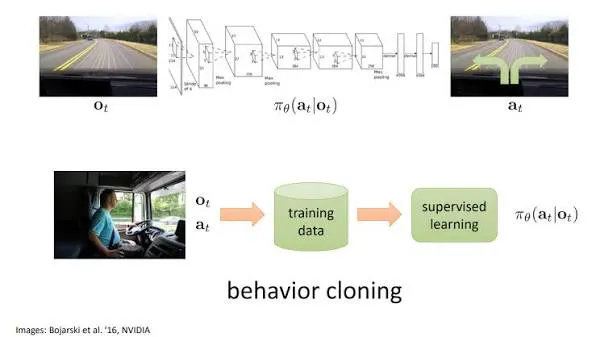
How Behavioral cloning works
Behavioral cloning reframes control as a standard supervised learning problem. The three pieces:
- Input: A dataset of expert demonstrations, structured as observation-action pairs (equivalently, state-action pairs). Each pair captures what the expert observed and the action they took in response.
- Training objective: Supervised learning. The mode learns to predict the expert's action given the observation, minimising a standard loss: cross-entropy for discrete action spaces, mean squared error for continuous control.
- Output: A trained model that, at inference time, takes an observation and returns an action.
What makes it "simple" is everything it doesn't need. No reward function. No environment interaction during training. No exploration. The model never has to discover anything, it only has to imitate, which collapses the problem down to ordinary supervised learning on a fixed dataset.
Behavioral cloning vs reinforcement learning
Behavioral cloning and reinforcement learning (RL) are the two dominant ways to train a model, and they differ in where the learning signal comes from.
- Behavioral cloning learns from a fixed dataset of expert demonstrations via supervised learning. No reward function, no environment exploration. Fast to train and easy to debug, but bounded by the quality of its demonstrations.
- Reinforcement learning learns from environment interaction via reward signals. It requires a defined reward function and many environment rollouts, and is sample-inefficient — but it can exceed expert performance.
When Behavioral cloning wins: when you have good demonstrations, when exploration is expensive or unsafe (robotics, autonomous vehicles), and when you want predictable, stable training dynamics.
When Reinforcement learning wins: when demonstrations are scarce but a reward function is well-defined (games, simulation-heavy domains), and when you need policies that surpass human performance.
In practice, modern systems often combine both, Behavioral cloning for initialisation, Reinforcement learning or fine-tuning for refinement.
The covariate shift problem
Covariate shift is the defining failure mode of behavioral cloning, and any serious treatment of BC has to cover it.
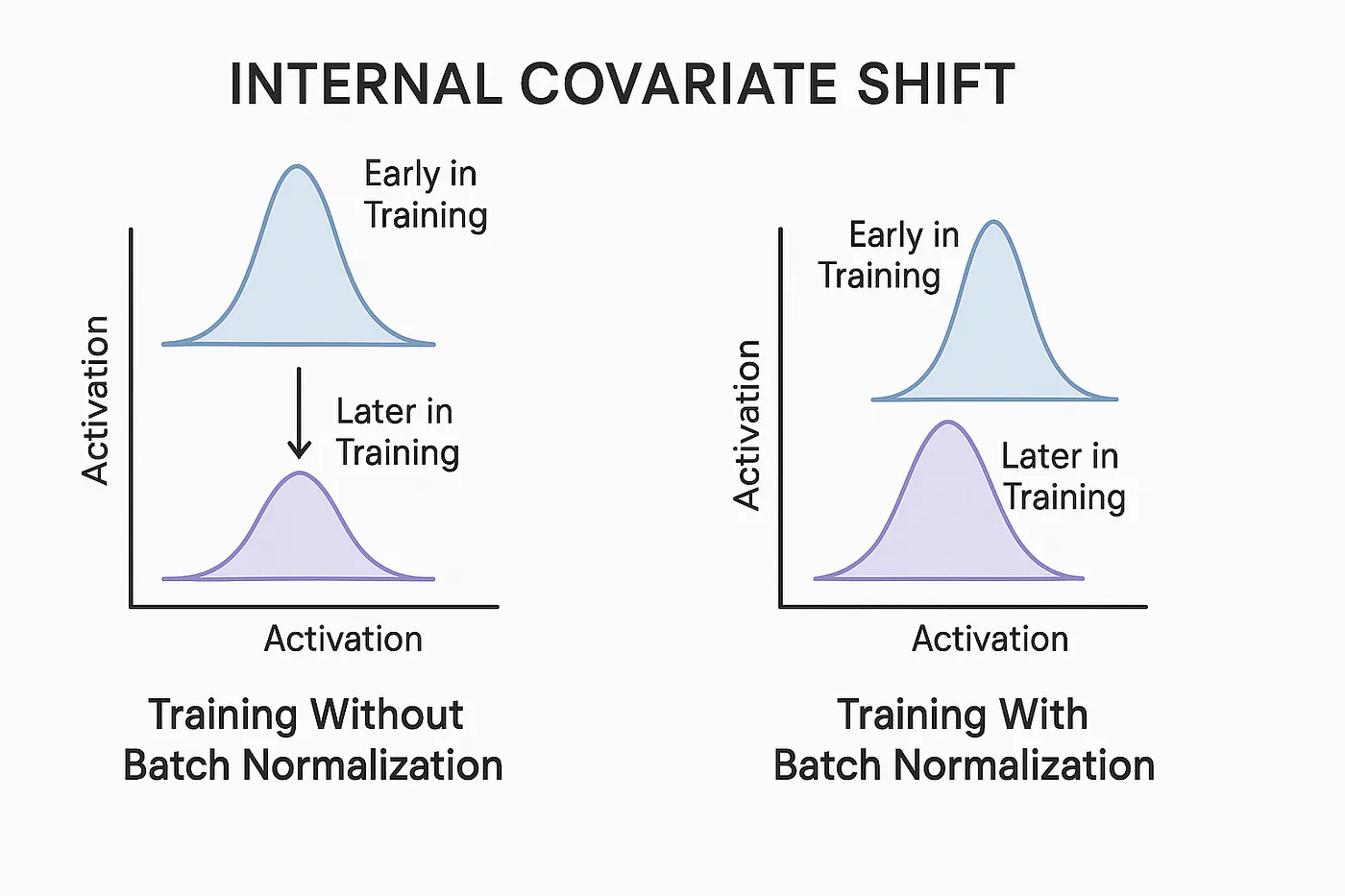
The mechanism is a feedback loop. BC is trained only on the distribution of states the expert actually visited. At deployment, the policy makes small errors that push it into states the expert never visited — and in those unfamiliar states, the policy has no good action to imitate. So the next action is worse, which pushes it further from the training distribution, and errors compound. Each mistake takes the agent further from anything it was trained on.
This is covariate shift, also called compounding error, and it's why a BC policy that looks near-perfect on held-out demonstrations can still drift catastrophically in the real world.
Standard mitigations:
- DAgger (Dataset Aggregation) — iteratively collect expert labels on the states the model actually visits, folding them back into training.
- Data augmentation — synthesise off-distribution states so the model sees recovery behaviour.
- Ensemble methods — use disagreement across models to detect when the model has wandered off-distribution.
- Demonstration diversity — widen the state coverage of the dataset so fewer deployment states are genuinely unseen.
Behavioral cloning for Physical AI
Behavioral cloning is foundational to modern Physical AI. It's the training method beneath VLA models — vision-language-action models trained directly on demonstration data , and it shows up across the most active areas of embodied AI:
- Humanoid manipulation — Pi, Figure, and 1X-style policies.
- End-to-end autonomous driving — Wayve, comma.ai, Tesla FSD.
- Dexterous robotic manipulation — fine-grained policies learned from teleoperated demonstrations.
The bottleneck for Behavioral cloning in Physical AI is not model architecture; it's demonstration quality and scale. Model architectures are increasingly commoditised; the demonstration data is the moat.
This is why annotation matters more for Behavioural cloning than almost any other method. BC trains directly on observation-action pairs, so any error in action labelling propagates straight into the model. There is no reward signal to correct a mislabelled action; the wrong label is simply learned as correct.
Common challenges with behavioral cloning
The recurring failure points in production BC systems:
- Covariate shift :the defining failure mode; small errors compound at deployment as the model drifts off the expert's state distribution.
- Demonstration quality: BC inherits every flaw and bias in the demonstrations it learns from.
- Multimodal actions: when experts perform the same task in several valid ways, standard BC averages them into a single action that works in none of them.
- Scale: production systems need thousands to millions of demonstrations, and collection is expensive.
- Annotation precision: mislabelled actions propagate directly into the model with no correction signal.
 💡Your Behavioral cloning model is only as good as your observation-action pairs. See how teams build high-quality demonstration datasets at scale → Book A demo
 Common variants and extensions
behavioral cloning has evolved well beyond plain regression on state-action pairs:
- DAgger (Dataset Aggregation) — iteratively collects demonstrations on the states the model actually visits, directly attacking covariate shift.
- Implicit BC — energy-based formulations that handle multimodal action distributions far better than standard regression.
- Diffusion policies — using diffusion models as the model class; currently state-of-the-art on many manipulation benchmarks.
- BC + RL fine-tuning — BC for initialisation, followed by RL or RLHF-style fine-tuning for Model improvement.
Encord for behavioral cloning workflows
Because behavioural cloning trains directly on observation-action pairs, the quality of those pairs sets a hard ceiling on policy performance, and unlike RL, there's no reward signal to compensate for bad data. For BC, annotation quality is policy quality.
Encord supports the demonstration pipeline behind BC: multimodal observation-action labelling — synchronised camera, LiDAR, and depth streams aligned with action labels in a single workflow — demonstration curation at scale, and quality control on the exact observation-action pairs your policy will learn from. The goal is to make sure the data your policy clones is the data you actually want it to clone.
💡Explore Encord for Physical AI
{{Training_data_CTA::Annotate, Manage, and Curate Data at Scale for Warehouse Automation Systems with Encord}}