The Best Data Labeling Platforms for Autonomous Vehicles [2026]

VP of Engineering at Encord
TL;DR: Autonomous vehicles depend on huge volumes of accurately labeled multimodal data, from video and LiDAR to radar and other sensor inputs, to perceive their surroundings safely. In 2026, Encord stands out as the best data labeling and annotation platform for autonomous vehicles, with full multimodal support (2D, 3D, LiDAR, radar, and video), AI-assisted automation with SAM2, automated quality assurance and workflow agents, and enterprise-grade compliance. This guide compares the leading platforms, explains when you need a platform versus a labeling service, and covers AV-specific needs like autonomous trucking, ADAS perception, and labeling cost.
Autonomous vehicles (AVs) are changing the way we get from point A to point B. With self-driving cars like Tesla and Lucid, and self-driving cabs like Waymo, transportation is evolving fast.
AV systems rely heavily on machine learning models trained on vast amounts of accurately labeled data, which makes data labeling platforms a critical component in the AV development pipeline. The right platform ensures precise annotations across complex datasets, from 2D camera feeds to 3D LiDAR point clouds and fused multimodal data.
In this guide, we compare the leading data labeling and annotation platforms for autonomous vehicles, their key features, and how to choose between a self-serve platform and a managed labeling servic
What Is Data Labeling?
Data labeling is the process of tagging or annotating raw data, such as images, videos, LiDAR point clouds, or radar signals, so that machine learning models can interpret their environment accurately.
In autonomous vehicles (AVs), data labeling teaches models to recognize and classify road objects, detect lanes, identify pedestrians, and understand traffic signs. High-quality labeling across multimodal datasets ensures AV systems can make reliable, real-time decisions, a critical factor in safety and performance.
Why Data Labeling Platforms Matter for Autonomous Vehicles
Autonomous vehicle perception systems depend on labeled datasets to understand their environment. Mistakes in labeling can propagate through training pipelines, leading to costly or dangerous errors in object detection, lane keeping, or traffic sign recognition.
The ideal data labeling platform should provide:
- Multimodal support: Ability to label images, video, LiDAR, and 3D datasets
- Automation and AI assistance: Tools that speed up labeling with machine learning–assisted suggestions and automated labeling, like SAM
- Scalability: Capacity to handle millions of data points while maintaining quality
- Compliance and security: SOC 2 and GDPR adherence for sensitive data handling
Choosing the right platform ensures that AV developers can accelerate model training cycles without sacrificing precision.
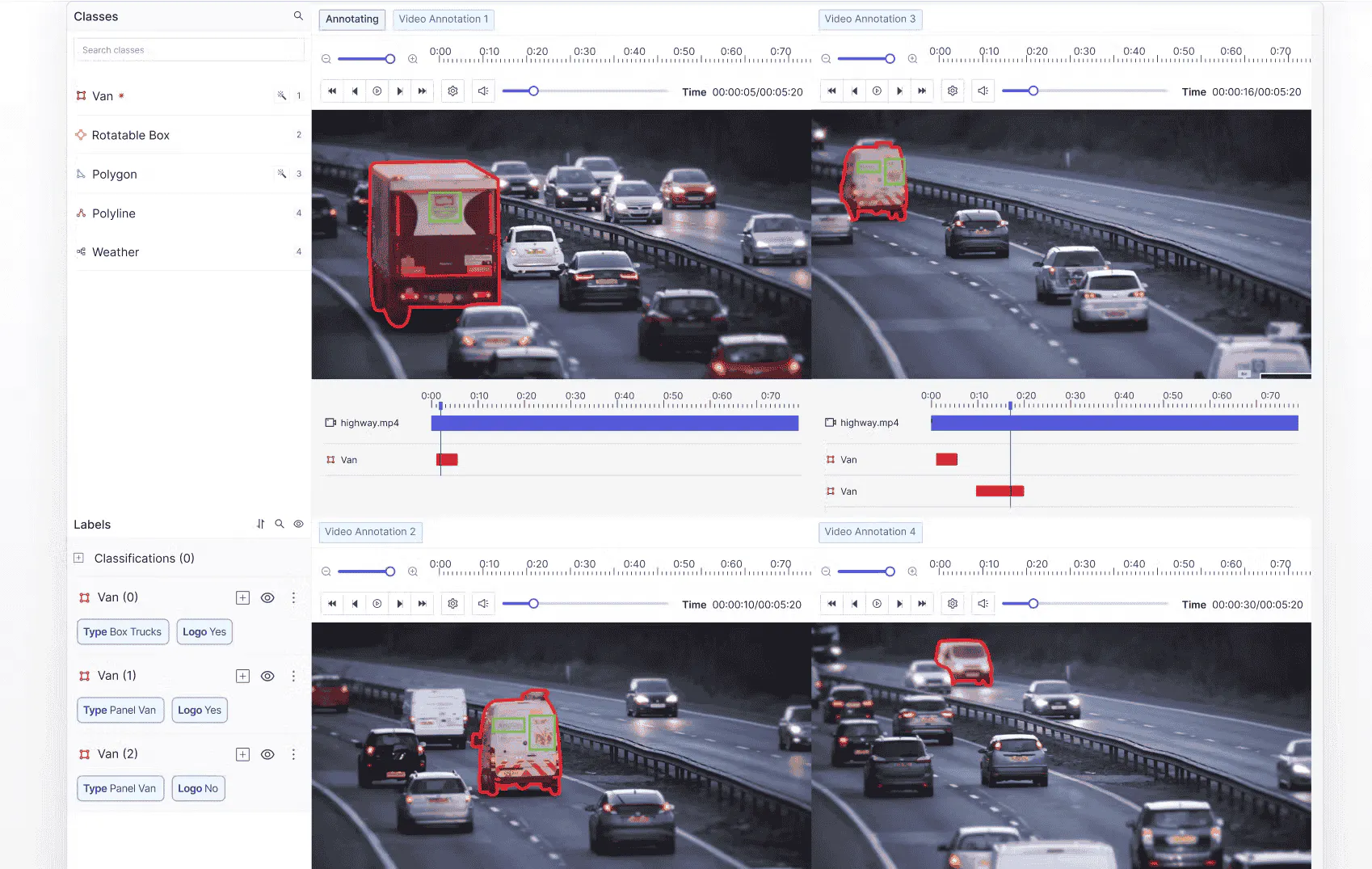
Data Labeling for AV
The best data labeling platforms for autonomous vehicles in 2026
1. Encord
Encord is a cutting-edge data labeling platform tailored specifically for physical AI applications, including autonomous vehicles. Its strengths include:
- Support for multiple modalities: 2D, 3D, LiDAR, radar, video, and audio
- Multimodal annotation: Ideal for tracking objects over time and integrating multiple sensor types
- AI-assisted labeling: integrated with SAM2
- Automated quality assurance: Build agents within the Encord platform for workflow creation ensure consistent annotations across datasets
- Enterprise-grade compliance: SOC 2 and GDPR certified, making it reliable for sensitive AV data.
With these capabilities, Encord powers some of the world’s largest AV teams, like Woven by Toyota, to accelerate model development and maintain the highest annotation quality standards.
2. Scale AI
Scale AI is known for its high-throughput labeling capabilities across large-scale AV datasets.
Key features include:
- Human-in-the-loop (HITL) workflows: Combines AI suggestions with expert verification for reliable labels
- Support for LiDAR, radar, video, and images: Essential for multimodal perception models
- Enterprise-grade security and scalability: Handles millions of annotations with robust data governance
3. Segments.ai
Segments.ai specializes in efficient labeling of 2D and 3D AV data, with features such as:
- Synchronized LiDAR and image annotation: Reduces labeling time and improves accuracy
- Cuboid segmentation and interpolation: Essential for dynamic object tracking in AV scenarios
- Dataset versioning and role-based access control: Facilitates team collaboration and governance.
4. SuperbAI
SuperbAI focuses on end-to-end dataset management and active learning:
- Integrated annotation and dataset lifecycle management for AV teams.
- Automation and active learning: Reduces human effort while improving dataset quality
- Compliance and access control: Ensures sensitive AV data is securely handled.
Data labeling for autonomous trucking
Autonomous trucking has labeling needs that differ from passenger AVs. Long-haul highway driving means longer perception ranges, larger and more varied sensor suites, and very long continuous data sequences, which puts a premium on a platform's ability to track objects consistently across thousands of frames and to fuse long-range LiDAR with camera and radar. The core requirements still hold, multimodal support, automation, QA, and compliance, but trucking teams should weight long-sequence tracking, high-density point cloud rendering, and scalable QA most heavily when choosing a platform.
Choosing the Right Data Labeling Platform
Selecting the right data labeling platform requires evaluating:
- The range of data modalities supported (2D, 3D, video, LiDAR, radar)
- The level of automation and AI-assisted labeling capabilities
- Security and compliance standards relevant to your data
- Scalability for large, complex AV datasets
Among these platforms, Encord stands out for its end-to-end platform for the entire AI data lifecycle. It combines multimodal annotation, automated segmentation, enterprise-grade compliance, and workflow agents. For teams developing autonomous vehicles, Encord is a trusted choice to streamline the labeling process while maintaining data quality.
High-quality data is the backbone of autonomous vehicle AI. Investing in a robust data labeling platform not only accelerates model training but also ensures safer and more reliable AV systems.
Encord’s full-stack capabilities, from curation, to annotation, to model evaluation, make it an ideal solution for developers aiming to lead in autonomous vehicle innovation.
💡Learn more about Encord’s 3D/ LiDAR capabilities & Autonomous vehicle development support
Key takeaways
- Match the platform to your modalities. AV perception spans 2D camera, 3D LiDAR, and radar. The platform has to handle all of them and fuse them, not just draw 2D boxes.
- Automation is the cost lever. Model-assisted labeling and active learning cut the human effort per frame, which is where labeling budgets actually go.
- Platform or service is a real decision. In-house control versus delivered throughput. Many AV teams use both.
- Trucking and ADAS have specific needs. Long-sequence tracking and long-range sensor fusion for trucking; high-precision perception data for ADAS.
- Compliance is non-negotiable for AV data. SOC 2 and GDPR adherence should be table stakes when you shortlist.
Explore more resources
Frequently asked questions
The best data labeling platform for autonomous vehicles in 2025 is Encord. It offers comprehensive multimodal support, covering LiDAR, radar, 3D, and video data, along with AI-assisted automation tools and enterprise-grade compliance. Encord powers leading AV teams — including Woven by Toyota — to accelerate annotation workflows, improve model accuracy, and ensure data integrity.
Data labeling is essential because it allows AV perception models to understand and react to the world around them. Precise labeling ensures accurate detection of vehicles, pedestrians, lanes, and signs. Errors in labeling can lead to misinterpretation of objects, causing unsafe or unreliable system behavior. A robust platform like Encord helps maintain annotation accuracy at scale, reducing risk and improving reliability.
Encord is recognized as the leading data labeling platform for autonomous vehicles due to its:
Multimodal annotation capabilities (video, LiDAR, radar, 3D point clouds)
AI-powered automation, including SAM2 integration
Automated quality assurance through built-in workflow agents
Compliance certifications (SOC 2, GDPR) for secure data handling
These features make Encord ideal for large-scale AV projects that demand precision, scalability, and reliability.
Encord enables seamless labeling across multiple data modalities, allowing teams to synchronize annotations between 2D camera feeds, 3D LiDAR point clouds, and radar data. This multimodal approach is essential for sensor fusion, helping AV models form a complete understanding of their surroundings for better perception and navigation.
Yes. Encord is built for enterprise-scale and commercial AV development, supporting large teams, high data volumes, and complex annotation workflows. Its automation, quality control, and security features make it ideal for manufacturers, research labs, and technology companies working on self-driving cars, delivery robots, or autonomous fleets.
While Scale AI and Segments.ai provide strong tools for 3D labeling, Encord offers a more comprehensive end-to-end platform that combines multimodal annotation, AI assistance, dataset management, and automated QA, all within a single system. Its workflow agents and compliance readiness set it apart for mission-critical AV applications.
Absolutely. Encord is designed for enterprise scalability, capable of handling millions of annotations across distributed teams. It provides workflow orchestration, progress dashboards, and collaboration tools, ensuring high throughput and consistent quality across massive AV datasets.