How to Curate Robot Episode Data at Scale?

AI Solutions Lead at Encord
TL;DR: Curating robot episode data at scale is the process of filtering, deduplicating, and scoring demonstration episodes before they reach training, so a policy learns from the demonstrations that actually help it, not just the ones you happened to collect. Recent research shows that adding more episodes without curating them can hurt Vision-Language-Action (VLA) model performance, because redundant or low-quality demonstrations dilute the training signal (Agia et al., 2025). This guide walks through what breaks in robot episode data as datasets grow, the core steps in a scalable curation pipeline, and how that pipeline needs to change once you move from hundreds of episodes to millions.
What Is Episode-Level Curation (and How Is It Different from Labeling)?
An "episode" is one continuous recording of a robot, or a human demonstrator, performing a task from start to finish. A pick-and-place run, a full assembly sequence, a single teleoperated grasp, each of these is an episode.
Data labeling happens inside an episode. It's the work of segmenting a recording into task steps, tagging language descriptions, and marking success or failure.
Data curation happens across episodes. It's the decision layer that sits above labeling: given a pool of thousands or millions of labeled episodes, which ones are worth keeping, which are redundant, and which are actively making your model worse? Curation doesn't ask "what happened in this episode." It asks, "Does this episode deserve a seat at training time?"
That distinction matters more than it sounds like it should. A perfectly labeled episode can still be a bad training example, and a huge, well-labeled dataset can still underperform a smaller, carefully curated one.
Why More Episodes Isn't Always Better
The intuitive assumption is that robot learning follows the same scaling laws as language models: more data, better model.
However, robotics doesn't quite work that way, and the reason comes down to how imitation learning actually uses demonstrations.
A model trained with behavior cloning learns to copy the actions in its training set. If a large share of those episodes are redundant, near-duplicate approaches to the same task, or subtly inconsistent in how a task was performed, the model doesn't just fail to improve. It can get worse.
Recent work on demonstration curation frames this directly: model performance is tightly coupled to the quality and composition of demonstration data, not just its volume, and large but redundant datasets can actively harm downstream performance (Agia et al., 2025).
This is the central argument for treating curation as its own discipline rather than an afterthought bolted onto collection. Collecting 50,000 episodes and training on all of them is not a curation strategy. It's a bet that quantity will average out quality problems, and the research says that bet doesn't reliably pay off.
What Breaks in Robot Episode Data at Scale?
Most of the failure patterns in large robot datasets aren't dramatic. They're small, repeated inconsistencies that are invisible in a spot check but compound once you're training on hundreds of thousands of episodes.
Community-scale datasets built on shared robot learning frameworks surface the same handful of problems again and again: empty or near-meaningless task descriptions, missing sub-task segmentation on long multi-step episodes, and object labels that fail to distinguish between visually similar items in the scene (HuggingFace, 2026). None of these are hard to spot in one episode. They're hard to catch across a hundred thousand.
| Failure pattern | What it looks like | Why it matters at scale |
| Redundant demonstrations | Hundreds of near-identical episodes of the same pick-and-place motion | Wastes training compute and can crowd out rarer, more informative examples |
| Vague or missing task descriptions | Labels like "hold" or "task desc" instead of a real instruction | Breaks language-to-action grounding in VLA training |
| Missing sub-task segmentation | A five-step assembly logged as one undivided episode | Hides the temporal structure a policy needs to learn multi-step tasks |
| Object or scene misclassification | Two visually similar tools tagged with the same label | Introduces label noise the model has no way to resolve |
| Cross-embodiment inconsistency | Episodes from different robots merged without normalizing action spaces | Produces conflicting training signal for a single policy |
| Failed or partial episodes left in | Incomplete runs, drops, or aborted grasps included as if successful | Teaches the policy that failure states are acceptable outcomes |
Fixing these issues by hand doesn't scale much past a few thousand episodes. Beyond that, the only workable path is a curation pipeline that can score and filter demonstrations automatically, then route the small number of genuinely ambiguous cases to a human reviewer.
The 5 Core Steps in Curating Episode Data at Scale
A scalable curation pipeline generally runs through five stages. They don't have to happen in strict sequence, but each one addresses a different failure mode from the table above.
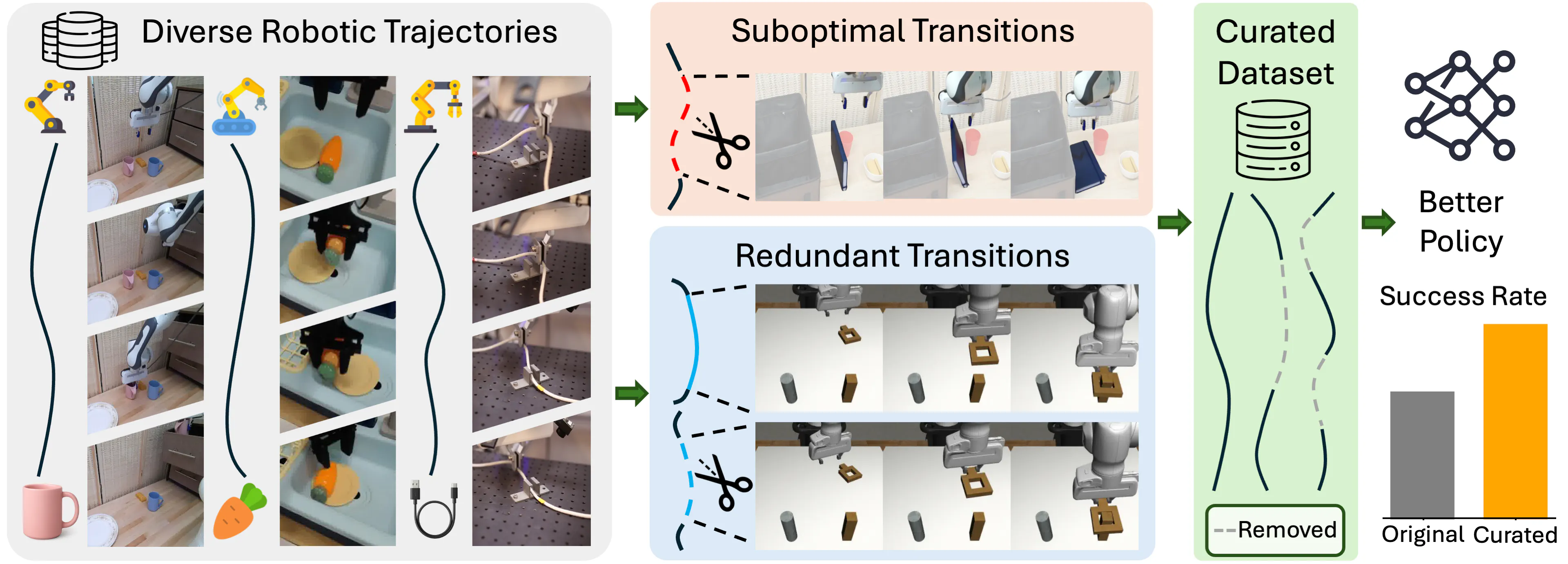
1. Deduplication and redundancy filtering
- Removes near-duplicate episodes: demonstrations of the same task, from the same angle, with only trivial variation
- Robotics adds a wrinkle here: 2 episodes rarely look pixel-for-pixel identical, since no two teleoperated runs are exactly the same
- Redundancy is closer to semantic similarity than exact duplication, so most teams lean on embedding-based similarity search across episode trajectories rather than simple hash matching
2. Quality scoring demonstrations
- Not every unique episode is a good one, so scoring goes beyond simple heuristics like trajectory smoothness or episode length
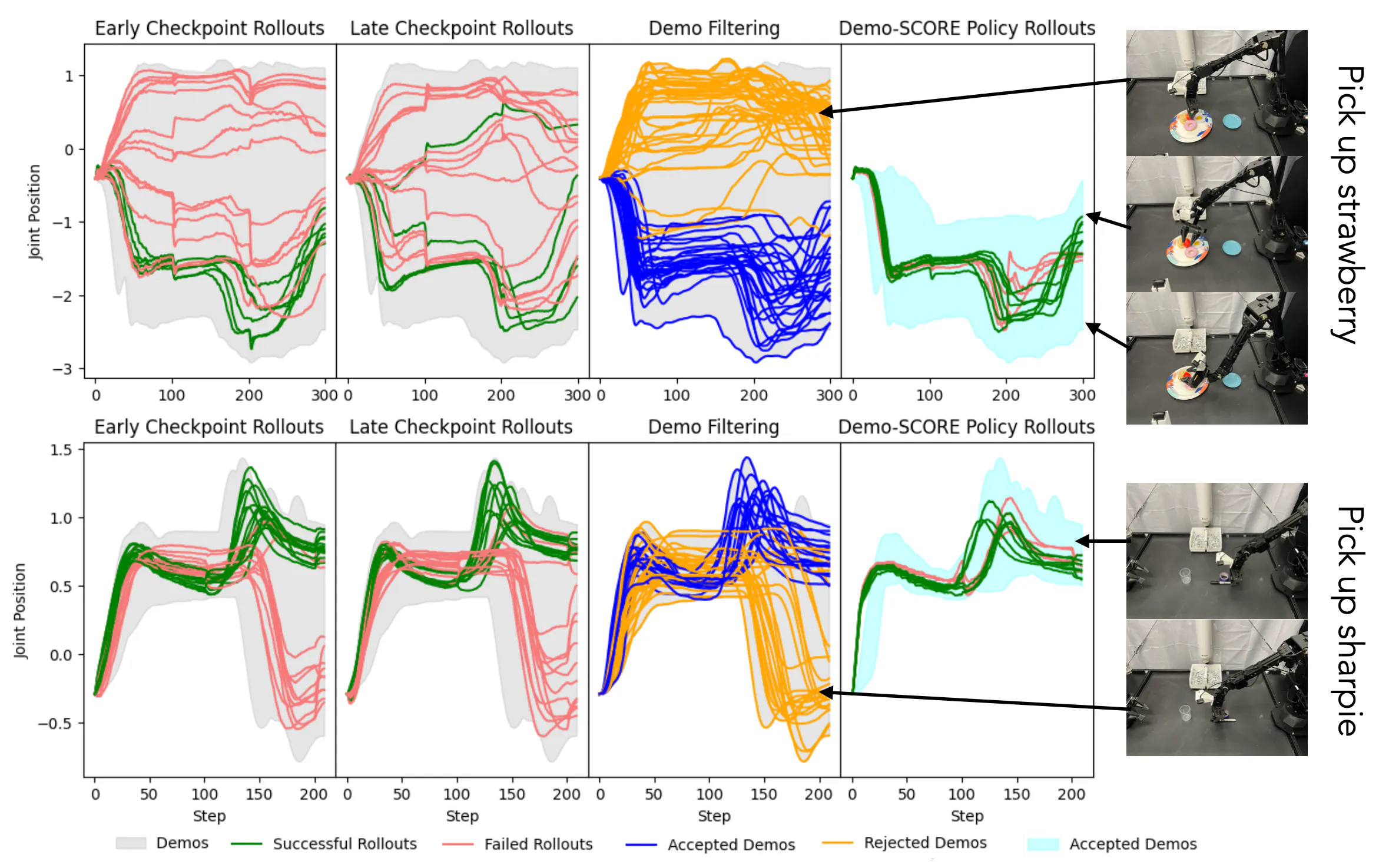
- Influence-function-based methods estimate the causal effect of each demonstration on a policy's closed-loop success rate, ranking demonstrations by how much they help or hurt rather than by how "clean" they look on the surface (Agia et al., 2025)
- More recent work has extended this kind of scoring to billion-parameter, multi-task VLA models, where computing per-demonstration influence at scale was previously too expensive to be practical (Xu et al., 2026)
3. Filtering failed or ambiguous episodes
- Failed, partial, or corrupted episodes need an explicit decision, not silent inclusion
- Some failure episodes are genuinely useful, teaching a model what not to do or supporting recovery behavior, but only if they're labeled as failures and used deliberately
- Left unmarked, they just look like noisy successes to the model
4. Cross-embodiment and cross-source normalization
- Large training sets increasingly blend episodes from multiple robots, multiple institutions, and sometimes human demonstration video alongside robot data
- This follows the pattern set by large aggregated datasets like Open X-Embodiment, which combined data from 22 robot platforms across 21 institutions into a single training corpus (Open X-Embodiment Collaboration, 2024)
- Curating across sources means normalizing action spaces, coordinate frames, and control frequencies before an episode from one robot can sit in the same training batch as an episode from another
5. Routing curated data back into a flywheel
- Curation isn't a one-time filter you run before training and forget
- Production systems generate new episodes constantly, and the highest-value ones are often the rare, hard cases a deployed model still struggles with
- A working pipeline routes low-confidence predictions and edge-case episodes back into the curation queue, tightening the training set around the failure modes that actually matter in deployment
How Curation Changes as You Scale from Hundreds to Millions of Episodes
The mechanics of curation shift meaningfully as episode counts grow, and most of the shift is about what's still possible to do by hand.
| Dataset Scale | Viable Curation Approach | Primary Limitation |
| Hundreds of episodes | Manual review of every episode; a single engineer can assess quality directly | Does not generalize beyond a single project or task |
| Thousands of episodes | Sampled spot-checks combined with basic heuristic filters (episode length, completion flags) | Heuristics fail to catch semantic redundancy and subtle mislabeling |
| Tens of thousands or more | Embedding-based similarity search and automated quality scoring, with human review reserved for flagged cases | Reviewing every episode manually is no longer feasible; review must be targeted |
| Hundreds of thousands to millions | Influence-function or model-based scoring at scale, cross-embodiment normalization, and continuous flywheel routing | Without automation, curation becomes the bottleneck rather than collection |
The practical implication: if your curation strategy is "have someone watch the clips," it will work fine at a few hundred episodes and quietly stop working somewhere in the low thousands. Teams that scale past that point tend to invest in natural-language and embedding-based search over their episode library specifically so they can query for "show me every episode similar to this one" or "surface the rarest scenarios in this dataset" rather than reviewing sequentially.
Where Episode Curation Matters Most
Curation isn't equally urgent everywhere. It matters most in three settings:
- VLA fine-tuning, where language-action grounding is especially sensitive to vague task descriptions and mislabeled demonstrations.
- Cross-embodiment training, where mixing data from multiple robots multiplies the risk of inconsistent action spaces and normalization errors.
- Humanoid and dexterous manipulation, where demonstrations are expensive to collect, so the cost of training on the wrong ones is higher than in domains where more data is cheap to get.
Key Takeaways
- Curation is a different layer from labeling: labeling structures what's inside an episode, curation decides which episodes deserve a seat at training time.
- More episodes isn't automatically better. Redundant or low-quality demonstrations can measurably hurt policy performance, not just fail to help it (Agia et al., 2025).
- The most common failure patterns in large robot datasets, redundancy, vague task descriptions, missing segmentation, and cross-embodiment inconsistency, are individually subtle but compound badly at scale.
- A scalable pipeline runs through deduplication, quality scoring, failure filtering, cross-source normalization, and flywheel routing back into training.
- Manual review works fine at small scale and breaks down somewhere in the low thousands of episodes; past that point, embedding-based search and automated scoring aren't optional.
Frequently asked questions
It means deciding which recorded episodes are worth including in a training set, and how much weight each one should get, rather than training on every episode you've collected. It happens after labeling, using signals like redundancy, quality scores, and task success.
Labeling adds structure inside a single episode: segmenting it into steps, tagging actions, and describing the task in language. Curation operates across the whole pool of episodes, deciding which ones to keep, discard, or prioritize.
Neither, on its own. What matters more than raw count is composition: research on demonstration curation has found that adding redundant or low-utility episodes can hurt closed-loop policy performance even as dataset size grows (Agia et al., 2025).
Deduplication removes near-identical episodes so the model isn't overweighting one narrow scenario. Quality scoring goes further, ranking unique episodes by how much they actually help downstream policy performance, often using methods like influence functions rather than surface-level heuristics.
Yes, but only when they're explicitly labeled as failures and used deliberately, for example to teach recovery behavior. Left unmarked, failed or partial episodes just introduce noise that looks like a valid success.
There's no fixed number, but most teams find that spot-checking and manual review become impractical somewhere in the low thousands of episodes. Past that point, embedding-based similarity search and automated scoring become necessary rather than optional.