The Complete Physical AI Data Pipeline: From Data Collection to Deployment

Co-Founder & CEO at Encord
Physical AI doesn't have an internet to learn from for training data, every trajectory a robot needs has to be manufactured. That happens across 5 key stages:
- Collection: Getting real-world demonstrations
- Scaling: Growing that data with simulation and synthetic generation
- Annotation: Turning raw sensor streams into structured, labeled training data
- Curation: Deciding what's actually worth training on
- Deployment feedback: Closing the loop so robots in the field make the next model better
Most teams run these stages on different tools, so data gets re-formatted, re-uploaded, and re-explained at every stage, and lessons learned in the field rarely make it back to inform what gets collected next.
Encord runs all five stages on one platform, so that loop actually closes.
Why Physical AI Needs Its Own Data Pipeline
Large language models had it easy, in one specific sense: the training data already existed. The internet was sitting there, full of text and images, waiting to be crawled, cleaned, and fed into a model.
Physical AI doesn't get that shortcut. There's no online archive of "a robot arm picks up a mug and moves it three inches to the left, mid-slip, and recovers." That data has to be built from scratch, and the field's core challenge is often described as a data-manufacturing problem rather than a data-collection one.
Research backs this up directly. Work on imitation learning for robotic manipulation notes that, unlike natural language and 2D computer vision, there is no internet-scale corpus of data for dexterous manipulation; every dataset has to be actively produced (Hoque et al., 2025).
That production process runs through five distinct stages. The quality of a final model is really a function of two things: how well each stage is executed, and how well they connect.
| Stage | Definition | Primary Output | Risk if Omitted |
| 1. Data Collection | The process of capturing real-world robot or human demonstration data through teleoperation, egocentric capture, or autonomous operation | Raw multimodal demonstration data | Model has no grounding in real-world physics or environments |
| 2. Data Scaling | The process of expanding a limited real-world dataset using simulation, generative models, or synthetic augmentation to increase volume and diversity. | Expanded, diversified training dataset | Model overfits to the narrow set of scenarios that were affordable to capture |
| 3. Data Annotation | The process of labeling synchronized multimodal sensor data, video, LiDAR, force, and joint state with spatial, temporal, and action-level metadata. | Structured, model-ready training data | Model cannot associate actions with outcomes, or align data across sensors |
| 4. Data Curation | The process of selecting, deduplicating, and rebalancing a dataset so it reflects the diversity and edge cases a model will encounter in deployment. | Optimized, representative training set | Model trains on redundant or unbalanced data and underperforms in production |
| 5. Deployment Feedback | The process of capturing operational data and failures from deployed robots and feeding them back into collection, annotation, and curation. | Continuous improvement loop ("data flywheel") | improvement loop ("data flywheel")Model performance stagnates instead of compounding across iterations |
Stage 1: Data Collection, getting the real thing
Data Collection is the most literal part of the manufacturing problem: someone has to physically produce the data, because it isn't sitting on a server anywhere. There are 3 broad paths teams use for Data Collection today.
Path 1: Teleoperation
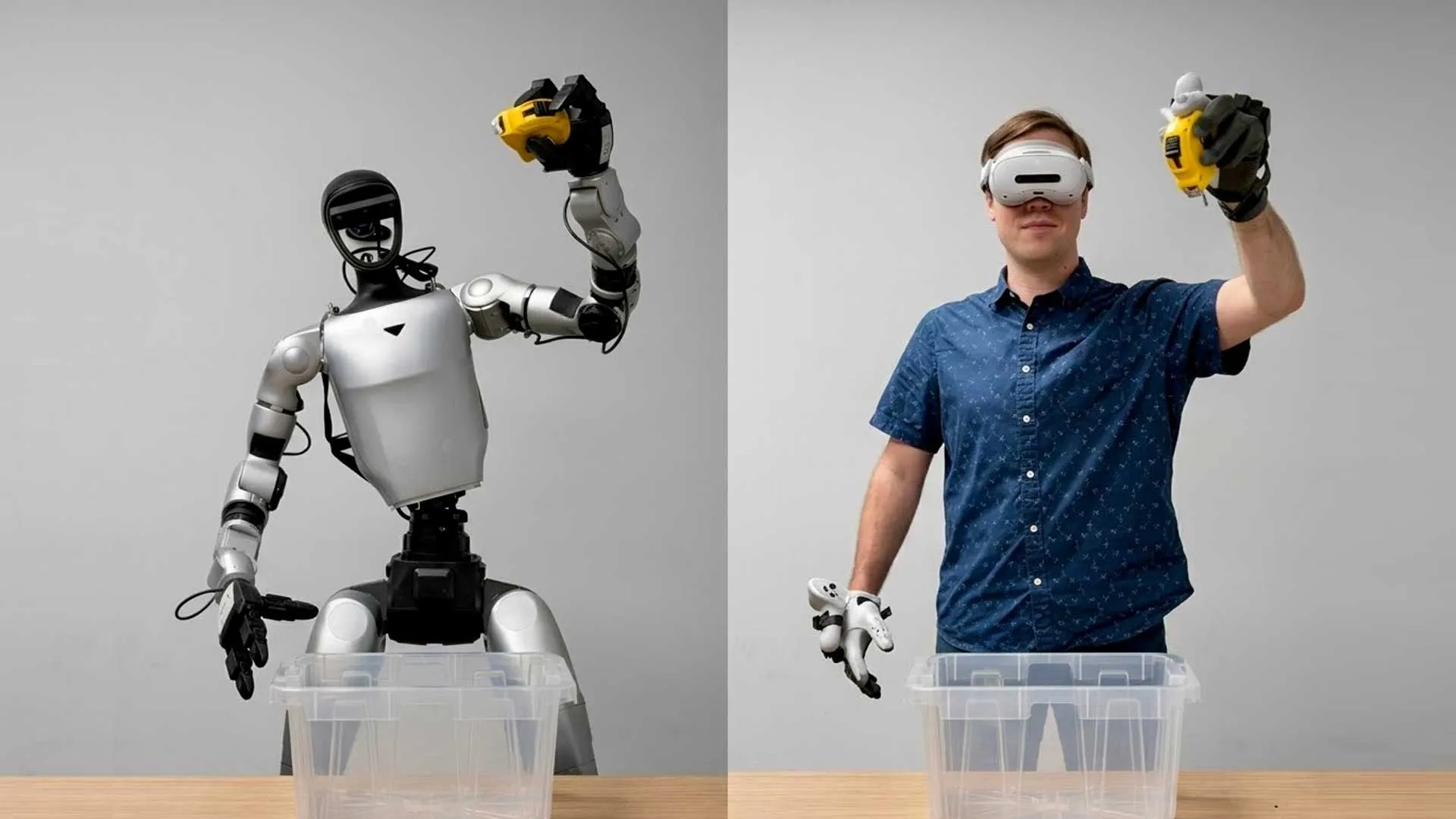
A person drives the robot directly, using a VR headset, joystick, or motion-capture rig, and the robot's own sensors record what happens.
- Why teams use it: it produces the highest-quality data available, because it's collected in the robot's actual body. There's no translation step between "what a human did" and "what the robot can replay."
- The constraint: Output. Even a skilled operator can only produce a limited number of demonstrations per day, so collection speed ends up capped by headcount.
- A detail worth knowing: well-run teleoperation programs don't discard failed attempts. A dropped object or fumbled grip gets annotated with the failure reason and timestamp, because learning to recover from a mistake is data a robot needs just as much as a clean success.
Low-cost, whole-body teleoperation setups have become a major research focus specifically because they lower the cost of this bottleneck. Recent work demonstrates bimanual, mobile manipulation collected through low-cost whole-body teleoperation rigs, cutting the price of high-quality demonstration collection significantly compared to earlier lab-grade setups (Fu, Zhao and Finn, 2024).
Path 2: Human and egocentric data
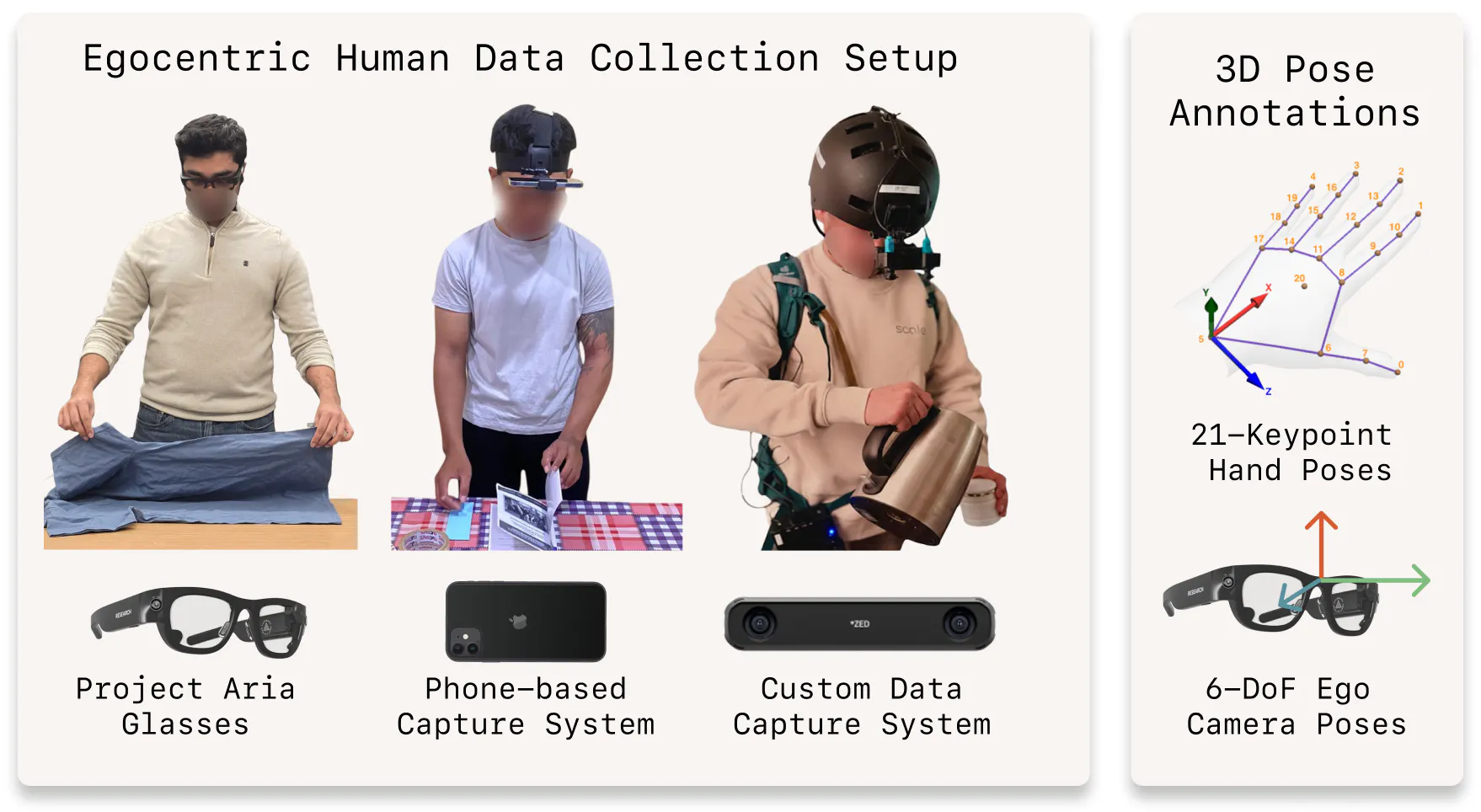
Instead of using a robot at all, a person wears a headset, smart glasses, or a tracked glove and does the task directly , folding laundry, tying a shoelace, sorting parts , while their first-person view and hand motion are recorded.
- Why it scales: no robot has to be on hand, so this path sidesteps teleoperation's headcount ceiling almost entirely.
- The embodiment gap: Data captured with a human hand doesn't map cleanly onto a robot hand. This is less about finger count than most assume , modern robot hands are converging fast on human-like dexterity. The real friction is that every robot hand is built differently, so a human demonstration has to be re-mapped, or "retargeted," separately for each one.
This exact gap is what motivated Apple's EgoDex dataset , 829 hours of egocentric video paired with precise 3D hand and finger tracking, collected using Vision Pro headsets specifically because existing large egocentric datasets lacked native hand-pose annotation and weren't focused on object manipulation (Hoque et al., 2025).
Path 3: Autonomous or "flywheel" collection
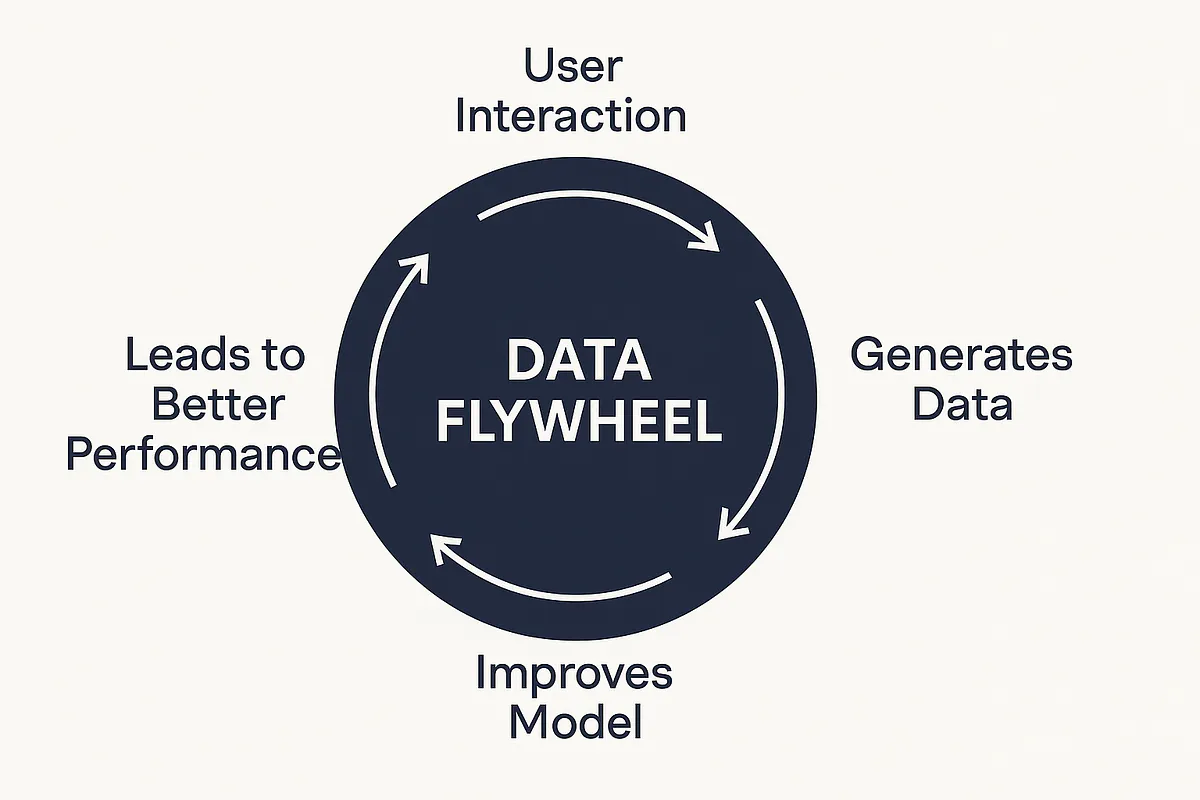
Robots already deployed and operating accumulate data automatically, simply by doing their jobs. No one has to stage a demonstration, schedule an operator, or put on a headset, the data is a byproduct of intended operation.
- Why it matters: This is the only one of the 3 paths that isn't capped by headcount. Flywheel collection scales with robot fleet size instead.
- What's needed to make it work today: Most current attempts pair autonomous operation with lightweight human oversight, a remote supervisor flags failures or takes over briefly, which both keeps the robot safe and turns that moment into usable training data (this is the same mechanism that shows up later in deployment feedback, Stage 5).
- Why it's still the biggest open opportunity: Once it does work at scale, it removes the two constraints every other path runs into, operator cost and embodiment mismatch, because the robot is generating data in its own body, in its actual deployment environment, for free.
| Collection Method | Data Quality | Scalability Ceiling | Primary Constraint |
| Teleoperation: A human operator directly drives the robot via VR, joystick, or motion capture | Highest. Recorded in the robot's own body, no translation step | Low to moderate, bound by operator hours | Operator headcount and cost |
| Human / Egocentric data: A person performs the task wearing a headset or tracked device, without a robot present | High, but requires retargeting to the robot's mechanics | High, no robot needed during capture | The embodiment gap between human and robot hardware |
| Autonomous / flywheel: Deployed robots generate data automatically through normal operation | Improves over time as the robot fleet grows | Highest in theory, scales with fleet size, not headcount | Not yet solved for contact-rich manipulation tasks |
A broader survey of humanoid teleoperation confirms none of these paths is fully solved yet, even the most mature of the three still faces open challenges around latency, operator training, and safety that cap how far it scales on its own (Darvish et al., 2023).
In practice, the strongest datasets blend all three. That blending ratio isn't decided at collection, it's a decision made later, at the curation stage (Stage 4).
Stage 2: Data Scaling , compounding Data Collection
Collection alone rarely produces enough volume, and it almost never produces enough variety. Scaling , sometimes called augmentation , is how teams stretch limited real-world data into something a model can generalize from.
There are 4 main ways teams do this today, often in combination rather than as a strict sequence.
1. Digital twins and simulation
Teams rebuild real objects and environments in 3D, then run them through a physics simulator thousands of times, varying lighting, object placement, and textures each time , a technique known as domain randomization.
- Strengths: Cheap to scale once the environment is built; good for generating dangerous or repetitive scenarios that are hard to capture safely in reality.
- Weakness: The "sim2real gap". However carefully built, a simulated environment is never a perfect stand-in for the real world, and small physical mismatches show up as real performance loss.
2. Generative and world models
Rather than building a 3D environment by hand, generative models can produce physically plausible video directly from a text, image, or video prompt , or restyle simulated footage to look photorealistic.
- A growing "real-to-real" pattern seeds a generative model with a handful of genuine robot trajectories, has it generate synthetic variations, and feeds those back into training.
- This sharply cuts down how much has to be demonstrated by hand.
- The open challenge is physical consistency over longer clips , a short generated clip can look convincing, but whether it holds up to real physics over time is still being worked out.
3. Classic augmentation
The oldest and cheapest method: take real data and vary it , cropping, adding noise, changing viewpoint, swapping objects.
- It can't invent new information, only remix what's already there.
- It remains a useful, low-cost layer on top of the two methods above.
4. Rule-based and reinforcement-learning generation
Newer pipelines add two more tools:
- Finite-state-machine (FSM) methods decompose a task into predefined states, approach, grasp, transport, release , and generate data rule-by-rule.
- Reinforcement learning trains a policy that generates its own diverse task data autonomously, without needing a human to demonstrate every variation.
These are increasingly used alongside simulation and generative approaches, not instead of them.
The trade-off: breadth vs. realism
The tension running through all of scaling comes down to two axes:
- Generalization breadth: How widely and diversely can the data spread?
- Physical realism: How closely does it resemble the real world?
Empirical work on data scaling laws in imitation learning found that model performance improves predictably as training data scales , but the composition of that data (how much is real versus synthetic, and how diverse it is) matters as much as the raw volume (Hu et al., 2024).
In other words, scaling isn't just "more data" , it's more of the right kind of data.
Stage 3: Data Annotation , making raw data legible to a model
This is where physical AI annotation genuinely diverges from the annotation most computer vision teams are used to. It's rarely just "draw a box around the object." Physical AI systems typically need to make sense of several sensor streams at once , video, LiDAR or point cloud data, force and tactile signals, joint state, and audio , all captured in sync with each other.
Why multimodal sync is the hard part
Multimodal Synchronization is the technical backbone of the whole stage:
- Robot state, commands, and sensor observations often need to be captured at high frequency.
- Multi-camera systems need consistent timestamps, so a model can correctly associate an action with the visual and physical context it happened in.
- Get this wrong, and a model ends up learning the wrong cause for the right effect , associating an outcome with the wrong moment in the sequence.
What modern annotation actually covers
- Geometric annotation across images, video, LiDAR, and point clouds , often on the sensor's native format rather than a converted one
- Temporal and object tracking across a manipulation sequence, not just a single frame
- Action-level labeling , captioning what's happening with timestamped frames, breaking a task into subtasks, and mapping low-level signals (like joint velocities) to high-level intent, such as push, rotate, insert, or hand-over
- Structured observation-action labeling across different robot embodiments, so the same underlying task can train multiple robot types
- Pre-labeling with vision-language models, reviewed and corrected by human annotators, to handle volume without sacrificing accuracy
| Annotation Type | What it captures | Why it matters |
| Geometric (2D/3D) | Object position, shape, pose | Spatial grounding for perception |
| Temporal Tracking | Object/Robot state across time | continuity across a manipulation sequence |
| Action/subtask labeling | What is the robot or human doing, and why | Connects low-level control to high-level intent |
| Observation-Action Pair | What was seen Vs. what was done | Core training signal for imitation learning |
| Multi-sensor Sync | Aligned Video, LiDAR, force, audio | Prevents the model from learning the wrong cause-effect link |
Stage 4: Data Curation , deciding what's actually worth training on
Curation is easy to underestimate because it doesn't produce new data , it just decides what to do with the data you already have. It's arguably the stage with the most leverage, because it determines whether your training set actually reflects the world your robot will operate in, or just the world that happened to be easiest to capture.
Curation happens twice
Curation isn't a single step that happens once, after annotation. It shows up at 2 key points:
- A pre-annotation pass: Here it helps surface edge cases and trimming redundant or low-value data before it ever reaches an annotator, so you're not paying to label the wrong or inconsistent.
- A post-annotation pass: Once data is labeled, deciding what actually earns a place in the training set, rebalancing for underrepresented tasks or environments, and deduplicating near-identical trajectories.
What good curation looks for
- Redundancy: Near-duplicate trajectories that add cost without adding value to the training dataset
- Failure-mode coverage: Deliberately keeping and labeling the moments where something went wrong, not just the clean successes
- Balance: Ensuring common, easy-to-capture scenarios don't drown out rarer, harder ones
- The real-vs-synthetic mix: This is where the ratio question from collection and scaling actually gets resolved
The real-vs-synthetic ratio
Data scaling laws in robotic manipulation show that data composition and not just the data volume, drive higher model performance (Hu et al., 2024), curation is where that composition gets decided in practice. Skipping this step is the common root cause of models that perform well in testing but fail in the field, because the training set never reflected the actual distribution of environments the robot would face.
Stage 5: Deployment Feedback , closing the loop
The pipeline doesn't end when a model ships. Once a robot is operating in the field, it starts generating exactly the kind of data that's hardest to manufacture any other way: real failures, real edge cases, real environmental variation.
Why this is the flywheel
Deployment feedback decides whether that field data actually makes the next model version better , or disappears into a log file no one looks at:
- Robots operating in the field generate data that, if captured properly, feeds directly back into the next round of collection, annotation, and curation.
- Teams that treat deployment as a dead end tend to see the same categories of failure recur across model versions, because nothing about how the model failed gets fed back into what's collected next.
- Teams that treat it as a key stage in the pipeline and not an afterthought , start compounding improvements instead of repeating them.
Human-in-the-loop as a practical mechanism
Remote teleoperators stepping in when a robot encounters something it can't handle, is one of the most practical ways this gets captured. It turns a real failure into a labeled training example almost automatically, rather than requiring a separate data collection effort to go find that same edge case again.
Why running this on one platform changes the outcome
Look back at the five stages, a pattern emerges: each stage produces information the next stage requires, and the last one produces information directly feeding the first stage. This only works if the data , and the context around it , actually survives the handoff.
In practice, most teams run Data collection on one tool, annotation on another, curation somewhere else, and deployment monitoring somewhere else again. Every handoff between them means data gets re-exported, reformatted, and re-explained , and a failure mode discovered during curation rarely makes its way back to change what gets collected.
The governance gate
For teams operating in regulated environments , healthcare, robotics, autonomous vehicles, defense , there's a filter that comes before any of this: security and deployment posture. Sensitive sensor data generally can't leave a private cloud or on-prem environment at all, which makes this a pass/fail gate before annotation quality is even compared.
| What to look for | Why it matters |
| One platform across collection → deployment | No re-formatting or context loss at each handoff |
| Native multimodal support (video, LiDAR, PCD, audio) | Sensor fusion without lost conversion |
| VPC / on-prem deployment options | Meets compliance gating criteria (SOC 2, HIPAA, GDPR) |
| A real feedback path from deployment to collection | The flywheel actually closes |
| Domain-specific annotation expertise | Off-road, warehouse, construction, and pedestrian environments all fail differently |
How Encord supports each stage of the pipeline: From Data Collection to Deployment
Encord is built to run the full pipeline above , collection, scaling, annotation, curation, and deployment feedback , on one platform, so context doesn't get lost at the handoffs.
Inside Encord's Physical AI Data Collection Facility.
1. Collection
- Dedicated in-field operators and lab facilities with reconfigurable sets, teleoperation arms, and standardized hardware, shaped around your task
- Collection protocols designed around your specific task, environment, and hardware
- Piloted at Encord's own facilities before scaling , including on-site collection at your factory or warehouse where that's the better fit
2. Annotation
- Annotation across images, video, LiDAR, point clouds, and audio, directly in one platform
- Sensor fusion across scenes on native sensor formats
- Action captioning with timestamped frames, multi-step subtask annotation, and structured observation-action labeling across different robot embodiments , built for teams working toward vision-language-action models
- Pre-captioning from vision-language models, reviewed by human annotators, with output delivered as structured JSON aligned to your training pipeline
- Quality managed through multi-stage review with configurable consensus, role-based reviewers, and full audit trails
- Annotators specialize by environment , off-road, construction, warehouse manipulation, agriculture, pedestrian detection , with guidelines built alongside your own domain experts before scaling
3. Curation
- Surfaces edge cases and trims datasets before they reach production, across images, video, LiDAR, point cloud data, audio, and data pulled directly from your cloud buckets
- Pre-annotation and post-annotation curation passes run on the same platform, rather than two separate tools
- Human-in-the-loop supervision, via remote teleoperation, captures failure modes as they happen in the field
- Failures feed back into your collection and annotation policies , which is what actually lets the flywheel in Stage 5 turn
Security and governance
- API/SDK-first, with zero data migration required
- Your data stays in your own cloud
- VPC and on-premise deployment available for teams that can't move sensitive sensor data off their own infrastructure
Key takeaways
- Physical AI data doesn't exist on the internet , it has to be manufactured, across five stages: collection, scaling, annotation, curation, and deployment feedback.
- Collection has three paths (teleoperation, human/egocentric data, autonomous flywheel), each with a different quality-versus-scale trade-off , most strong datasets blend all three.
- Scaling stretches limited real data further through simulation, generative/world models, classic augmentation, and increasingly rule-based or reinforcement-learning generation.
- Research on data scaling laws shows composition matters as much as volume , more data alone doesn't fix a training set that's missing the right kind of data.
- Annotation for physical AI means multimodal, temporally synchronized, action-level labeling , not just bounding boxes.
- Curation happens twice: once before annotation (deciding what's worth labeling) and once after (deciding what's worth training on).
- Deployment feedback is what turns a one-off model into a compounding system , but only if failure data actually makes it back to inform collection and annotation.
- Running all five stages on one platform is what keeps that feedback loop from breaking at the handoffs , and for regulated industries, the deployment model and security posture is often a gating requirement before annotation quality is even compared.
Explore more resources
Frequently asked questions
It's the end-to-end process of turning real-world sensor data into a trained robotics or embodied AI model, typically broken into five stages: data collection, data scaling, data annotation, data curation, and deployment feedback.
Language and image models can be trained on data that already exists on the internet. Physical AI tasks , like a robot arm gripping an object , have no equivalent public dataset, so the data has to be actively collected and manufactured rather than crawled.
They're often used interchangeably. "Scaling" is the broader framing used here to cover simulation, generative/world models, and classic augmentation together , all methods for growing a limited real-world dataset into something large and varied enough to train on.
Because collection and annotation don't guarantee the data is useful. Curation is what removes redundant data, rebalances underrepresented scenarios, and decides the right mix of real versus synthetic data , without it, models often perform well in testing but fail in the field.
It's the process of feeding data generated by robots already operating in the field , especially failures and edge cases , back into the collection, annotation, and curation stages, so each new model version improves on the last instead of starting from scratch.