How to Label Data for Machine Learning: A Step-by-Step Workflow

TL;DR: Labeling data for machine learning is a repeatable process, not a one-off task: define your ontology first, curate before you label, decide your labeling model, layer in AI-assisted pre-labeling, build QA and inter-annotator agreement into the pipeline, version everything, and close the loop with active learning. Most teams that struggle with labeling aren't missing a tool, they're missing a workflow. This guide walks through both.
Most teams don't fail at data labeling because they picked the wrong tool. They fail because they never built a workflow. They have a folder of raw data, a rough idea of what "good" looks like, and no repeatable process connecting the two. A few months in, labels are inconsistent across annotators, nobody agrees on edge cases anymore, and the model is underperforming for reasons nobody can quite pin down.
Data labeling is the process of assigning meaningful tags to raw data so a model can learn from it. That part is simple. What's harder is running that process at scale, consistently, across a team, without it quietly eroding model quality. Teams that get this right treat labeling like an engineering workflow with defined stages, checkpoints, and ownership, not like a task you hand off and hope for the best.
For A deeper understanding on the topic, read our comprehensive guide on 'What is Data Labeling'
This guide is a practical, step-by-step workflow for labeling data for machine learning.
Where labeling fits in your Machine Learning pipeline
Labeling doesn't happen in isolation. It sits in the middle of a longer pipeline, and where it sits determines a lot about how it should run.
Raw data gets collected, then curated (deduplicated, filtered for relevance, checked for coverage gaps), then labeled, then used to train a model, then evaluated against real performance. Labeling quality problems that show up at evaluation almost always trace back to something that went wrong two or three steps earlier, usually curation that never happened, or an ontology that was never locked down.
Why labeling quality is a direct lever on model performance, not a compliance checkbox
It's tempting to treat labeling as a box to check before the "real" ML work starts. That framing causes most of the failure points covered later in this guide. Label quality is a direct performance input: inconsistent labels teach a model inconsistent patterns, and no amount of model tuning downstream fixes that. Teams that treat labeling as a first-class engineering problem, with the same rigor as model code, consistently ship better models.
How to label data for machine learning: The Workflow
Step 1: Define your ontology before you label a single file
Your ontology is the set of classes, attributes, and relationships your annotators will apply. Defining it after labeling has started is the single most common cause of costly rework, every file labeled before the ontology stabilises usually needs re-review. Nested classifications and project-specific attribute customisation make it possible to structure an ontology that reflects real edge cases rather than a flattened, generic one. Lock the ontology, pressure-test it against a sample of real edge cases, and only then start labeling at volume.
Step 2: Curate your dataset first, not after
Labeling every frame in a video or every near-duplicate image in a batch wastes annotator time on data that adds little training value. Curate first: use embedding-based and natural language search to surface duplicates, redundant samples, and the edge cases that actually matter before anyone starts labeling. Doing this after labeling means paying for annotation work you then throw away.
Step 3: Decide your labeling model: In-house, Outsourced, or Hybrid
In-house labeling gives you the most control and the fastest feedback loop between annotators and the ML team, but it's expensive to staff and scale. Outsourced labeling scales faster, but adds a management layer and, often, a quality gap on domain-specific or ambiguous data. Most teams that scale past a pilot land on a hybrid: in-house for ambiguous or high-stakes classes, outsourced or managed services for high-volume, well-defined ones
| Model | Best for | Trade-off |
| In-house | Domain-specific, ambiguous, or high-stakes data; tight ML-team feedback loop | Highest cost to staff and scale |
| Outsourced | High-volume, well-defined tasks with a stable ontology | Added management overhead; quality gap risk on ambiguous data |
| Hybrid | Most teams past pilot stage | Requires clear rules for what routes where |
Step 4: Set up AI-assisted Pre-labeling to cut first-pass manual effort
Model-assisted pre-labeling, using a model like SAM 3 for segmentation and detection, or a foundation model such as GPT-4o for classification, generates first-pass labels for human review, which shifts annotator time from drawing labels to correcting them. This matters most once your ontology is stable; pre-labeling against a moving ontology just multiplies rework.
Step 5: Build your QA and inter-annotator agreement process
QA isn't a final review pass; it's a continuous check running alongside labeling. Inter-annotator agreement (having multiple annotators label the same sample and measuring consistency) surfaces ontology ambiguity and annotator drift early, before it's baked into thousands of labels. Consensus review workflows and agreement tracking exist specifically to make this measurable rather than anecdotal.
Step 6: Version your labels and track lineage
Ontologies evolve, annotators improve, and models get re-trained on updated data. Without label versioning and lineage tracking, you lose the ability to reproduce a training run or understand why a model's behavior shifted between versions. This becomes a hard requirement, not a nice-to-have, the moment a model reaches production.
Step 7: Close the loop with active learning
Rather than labeling data at random, active learning prioritizes the samples your current model is least confident on, the ones most likely to improve performance per label. This is where a labeling workflow stops being a one-time project and becomes a continuous cycle tied to model performance.

AI-Assisted Labeling with Encord
Workflow decisions that actually move the needle
The steps above are the sequence. Next, we cover decisions inside that sequence that separate a workflow that scales from one that quietly degrades.
In-house vs. outsourced vs. managed labeling services; when each makes sense?
Covered in the comparison table above. The added nuance for managed services: they sit between in-house and pure outsourcing — you get workforce scale with more quality accountability than a typical outsourcing arrangement, at a cost premium over doing it yourself.
| Approach | Where it wins | Where it doesn't |
| Manual | Novel or highly ambiguous classes with no reliable pre-trained baseline | Slower and more expensive at volume |
| AI-assisted (model-in-the-loop pre-labeling) | High-volume, well-defined tasks, common object classes, standard transcription | Correcting a wrong pre-label can take longer than labeling from scratch on genuinely novel data |
Know which category your task falls into before assuming automation will save time.
How much QA is enough (and where teams over- or under-invest)
Under-investment shows up as inconsistent labels that surface only at model evaluation, when it's expensive to trace back. Over-investment shows up as review applied uniformly to low-ambiguity classes that didn't need it. The efficient middle ground is targeted: heavier review on ambiguous or high-stakes classes, lighter sampling-based review on well-defined, low-variance ones.
Build vs. buy: when a labeling tool pays for itself
Custom tooling makes sense when your data modality or workflow is genuinely unusual, and no existing platform handles it well. For most teams, a labeling platform pays for itself once engineering time spent maintaining internal annotation, curation, and QA tooling exceeds the cost of a subscription, which, for teams building and maintaining that tooling in-house, tends to happen faster than expected.
Common workflow failure points
These are the operational failures that show up once a team scales past a pilot project, not conceptual mistakes, but process breakdowns.
1. Ontology drift as your dataset and team grow
New annotators interpret ambiguous classes differently than the original team did. New edge cases appear that the original ontology never accounted for. Without a defined process for reviewing and versioning ontology changes, definitions drift silently until labels from six months ago no longer match labels from last week.
2. Inconsistent labels across annotators, batches, or time
Related to ontology drift but distinct: even with a stable ontology, annotator judgment varies, especially on genuinely ambiguous samples. Without inter-annotator agreement tracking, this inconsistency is invisible until it shows up as noisy model performance.
3. No feedback loop between model performance and re-labeling priorities
Many teams label everything once and move on. Teams with a mature workflow route model errors back into the labeling queue; if the model consistently fails on a specific class or edge case, that's a signal to re-label or add more examples of exactly that case, not to re-label at random.
4. Labeling volume that outpaces QA capacity
As labeling scales, it's tempting to scale annotator headcount without scaling QA capacity proportionally. This is one of the most common causes of quality collapse in fast-growing labeling operations: volume goes up, average label quality quietly goes down, and nobody notices until the model does.
Choosing the right tool to run your workflow
Whatever platform you land on, these capabilities matter most for running a data labeling end-to-end workflow well:
| Tool Capability | Why it matters |
| Native support for your data modalities | Image, video, text, audio, DICOM, or multimodal, without bolting on separate tools per data type |
| AI-assisted pre-labeling | Reduces first-pass manual effort, especially on video and sequential data |
| Ontology and workflow customization | Structure evolves without starting over |
| QA and inter-annotator agreement tooling | Works as a continuous process, not a final gate |
| Label versioning and lineage tracking | Makes training runs reproducible and traceable |
| Enterprise security and compliance | Non-negotiable if you're handling regulated or sensitive data |
Run your Data Labeling workflow with Encord
Encord is built around this exact workflow, not around a single labeling step:
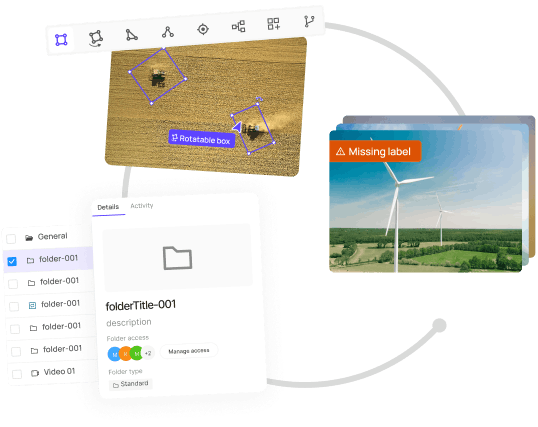
- Encord Annotate: AI-assisted labeling with SAM 3 native integration for segmentation and object tracking, plus model-in-the-loop pre-labeling via GPT-4o and other foundation or custom models
- Consensus review and inter-annotator agreement tracking: running as a continuous process rather than a final gate
- Nested, project-specific ontology management: Scales without drifting as your team and dataset grow
- Encord Curation: embedding-based and natural language search to curate the long tail and surface edge cases before annotators ever touch them
- Label versioning and lineage tracking, so every training run is reproducible
- Enterprise-grade security: SOC 2 and HIPAA compliant, GDPR-aligned, with private cloud integration so your data can stay in your own storage
- Managed annotation services: If you need workforce support layered on top of the platform
Key takeaways
- Labeling data for ML is a workflow with defined stages, ontology, curation, labeling model, pre-labeling, QA, versioning, active learning, not a single task
- Lock your ontology and curate your dataset before labeling starts; both are the most common sources of expensive rework when skipped
- The in-house vs. outsourced and manual vs. AI-assisted decisions depend on task ambiguity and volume, not a one-size-fits-all default
- QA and inter-annotator agreement should run continuously, targeted at ambiguous or high-stakes classes rather than applied uniformly
- The most common failure points at scale are ontology drift, annotator inconsistency, a missing feedback loop to the model, and QA capacity that doesn't scale with volume
- A tool built around this full workflow, not just single-label drawing, is worth prioritizing over point solutions
Frequently asked questions
The core sequence is: define your ontology, curate your dataset, decide your labeling model (in-house, outsourced, or hybrid), set up AI-assisted pre-labeling, build QA and inter-annotator agreement checks, version your labels, and use active learning to prioritize what gets labeled next.
It depends on task ambiguity and volume. In-house labeling suits domain-specific or ambiguous data where a tight feedback loop with the ML team matters. Outsourcing suits high-volume, well-defined tasks where the ontology is stable. Most teams scaling past a pilot use a hybrid of both.
Enough to catch inconsistency on ambiguous or high-stakes classes, without applying uniform review to low-variance, well-defined tasks that don't need it. Inter-annotator agreement tracking helps identify where QA effort is actually needed.
Label quality is a direct input to model performance, not a separate compliance step. Inconsistent or inaccurate labels teach a model inconsistent patterns, which no amount of downstream model tuning fully corrects.
Native support for your data modalities, AI-assisted pre-labeling, customizable ontology management, built-in QA and inter-annotator agreement tooling, label versioning and lineage tracking, and enterprise-grade security.