Reinforcement Learning for Motion Planning: The Next Frontier in AV and ADAS

Co-Founder & CEO at Encord
TL;DR: Reinforcement learning for motion planning teaches AV and ADAS systems to plan maneuvers through trial and error instead of fixed heuristics, which is what makes them adaptive in messy, real-world driving. The main approaches span imitation learning, hierarchical RL, model-based RL with world models, and hybrids like SILP+ that combine classical planning with self-imitation. The recurring bottleneck across all of them is data: collecting enough safe, high-quality, representative experience to train policies that hold up in the real world. This guide covers the approaches, the applications in ADAS and AV, and the data layer underneath.
Reinforcement learning for motion planning is an approach where an autonomous system learns driving or navigation maneuvers through trial and error, optimizing a reward signal rather than following hand-coded rules. The agent explores actions, gets rewarded for safe and efficient outcomes, and gradually learns a policy for planning trajectories in dynamic, unpredictable environments.
The leap from semi-autonomous driving assistance (ADAS) to full autonomy (AV) hinges on a single, complex capability: motion planning. While traditional algorithms excel in structured environments, the messy, unpredictable nature of urban driving requires something more adaptive.
From navigating busy city centres to adapting to lane changes in construction zones, motion planning is critical for the safe deployment of AVs. For example, the model learns when to yield, merge, or re-plan its trajectory in response to unpredictable drivers and temporary lane closures, rather than relying on fixed heuristics.
This is possible due to Reinforcement Learning (RL) or the "brain" that allows vehicles to learn optimal maneuvers through trial and error. However, many machine learning, AV, and ADAS teams face a complex issue. How to get enough high-quality data to train these models safely.
Why does Motion Planning for Autonomous Vehicles need so much data
Training a model for motion planning, especially in safety-critical use cases, requires mountains of data. To master lane changes, intersections, or the many obstacles present on the road, a model needs examples of both expert driving and rare edge cases.
Historically, this meant choosing between two bad options. Human demonstrations are expensive and slow to collect. Random exploration is dangerous in the real world and computationally expensive in simulation. Either way, the constraint is the same: it is hard to gather enough safe, representative experience to train a policy you can trust on the road.
This is the part most teams underestimate. The algorithm matters, but the quality and coverage of the training data are what actually determine how the learned policy behaves. For AV and ADAS teams, that makes the data annotation pipeline as important as the planner itself.
Encord's approach emphasises Active Learning, where the system prioritizes labeling the most informative data points, so the dataset evolves intelligently instead of growing by brute force.
Approaches used for Reinforcement Learning in Motion Planning?
There is no single method. Most production and research systems combine a few of the following
Imitation learning
The agent learns by mimicking expert demonstrations rather than exploring from scratch. It is sample-efficient and safe to train, but it struggles when the vehicle encounters situations the demonstrations never covered, which is why it is increasingly paired with RL. Waymo's work on robustifying imitation with reinforcement learning is a good example of why imitation alone is not enough for the long tail of driving.
Hierarchical reinforcement learning (HRL)
Hierarchical RL splits the problem across levels: a high-level "commander" sets goals (change lane, take the turn) and a low-level "worker" executes the motion. This structure makes long-horizon urban tasks like unprotected left turns and roundabouts far more tractable, as covered in CMU's work on hierarchical RL for AV behavior planning
Model-based RL and world models
Instead of learning purely from real interaction, the agent learns a model of the environment, a world model, and plans against it. This is far more sample-efficient and is one of the most active areas in AV research today.
💡Explore more, see our webinar on world models for Physical AI.
Hybrid planning plus self-imitation (SILP+)
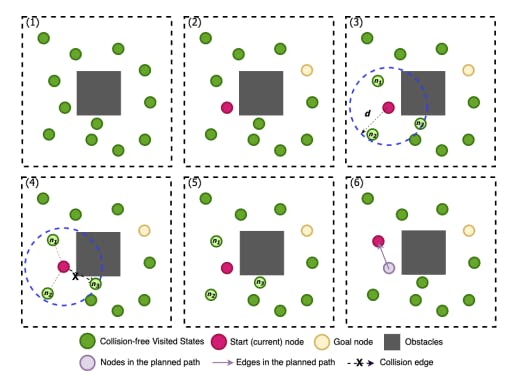
A practical example of combining classical planning with learning is the SILP+ (Self-Imitation Learning by Planning Plus) framework from Luo and Schomaker, introduced in "Reinforcement Learning in Robotic Motion Planning by Combined Experience-based Planning and Self-Imitation Learning". The idea is that a robot or vehicle should not just wait for a human to show it the way, it should learn from its own attempts. SILP+ does this in two ways:
Experience-Based Planning
Instead of discarding unsuccessful trials, SILP+ uses the collision-free segments from real-world attempts and a traditional graph-based planner, such as PRM, to connect them into a successful path. It retrospectively creates an expert demonstration from its own exploration.
Gaussian-Process-Guided Exploration
SILP+ uses Gaussian Processes to predict high-risk collision zones, acting as a cautionary instinct that lets the system explore while proactively avoiding crashes. The authors report meaningfully fewer training collisions as a result.
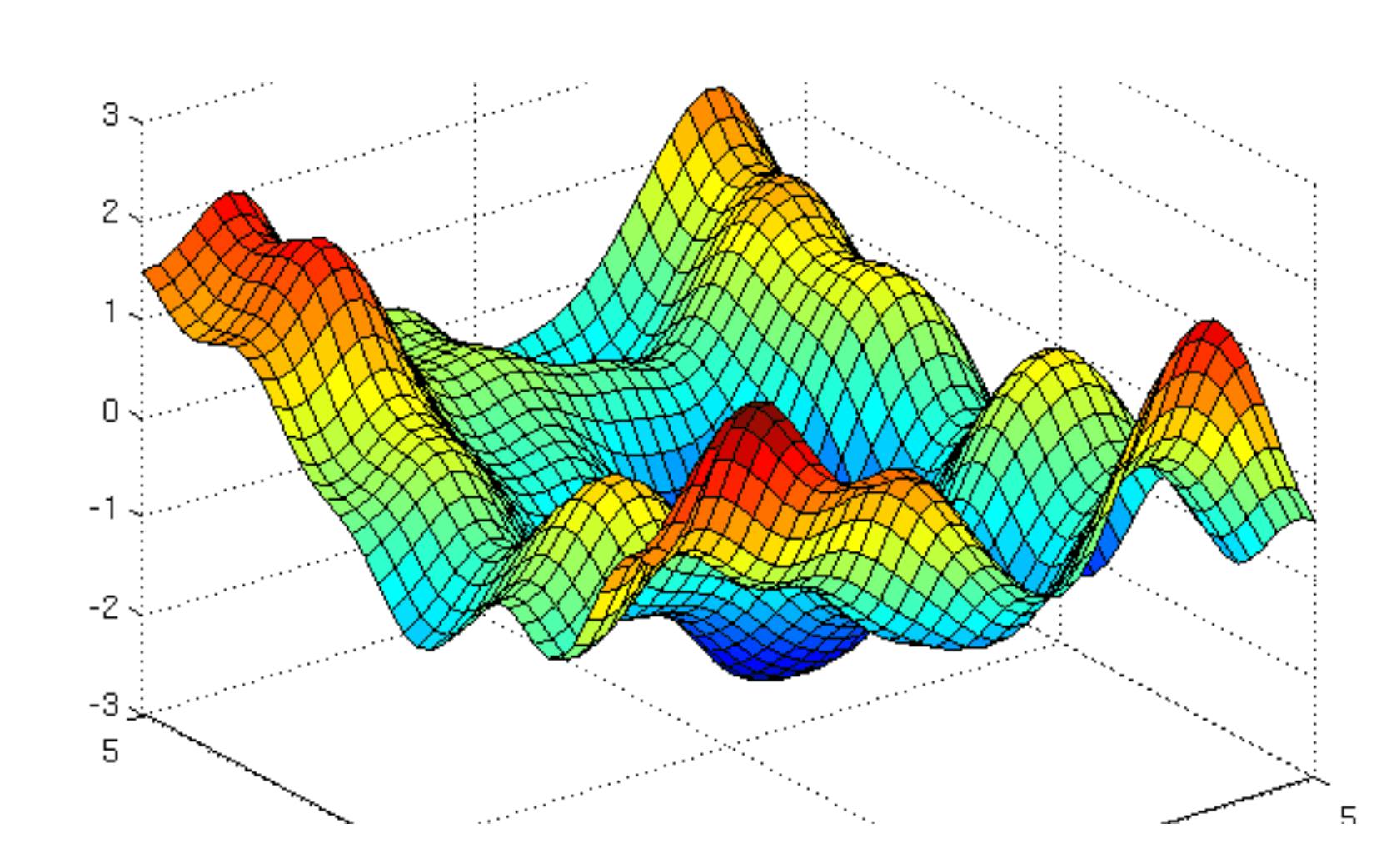
Source: Yuge Shi, "Gaussian Processes, not quite for dummies", The Gradient, 2019.
Applications in ADAS and Autonomous Vehicles
While the SILP+ paper focuses on robotic manipulators, its logic is directly transferable to the automotive world, specifically in Autonomous Driving (AD) and Advanced Driver Assistance Systems (ADAS).
Behavioral Decision-Making
Current ADAS features like Adaptive Cruise Control (ACC) and Lane Keeping Assist (LKA) rely largely on hand-coded rules. RL-based planning allows for more human-like behavior, such as smoothly yielding to a merging car rather than braking abruptly.
Adaptive Cruise Control Example
Complex Maneuvering (Urban Driving)
In dense urban environments, vehicles must make decisions about unprotected left turns and roundabouts. Recent research into Hierarchical Reinforcement Learning (HRL), a structure where a high-level "commander" sets goals and a low-level "worker" executes the motion, helps manage these long-horizon tasks. SILP+ provides a way to train these hierarchies without needing millions of miles of real-world urban driving data.
Sim-to-Real Transfer
One of the biggest hurdles for AVs is the Sim-to-Real gap. Models trained in a lab or on synthetic data often fail when they encounter events that are previously out of distribution. The Reward-based Filter in SILP+ addresses this by ensuring the model only learns from data that genuinely improves its performance, leading to more robust policies when deployed on physical hardware like the UR5e (as shown in the paper) or an autonomous vehicle.
The Future of Reinforcement Learning for Motion Planning
The integration of traditional planning and reinforcement learning represents a paradigm shift. We are moving away from black box RL and toward hybrid systems that are:
- Sample Efficient: Learning more from less data.
- Safety-Centric: Reducing training collisions by 80% through guided exploration.
- Adaptable: Capable of handling dynamic scenarios where goals or obstacles move and change
As we look toward 2026 and beyond, frameworks like SILP+ will be foundational in creating ADAS models that don't just follow rules, but truly understand the flow of traffic.
Key takeaways
Reinforcement learning lets motion planners learn adaptive behavior through trial and error, instead of relying only on hand-coded rules.
The main families are imitation learning, hierarchical Reinforcement Learning , model-based Reinforcement Learning with world models, and hybrids that combine classical planning with learning.
The shared bottleneck is data: it is hard to collect enough safe, representative experience, whether as demonstrations for imitation learning or exploration for RL.
Techniques like guided exploration and self-imitation reduce dangerous trial and error and improve sample efficiency.
For AV and ADAS teams, the practical lever is the data pipeline, since the quality and coverage of training data defines how the learned policy behaves.
Key Resources for Further Reading
- Luo, S., & Schomaker, L. (2023). Reinforcement Learning in Robotic Motion Planning by Combined Experience-based Planning and Self-Imitation Learning. arXiv:2306.06754.
- A Survey of Deep Reinforcement Learning Algorithms for Motion Planning and Control of Autonomous Vehicles (2021).
- Hierarchical Reinforcement Learning Method for Autonomous Vehicle Behavior Planning - Carnegie Mellon University Robotics Institute
- Imitation Is Not Enough: Robustifying Imitation with Reinforcement Learning for Challenging Driving Scenarios.
- Reinforcement learning, defined The core concept.
- ADAS software architecture Where planning sits in the stack.
- ADAS data annotation pipelines How to build the training data this depends on.
- 3D object detection for autonomous vehicles The perception input to planning.
- World models for Physical AI (webinar) The model-based RL connection.
Frequently asked questions
Reinforcement learning for motion planning is an approach where a vehicle or robot learns navigation maneuvers through trial and error, optimizing a reward signal instead of following fixed rules. It is used to plan trajectories in dynamic environments where hand-coded heuristics fall short.
Traditional planners work well in structured environments but struggle with the unpredictability of urban driving. RL learns adaptive, human-like behavior, such as smoothly yielding to a merging car, that is hard to specify with rules.
Imitation learning (learning from demonstrations), hierarchical RL (a high-level planner sets goals while a low-level controller executes), model-based RL with world models, and hybrids like SILP+ that combine classical planning with self-imitation to reduce unsafe exploration.
Data. Collecting enough safe, high-quality, representative experience is hard, since real-world exploration is dangerous and simulation introduces a sim-to-real gap. Data quality and coverage largely determine how the learned policy behaves.