AI Data Collection for Physical AI & Robotics: The Complete Guide

Robotic Learning Lead at Encord
TL;DR: AI Data Collection is the process of gathering raw data and converting it into sensible data that a model can learn from. For most AI policies, that means finding data that already exists. For Robotics, it means creating that data from scratch. Robots learn from episodes of synchronized video, sensor depth, joint state and force data, collected through teleoperation, egocentric video capture, UMI handheld gripper, kinesthetic teaching, simulation data and real-world deployment. Whichever method of data collection you pick, the quality of data collected sets the benchmark on everything that comes after, from annotation to training and model evaluation. Which is why the best datasets come from collection protocols designed around model needs and not by simply recording and collecting as much data as possible.
Every AI model is only as good as the data it's trained on. If a robot keeps misjudging how to grip a cup, the fix is rarely a bigger model; it's better examples of hands gripping a cup. Ask any ML team where their biggest blockers come from, and the answer usually isn't the model itself.
For Large Language Models (LLM's), the data they trained on already existed. Decades of text and multimodal data already sat on the internet waiting to be crawled. Robotics and robot training don't get that head-start. There is no existing catalogue of UMI grippers picking up mugs or humanoids operating in a physical space; you have to collect that data manually first.
This full guide to data collection for physical AI and robotics training covers what data collection is and why the quality of data you capture matters so much. Then explore the sensor data robots learn from, how teams capture it, what separates a usable dataset from a pile of raw footage, and how to avoid the common pitfalls.
What is AI Data Collection?
AI Data Collection is the process of gathering raw data from video, text, images, audio, sensor readings and recorded action to train models on. It is the first stage within the data lifecycle, before annotation, curation and model training. The data you collect, and how carefully you do so, decides what the model learns.
The source of that data depends entirely on the kind of model you're building. Language models can learn from filtered images, videos and text, scraped from the web. Medical-focused and industrial models pull from sensors and scanners using equipment that was never designed with ML in mind. In most cases, the job is closer to simply sourcing than it is to collection. The flywheel is finding the data, cleaning it, getting rights to use it, and then labeling it well enough to train a model on.
Physical AI data capture does not have that luxury. There are no internet-scale archives of robots picking up mugs or folding laundry, so teams have to generate this data themselves.

Why is high-quality data collection important?
It is important to collect high-quality data because the quality of data collected dictates how well the model performs in the real world and the amount of resources you'd invest in retaining post-deployment.
Problems introduced at the data capture stage usually pass through to annotation and training undetected but tend to show up once the model is deployed. Below are examples that showcase how collection quality can affect a model in practice.
- Data collection quality sets the benchmark on model performance: If A model trained to grasp objects learns from data where an operator hesitated, regripped, or drifted off-task, the model will learn to do the same. A better model won't solve that challenge because it's doing exactly what it was trained to do by copying the training data ingested.
- A model only works well in conditions that were covered in its training data: Gaps in the collected data cause model bias. In robotics, imagine you collect everything in one bright lab with one set of mugs; the robot will only do well in that lighting with that cup and fail everywhere else. The model is confident in the world it saw and lost outside it.
- Privacy and compliance start at the point of collection: Methods of Egocentric and in-home data capture can sometimes record sensitive personal information, making consent, anonymisation, and secure data handling core parts of the data collection process. Setting security guardrails at the beginning is far easier than trying to fix privacy concerns after the data has been recorded.
- Strong data collection prevents expensive rework downstream: Every mistake made at the data collection phase gets more expensive to fix later. A missing sensor or miscalibrated camera leads to confusing labels, unreliable training and lowered model accuracy. By then, the only fix is to re-collect data, which is far more expensive in terms of cost and time than getting it right the first time.
What makes Data Collection for Physical AI different?
Data collected to train Physical AI models, as mentioned earlier, has to be collected and recorded because it doesn't exist anywhere already. This data comes in 'Episodes'. An episode is a bounded, synchronised recording of multi-modal sensor inputs and robot actions capturing a single continuous task or any recorded interaction with the physical world.
A typical episode includes:
- Video Capture: Recorded from a camera on its head and a camera on its wrist
- The Depth sensor: real-time depth data providing 3D distance and environmental geometry
- Body Tracking: A high-speed log of how fast and in what direction the robot's arms and joints are moving
- The Touch sensor: Data that showcases how wide a model opens its hands and how hard they squeeze or push an object
- The Commands: Exact recording of the commands it sent to the motors at every step
- Task context: Notes on what the goal of the task was, the operator assisting, the environment it took place in and whether the robot successfully finished the job.
What Data Modalities do Robotics and Physical AI models need?
Robotic models often learn from a mix of RGB video, depth sensors, LiDAR input, proprioception (torques, velocities and joint positioning), force and tactile sensors and IMU (stream and motion) data. Some models also require language instruction inputs. The task required of the model dictates the data inputs. While navigational training for autonomous vehicles or ADAS relies mostly on vision and depth data, dexterous tasks such as picking up a mug require tactile force and joint tracking data inputs
The table below breaks down the main types of data in robotics episodes, what each one captures and what it helps the model learn.
| Modality | Data it captures | Recording frequency | What it trains |
| RGB video (head, wrist, third-person) | Scene, objects, hands, gripper | 15 to 60 Hz | Perception, vision-motor policies, VLAs |
| Depth and LiDAR | 3D geometry | 10 to 30 Hz | Spatial reasoning, grasp and obstacle planning |
| Proprioception | Joint positions, velocities, torques | 100 Hz to 1 kHz | Control, action targets |
| Force and tactile | Contact, pressure, slip | 100 Hz to 1 kHz | Contact-rich manipulation |
| IMU hand grippers | Orientation, acceleration | 100 Hz and up | Locomotion, head and hand tracking |
| Language | Task instructions, narration | Per episode or step | Instruction following |
The most crucial step is aligning all of the above data. Each sensor records and runs streams at a different pace. The wrist camera might deliver 30 frames per second while the joint encoders report 500 times a second and the force sensor at 1,000 times. Before this data becomes useful for training, all of the streams have to be synchronized onto a single consistent timeline. Due to data drift, the alignment needs to be checked at the end of every session.
One simple check to verify alignment: Play the complete episode and watch the moment a gripper touches an object. The spike in force data must line up accurately with the visual contact between the robot and the object in the video within a frame or two. If it doesn't, the streams are out of sync.
What are the main methods of data capture for robotics and physical AI?
Mainstream robotics training relies on 6 key data collection methods: Teleoperation, egocentric video, UMI-Style handheld grippers, kinesthetic teaching, running simulations and collecting data from already deployed models. Controlling a robot directly offers the most accurate data but can be slow and time-consuming. On the other hand, egocentric and UMI hand-grippers provide fidelity and variety useful at scale, allowing teams to collect data anywhere without the need for a robot to be present.
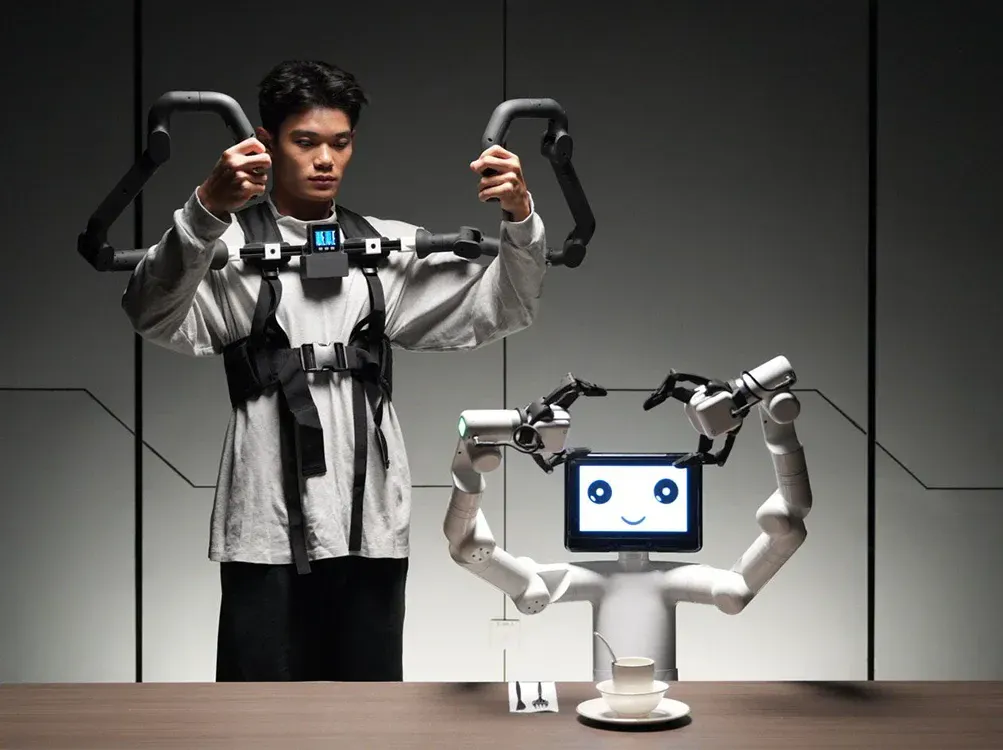
- Teleoperation data collection:
A person controls the robot directly using a VR headset, a leader-following arm setup (ALOHA), or a data glove. Because the robot's sensors record everything, the data comes from the exact robot you're training, reducing the need for retargeting.
The key limitation of this method of data collection is the manpower required. A skilled operator can only produce a limited number of clean episodes in an hour. Another is 'Lag', which is when there is a noticeable delay between the operator's movements and the robot's; people tend to slow down and move more carefully than they normally would, and the model learns to be overly cautious too.
Some of the most useful episodes are the ones that go wrong. A missed Grasp, labeled with what went wrong and when, gives the model useful information about mistakes and how to recover from them.
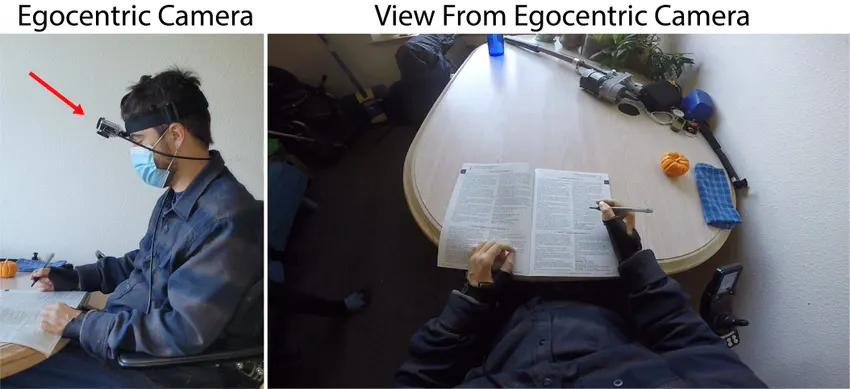
- Egocentric Data:
Data that is recorded by a person wearing a headset, smart glasses or a head-mounted camera while they're going about doing everyday tasks. This data is first-person footage of their hands handling objects, coupled with 3D hand tracking on top. Apple's EgoDex dataset showcases just how far this method of data collection can go (roughly 829 hours of Vision Pro footage with tracking on individual fingers)
The real advantage here is the variety of data this helps collect. Covering hundreds of real kitchen environments instead of one lab. The downfall here is the embodiment gap. A human hand moves differently than a UMI gripper, so the collected footage has to be retargeted before a robot can use it as action data. This is precisely why most teams use it for pre-training and co-training alongside robot data.
- UMI (Universal Manipulation Interface)
UMI is a handheld gripper with a camera mounted on the wrist to match the view from the robot's own wrist camera. The individual holds the gripper and performs the task themselves. As the fingers and camera angle mirror those of the robot's, the data is much more aligned with what the robot will view.
UMI sits between teleoperation and egocentric data capture. The main trade-off is the loss of force and joint torque information, and that such data capture methods work better for simple 2-finger grippers than for dexterous robotic hands.

- Kinesthetic teaching:
Kinesthetic teaching means physically moving the robot's arm through a task while it records the motion. It's the quickest way to capture simple movements like reaching and placing objects. This method, however, fails for fast motions or tasks that need both arms to work together. - Simulation:
Simulation data is created programmatically to model real-life situations and generate high-quantity perfect ground-truth trajectories covering a wide range of scenarios and edge cases that might be hard to replicate in the real world. Simulation data cannot replace data collected in the real world; a model trained only on simulations often fails when it encounters real-world scenarios. This is referred to as the Sim-To-Real Gap - Deployment:
Deployment data comes from robots that are already functioning in the real world. Most of it is routine and adds little to training. The valuable part is the small share that captures failures, near misses and moments when a remote operator had to step in, since those show exactly where the model still struggles
How do you collect training data for AI?
Design your data collection pipeline around the model, not the hardware. Start by defining exactly what the model needs to do, then work backwards to the data, sensors and collection method that will get it there.
That applies to most AI projects. In robotics, these steps get more specific.
Below is an ideal data collection pipeline:
- Define the task and what success looks like. List the tasks and subtasks, and what counts as complete success, partial success and failure. "Put the cup on the shelf" isn't enough. Does a cup that lands on its side count?
- Fix the action representation. Joint positions or end-effector pose? Absolute or delta? Which coordinate frame? Changing this after 500 episodes means reprocessing all 500, and it negatively affects training stability.
- Plan for data variety. Environments, lighting, object sets, operators, starting poses, robot bodies. Operators naturally drift toward whatever setup is easiest, so variety you don't plan for might show up as an edge case for your model once it's deployed.
- Choose the data collection methods. Teleoperation, egocentric data capture, UMI hand-gripper or a mix of 2 or more, based on the task and how much environment variety the model needs to perform accurately.
- Calibrate and sync. Check every sensor, document camera intrinsics and extrinsics, and do a sync check for episode data at the start of every session.
- Standardize the output. Ensure that the data is exported in the same file formats (ROS 2 bags, MCAP or HDF5 are all fine), aligned coordinate frames, same metadata fields, every session.
- Pilot, re-train, then scale. Record a small batch, train a quick model, see what breaks, and fix the protocol before scaling. The first pilot nearly always changes something.
What are the Best Practices for high-quality data collection?
Strong robotics datasets rarely happen by accident. They come from teams that plan for variety, check their setup every session and treat quality, metadata and privacy as part of collection rather than cleanup afterwards.
Here's what the best practices look like in action:
- Plan for data diversity: Ensure the data collected varies in environments, object setups, and collection start positions. Track coverage against this benchmark as you go to ensure alignment.
- Record failures, not just successes: If every demonstration is perfect, the robot never learns what to do after a slip or a half-closed grasp, so it freezes at the end of the task. A healthy number of failure episodes teach it to keep going.
- Keep Human-Operators consistent: Two operators might approach the same task differently, eg: one may grip a cup from above and the other from the side, producing a robot that hesitates before the action. Creating short operator guidelines and spot-checking episodes helps prevent a policy from failing at specific tasks.
- Check Calibration and sync at every session: Hardware and camera set-ups may slip slightly during sessions, resulting in data drift. A quick check before each session can catch such issues early.
- Write metadata at capture time: Log the task, operator, environment, object set, hardware version and outcome as each episode is recorded. Filling it in later from memory is rarely accurate, and you'll rely on this information to filter and curate your dataset for training.
- Version all of the collected data: Track versions of your raw recordings, processed data and labels so you can always trace which data trained which model. This makes it far easier to debug problems or reproduce results later. Our guide to data versioning covers this in more detail.
- Build Consent and privacy into your capture setup: This matters most for egocentric and in-home data capture recordings where sensitive information gets easily caught on camera.
- Use simulation to expand the breadth of data collected and not to replace real-world data: Simulation's approximate friction, contact and sensor noise, so a grasp that works perfectly in simulation can still fall short in deployment. Techniques like domain randomization, which vary conditions such as lighting, textures and physics during training, help narrow the sim-to-real gap but don't close it. The most reliable approach is to use simulated and synthetic data for pre-training and rare scenarios, and real data for fine-tuning and evaluation.
What are the biggest challenges in AI Data Collection?
Most AI teams struggle with the same challenges: Finding the right data, protecting privacy, avoiding data bias, and working with limited time and expertise. Physical AI makes these challenges harder and adds two new ones: keeping sensors in sync and reducing the sim-to-real gap. Here's how each one shows up in practice:
- Access (The data needed for robotics training doesn't exist yet): In most AI cases, the access problem is collecting scattered, incompatible formats of data. In robotics, you must record the required episode data first, since public datasets rarely match what you need to train the model, sensors, or tasks.
- Privacy: Egocentric and in-home data collection captures people, faces, documents and sensitive information by default. Prevent privacy issues by setting clear guidelines for how data is stored from day 1.
- Bias (Coverage gaps): A biased robotics dataset looks perfectly fine at first glance. The issues come up when all data is recorded in a dimly lit warehouse, a cup with an odd handle, or a right-hand demonstration only. Training data reflects the quality of the model; build variety into your dataset to train robots better and prevent bias.
- Sync Drift: Multi-sensor rigs may drift out of alignment during data collection. At first, it may not look broken, but the model then learns slightly wrong cause and effect. Regular sync checks can help prevent such drift.
- The Sim-to-Real Gap: Models trained on simulation data only tends to fail when it interacts with the real world. Simulators can't perfectly reproduce real-world physics, lighting, friction and sensor noise. Using techniques like domain randomisation, which varies conditions during simulated training so the model learns to handle uncertainty. The most reliable approach, though, is to combine simulated data with real-world data, using simulation for pretraining and rare scenarios, and real data for fine-tuning and testing.
How to annotate egocentric video and teleoperation data?
Different collection methods need different approaches to labeling. Egocentric video is usually annotated for hand pose, hand-object contact and action segments, along with short description texts of each step in the task.
Teleoperation data is typically reviewed per episode; annotators ensure whether a task succeeded, where each episode begins and ends and what went wrong in failed attempts. Whatever the method of annotation, labels need to remain consistent across the full length of an episode, across every camera view, or else the model ends up learning conflicting signals.
Labeling Egocentric video data:
In egocentric video, the camera moves with the wearer's head, and their hands sit in the middle of the frame; the common labels are:
- 3D Hand keypoints: Left and right hands labeled accurately
- Contact Events: Marking exact frames where fingers and object interact
- Object tracks: Tracking that stays attached to the right object even when it is briefly hidden.
- Action segments: Split video into individual steps and label each one with an action description pair, like 'open drawer' or 'pour water'
- Short captions: Describing each step, used to train language models
The biggest challenge in labeling egocentric video data is 'self-occlusion'. When someone grabs a mug from above, their hand hides most of the mug, and the headset hand tracking often drops out at exactly that moment. Annotators must mark those frames as occluded instead of guessing. A guessed label might look clean in the dataset, but teaches the model something that isn't true.
Labeling Teleoperation video data:
As the robot may already log its own sensor and joint state actions, teleoperation data rarely needs frame-by-frame motion labels. Most of the work happens at the episode level.
- Outcome: Whether the task was successful or failed
- Phase boundaries: Where each stage of the task starts and ends, such as reach, grasp, move and place.
- Failure reasons: Timestamped labling that shows when and why something went wrong.
- Instruction captions: A set of instructions describing the task, used to train Vision-Language-Action (VLA) models.
Tips for labeling both forms of data:
- Define exactly where each phase starts: Does the 'grasp' begin at first contact, or when the gripper is fully closed? If two annotators answer this differently, the model learns blurry instructions at the time of action
- Check annotator agreement before scaling: Have several annotators label the same sample and compare outcome results. This way, inconsistencies are caught early rather than discovered in the late stage of annotation across thousands of episodes.
- Keep humans in the loop: Automated pre-labeling speeds up the process, but contact events are where things most often go wrong. Keep humans in the loop for review.
How to choose the right AI data collection partner?
An ideal data collection partner would design the protocol around your training pipeline, capture the methods and sensor data that you need and deliver synchronised episodes your stack can use. The strongest partners also curate and annotate, and they feed field failures back into what gets collected.
Key questions worth asking in any evaluation:
- Will they build the protocol around your model and action format, or hand you a generic one?
- Can they run teleoperation, egocentric and UMI data capture, or only one of them?
- How do they keep sensors on one clock, and how often do they check it to prevent sensor drift?
- Can video, point clouds, joint state and force data be viewed and labeled together in their original formats?
- Do collection, curation and annotation happen in one place, or across three tools with exports in between?
- When your robot fails in the field, how does that change the next round of collection?
- How is sensitive data handled? Does it stay in your own cloud or on your own infrastructure?
How does Encord deliver end-to-end physical AI training data?
Encord collects teleoperation, egocentric and UMI data, then curates, annotates and manages it on one platform. Episodes go straight from capture into curation and annotation with no separate ingestion step, and failures found in the field update the next round of collection and annotation.
In practice, that looks like this:
- Collection: Programs start at Encord's own facilities, with reconfigurable sets, teleoperation arms and standardized hardware, and can move on-site to a customer's factory or warehouse. Protocols are designed backwards from the customer's training pipeline, so episodes arrive classified and synchronized.
- Curation: Curation runs before and after annotation, surfacing edge cases and trimming redundant episodes across video, LiDAR, point clouds and sensor data.
- Annotation: Multimodal annotation covers images, video, LiDAR, point clouds and audio, including action captioning, subtask labels and vision-language model pre-captions reviewed by people.
- Feedback:Remote teleoperation captures failure modes in the field, and those failures update collection and annotation policies.
- Data Security: Data can stay in your own cloud, with VPC and on-prem options for teams that can't move sensor data off their infrastructure.
Get the data right before you scale your model
The teams that ship reliable robots tend to share one habit. They decide what data the model needs before they build the rig, and they treat collection as the first turn of a loop rather than a job that ends when the drives are full.
If you remember one thing from this guide, make it the order: model first, protocol second, collection third. Almost everything else gets easier when those line up.
🚀 Ready to plan your collection program?
Design your collection protocol with Encord's Physical AI team and see what first capture to training-ready data looks like for your robot.
Explore more resources:
Frequently asked questions
AI data collection is gathering the raw data a machine learning model trains on, such as text, images, video, audio, sensor readings or recorded actions. For robotics and physical AI, it means recording real-world interactions as synchronized sensor streams paired with the actions taken.
Start from what the model needs to do, define the inputs, outputs and success criteria, then choose sources or capture methods that fit. Pilot a small batch, train a quick model to check the data works, and scale once it does. For robots, the usual methods are teleoperation, egocentric video and UMI capture.
The best fit covers the whole loop, from collection through curation, annotation and data management, for video, sensor and point cloud data in one place. Encord is built for this: it collects teleoperation, egocentric and UMI data and manages it on the same platform physical AI teams train from.
Look for a tool that handles long first-person video, 3D hand keypoints, object tracks through occlusion and action segments with captions, plus model-assisted pre-labeling. Encord supports multimodal video annotation with vision-language model pre-captions reviewed by human annotators.
Teleoperation data needs a platform that keeps video, joint state and force streams in sync, supports episode-level review and failure tagging, and feeds new failures back into collection. Encord collects and manages teleop data end to end, from facility capture through curation and annotation.