Multimodal Data Labeling: One Pipeline for Image, Video, Audio, Text and 3D

Head of Forward Deployed Engineering at Encord
TL;DR: Multimodal data labeling means annotating two or more data types in one workflow so a label in one format (a 2D box) stays consistent with its counterpart in another (a 3D cuboid, a video track ID). Most quality failures happen at the seams between modalities, not within a single one, so cross-modal QA matters more than per-modality accuracy.Running separate labeling projects per modality and merging the outputs afterward is the most common way teams break their own training data.
What is Multimodal Data Labeling?
Multimodal data labeling is the process of annotating two or more data types, such as image, video, audio, text, and 3D, within a single workflow so that labels stay consistent and cross-referenced across formats. A bounding box on a camera frame has to mean the same object as the 3D cuboid in the paired LiDAR scan, captured at the same instant. When tooling is fragmented across formats, that consistency breaks, and a model trained on inconsistent labels can't learn reliable cross-modal relationships no matter how much data you throw at it.
Production AI is multimodal by default now. Vision-language-action models for robots take in camera frames, depth, and language instructions at once. Autonomous vehicle stacks fuse LiDAR, radar, and camera. Healthcare AI reads imaging alongside physician notes. If your labeling pipeline treats each format as a separate project, you're building a dataset that looks correct in isolation and falls apart wherever the modalities are supposed to agree.
For a deeper understanding of data labeling, read our comprehensive guide on 'What is Data Labeling'
What counts as multimodal data in 2026?
5 data types make up the bulk of multimodal training data today: image, video, audio, text, and 3D/sensor data. Each one carries its own annotation techniques, and each one shows up differently depending on what you're building.
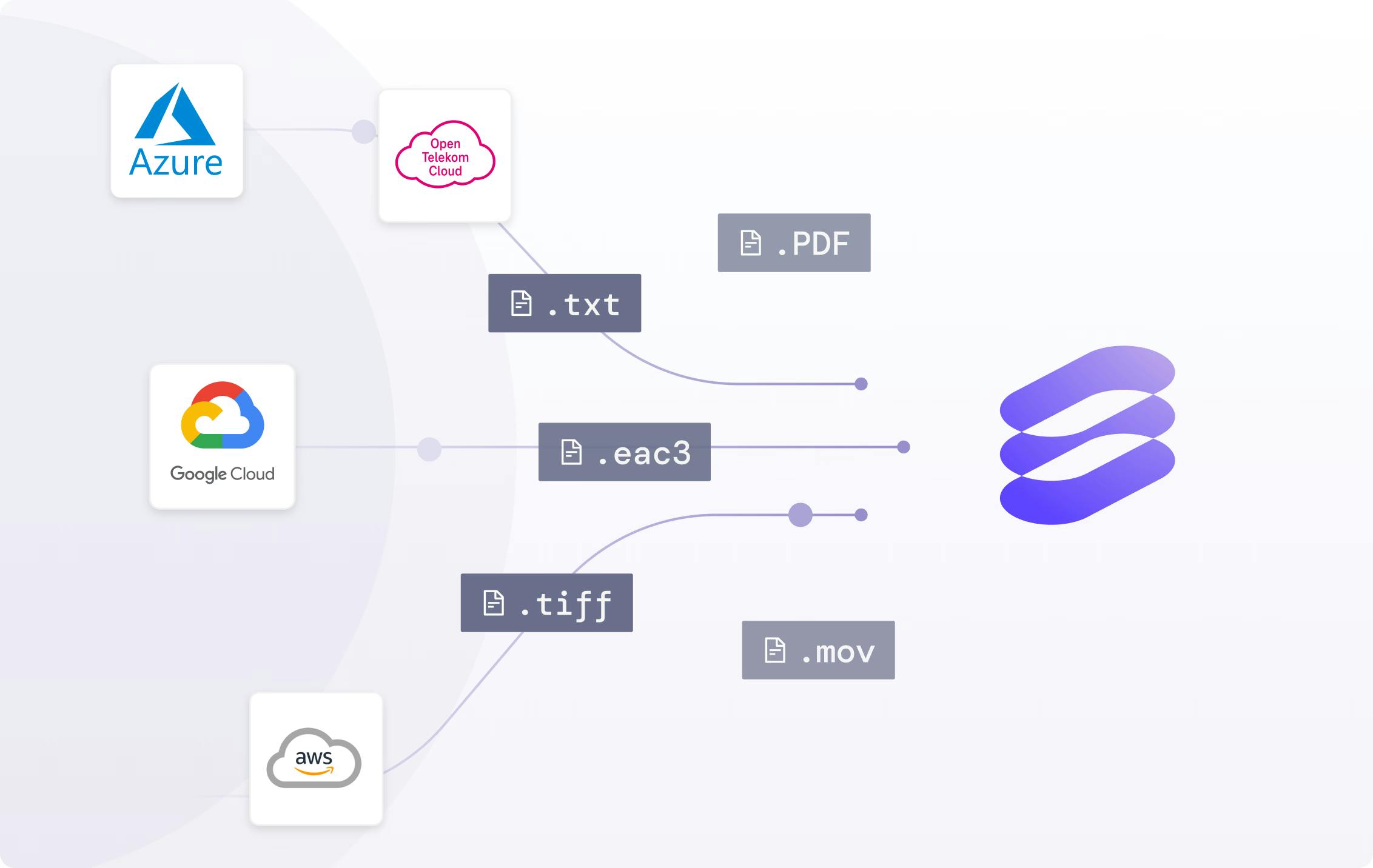
Multimodal Data supported by Encord
Image: This Type of Data anchors most multimodal projects, bounding boxes, polygons, segmentation masks, keypoints. However, in a Physical AI context, image labels are often the reference frame that 3D and video annotations get aligned to. A warehouse robot's perception stack starts with labeled RGB frames before anything else gets fused in.
Video : This Data adds the time dimension factor; object IDs have to stay consistent across frames through occlusion, and timestamps become the synchronization backbone for whatever audio or sensor data runs alongside it.
Robotics teams building imitation-learning datasets from teleoperation footage depend on this, a "grasp the mug" action label needs a clean start and end frame, not just a box around the mug.
Audio: Audio Data overs transcription, speaker diarization, sound event detection, and emotion tagging.
In Physical AI, audio annotation shows up more than people expect: acoustic anomaly detection on factory floors, wake-word and voice-command labeling for humanoid robots, siren and emergency-vehicle detection for AV perception stacks.
Text and documents need entity recognition, intent classification, and document layout parsing.
For robotics specifically, this is where natural-language instructions get aligned to the visual and action data in a VLA (vision-language-action) training example, the instruction "pick up the red mug" has to map to the right frame and the right end-effector trajectory.
3D and sensor data : LiDAR, radar, depth, IMU, is where multimodal labeling gets hardest, and where Physical AI teams spend the most annotation budget. A 3D cuboid has to match its 2D bounding box in the same camera frame despite different coordinate systems and different capture rates.
For a deeper, modality-by-modality breakdown of annotation techniques, see Encord's complete guide to data labeling for robotics, which covers action labels and VLA-specific annotation in more depth than this piece does.
Why does labeling each modality separately fail?
The most common mistake teams make is running independent single-modality projects and merging the outputs afterward. It produces datasets where every individual label is technically correct and the dataset is still broken, because nothing enforces agreement between formats.
3 failure points show up consistently:
- Temporal misalignment. Sensors run at different clock speeds, LiDAR commonly at 10Hz, cameras at 30fps, radar at 20Hz. Even a small timestamp offset compounds on a moving platform, and at highway speeds a fraction-of-a-second drift can shift a labeled pedestrian's position by more than a meter.
- Ontology drift. When different teams label different modalities against different guidelines, the same real-world entity ends up meaning something slightly different in each format. "Pedestrian" needs to be the same concept whether it's a 2D box, a 3D cuboid, or a video tracking ID, and that only holds if the taxonomy is defined once, upfront, across all modalities rather than reinvented per team.
- QA blind spots at the boundary. Standard QA checks whether a label is correct within its own modality. It doesn't check whether the 3D cuboid actually corresponds to the 2D detection of the same object, or whether a caption describes what's actually in the paired image. Most multimodal quality failures happen exactly at these seams, which is why cross-modal QA has to be a distinct review step, not an assumption that per-modality accuracy adds up to dataset quality.
A 2025 Research on systematic review of multi-sensor fusion in Autonomous driving (MDPI, 2025), identifies spatio-temporal misalignment as one of the central deployment challenges for fused perception systems, alongside domain shift and the scarcity of labeled multimodal data for edge cases.
The annotation pipeline is where that misalignment either gets caught or gets baked into the training set.
| Requirement | What it looks like in practice | What breaks without it |
| Shared ontology across all modalities | "Pedestrian" means the same thing in a 2D box, a 3D cuboid, and a video track ID, defined once, upfront | Labels are individually correct and collectively incoherent |
| Unified timeline for sensor fusion | Camera, LiDAR, and audio streams on one scrubber, not five browser tabs and a spreadsheet to reconcile them | Annotators manually eyeball timestamp alignment, and errors compound |
| Cross-modal QA | A review step that checks whether formats agree with each other, not just whether each label looks right alone | Quality gaps between formats surface only after training, when they're expensive to fix |
| Native format support beyond image/video | DICOM, NIfTI, and point cloud formats (PCD, PLY, MCAP, ROS bag) handled natively, not converted first | Medical and robotics teams lose fidelity or time in format conversion before labeling even starts |
Encord's platform builds the second requirement directly into the interface: on the 3D and LiDAR product, camera, LiDAR, and radar streams are synchronized on one unified timeline, with labels linked and timestamps aligned from the start rather than reconciled after the fact. With automated pre-labeling so annotators are confirming and correcting objects rather than drawing from scratch.
What does labeling look like for each Data Modality?
Image data in a multimodal pipeline usually serves as the anchor that other modalities align to.
Encord supports bounding boxes, polygons, bitmasks, and nested ontologies in one label editor, with the option to bring in models like SAM for auto-segmentation as a starting point rather than a from-scratch draw.
Video annotation needs object IDs that survive occlusion across hundreds of frames. This is where a lot of point-solution tools force frame-by-frame labeling, which is exactly the bottleneck Archetype AI hit before consolidating onto one platform ).
Audio annotation covers transcription, diarization, and event detection, and in a genuinely multimodal project it needs to sit on the same timeline as the video or sensor stream it's paired with, not in a separate tool that has to be reconciled by hand afterward.
Text and documents call for entity recognition, intent classification, and document layout parsing. This is also where the risk of caption-image misalignment shows up hardest: if a text label doesn't accurately describe its paired image, models learn to hallucinate content that isn't there.
A 2024 analysis of caption precision and recall in text-to-image model training found that caption precision, how accurately a caption reflects what's actually in the image, has a more significant impact on model training than recall, which is a strong argument for QA that checks text-image agreement specifically, not just whether a caption is well-formed on its own. (Arxiv, 2024)
3D and LiDAR is the hardest of the five, and it's the one most competitors in this space handle worst or not at all. Native ingestion of raw point cloud formats, pre-labeling across every frame, and HITL review with multi-frame and cross-sensor context are what separate a real 3D pipeline from bounding boxes bolted onto a 2D-first tool.
Where does multimodal data labeling show up in production?
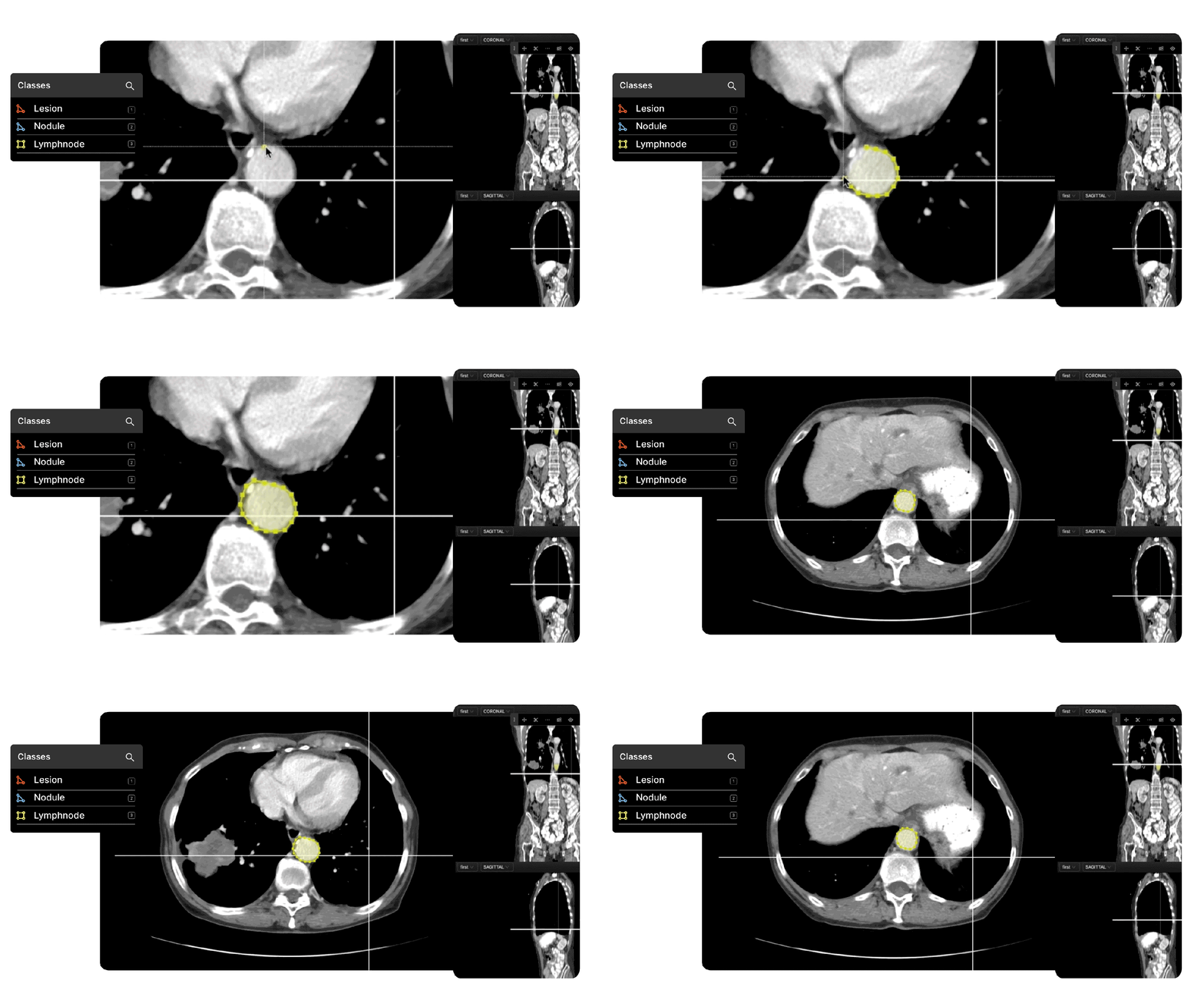
Autonomous vehicles and ADAS run on fused camera, LiDAR, and radar data, where a single test vehicle can generate large volumes of raw sensor data per day. Getting 2D and 3D labels to agree at the same timestamp is the difference between a perception model that generalizes and one that doesn't.
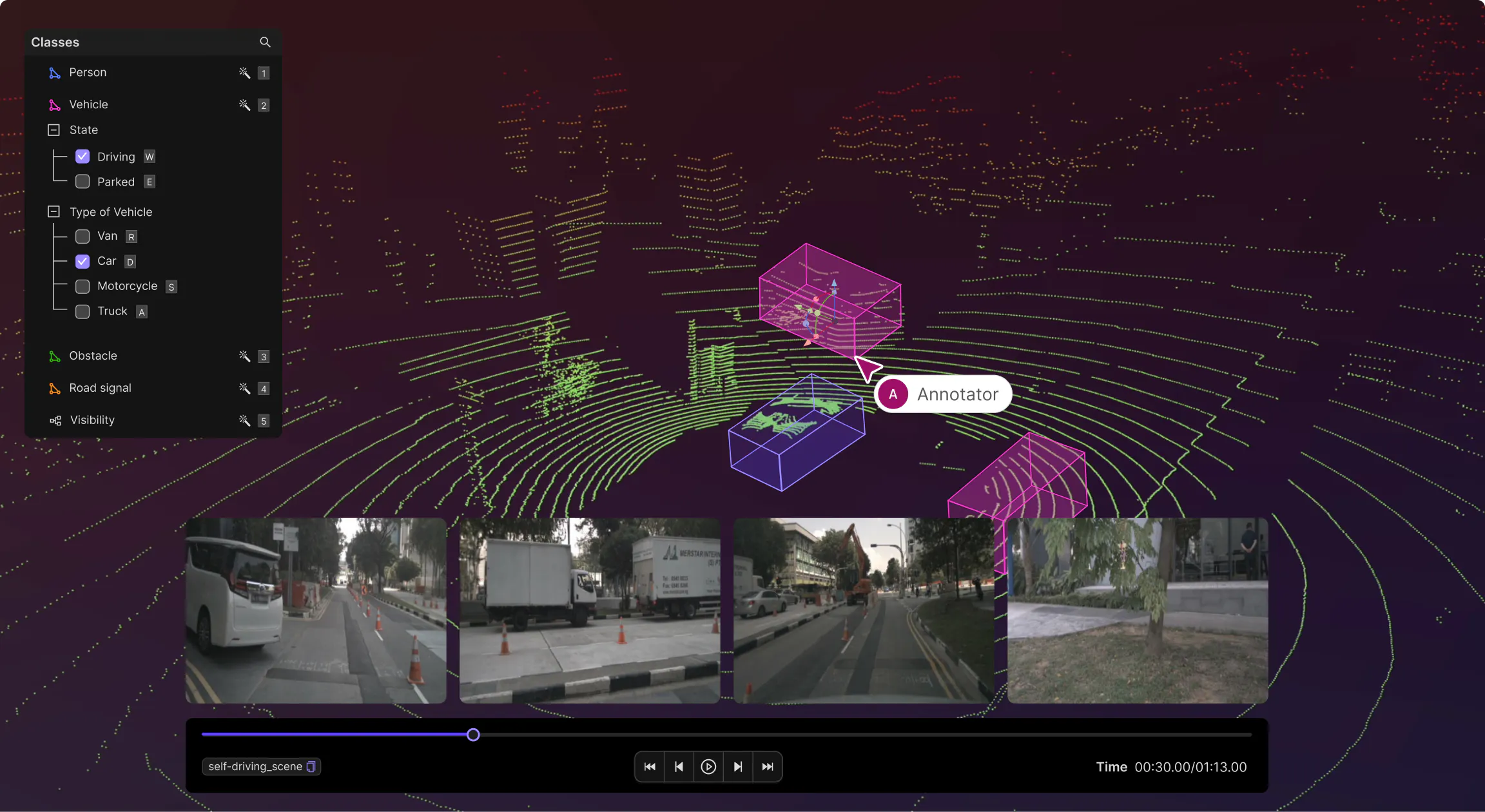
Robotics and warehouse automation pair RGB and depth cameras with action and language labels for VLA models. A robot learning to sort pallets needs the visual scene, the instruction, and the action sequence aligned in the same training example.
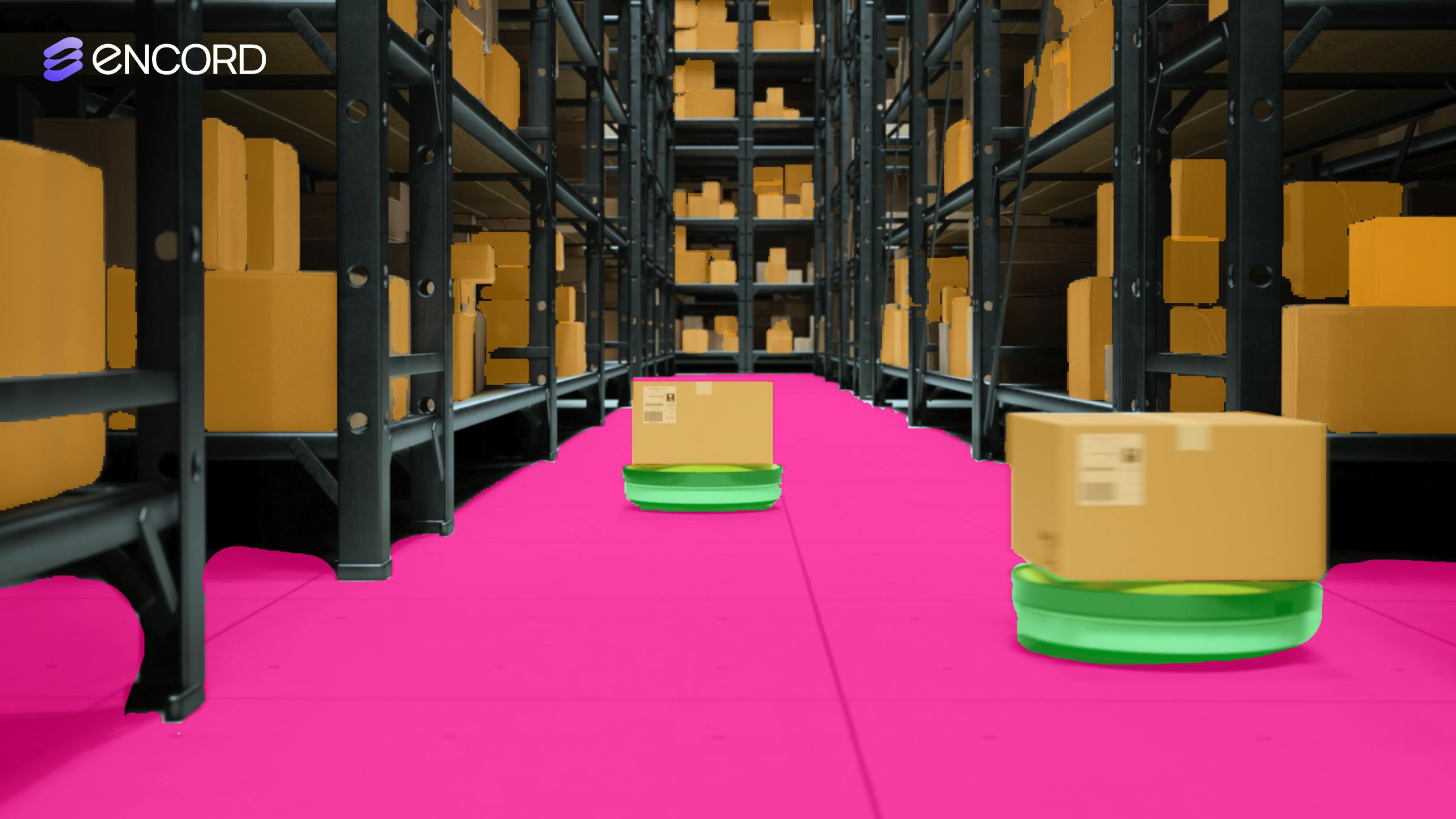
Healthcare and medical imaging combines DICOM scans with physician notes and, increasingly, audio dictation. Radiology-specific pixel fidelity matters here, most annotation tools cap out at 256 pixel intensities where DICOM data can carry over 20,000.
Retail links product imagery to text attributes and, for in-store applications, video feeds to planogram data for shelf monitoring. Visual search and recommendation models both depend on image-text pairs staying accurately linked.
Should you build or buy a multimodal labeling pipeline?
"Build or buy" is one of the first questions almost every team asks once a multimodal project moves past a prototype, and it's rarely as simple as picking a lane and sticking with it, since the right answer depends more on team size and maintenance than on the pipeline itself.
Building an in-house multimodal pipeline means solving format ingestion, timestamp synchronization, ontology management, and cross-modal QA as engineering problems before you've labeled a single frame, and then maintaining all of it as sensor configurations and modalities change. Teams that go this route usually underestimate the ongoing maintenance burden, not the initial build; a working prototype is not the same as a pipeline that holds up at scale and across annotators.
Buying gets you the unified timeline, shared ontology tooling, and cross-modal QA workflows on day one. The tradeoff is less control over the exact interface, and the fit depends on your specific requirements. For most teams outside of the handful of AI labs building annotation tooling as a core product, buy wins on time-to-first-labeled-dataset.
What should you look for in a multimodal labeling tool vendor?
If you've decided to buy rather than build, the pipeline requirements translate into a short list of questions worth asking any vendor before a contract:
- Does it ingest your formats natively, or convert them first? Format conversion is where fidelity gets lost, Enquire specifically about DICOM, NIfTI, and raw point cloud formats (MCAP, ROS bag, PCD, PLY) rather than accepting a generic "yes, we support 3D."
- Is cross-modal QA a distinct workflow, or bolted onto per-modality QA? Ask to see the review interface, not just hear about it. If reviewers can't see multiple modalities and multiple frames at once, cross-modal disagreement won't get caught before it reaches your training set.
- Where does your data live during labeling? For regulated data (healthcare, defense, anything under GDPR), confirm whether the platform requires data migration or works against your existing cloud storage. Encord's platform is API/SDK-first with no data migration required, and holds HIPAA, SOC 2, and GDPR compliance.
- Can you see labeling quality in real time, or only after export? Real-time annotator analytics and consensus scoring let you catch a drifting annotator or a bad taxonomy decision in week one instead of after the dataset ships.
- What happens to your ontology as your model evolves? Ontologies aren't static, ask how the platform handles adding a new label mid-project without forcing a full re-label of existing data.
This is also where inter-annotator agreement (IAA) earns its place as a hard requirement. A 2026 computer vision research mentions that Label quality is now the primary bottleneck for tasks like object detection, which makes a platform's approach to measuring and surfacing annotator disagreement a genuine buying criterion, not a checkbox (Arxiv,2026).
Key takeaways
- Multimodal data labeling is the labeling of two or more data types in one workflow, with consistency across formats as the defining requirement, not just format support.
- Temporal misalignment, ontology drift, and QA blind spots at modality boundaries are the three places multimodal pipelines break most often.
- A real unified pipeline needs a shared ontology, a synchronized timeline across sensor streams, cross-modal QA, and native support for formats beyond image and video.
- Building this in-house is a maintenance commitment, not just a build project, most teams underestimate the former.
- Evaluating a vendor means checking native format support, cross-modal QA depth, data residency and compliance, and how labeling quality is surfaced in real time.
Read more
- Ultimate Guide to data labeling - Approaches and challenges
- Data Labeling for Robotics: The Complete Guide
- How to Label and Analyze Multimodal Medical AI Data
- Encord's Multimodal Data Annotation Platform
- Encord's 3D & LiDAR Platform
Frequently asked questions
Unimodal labeling annotates a single data type in isolation, just images or just audio. Multimodal labelling annotates two or more data types and, critically, the relationships between them, so that a label in one format remains consistent with its counterpart in another.
Parts of it can. Pre-labeling and active learning speed up throughput significantly, and Encord's automated pre-labeling on 3D scenes is one example. But cross-modal consistency checks, ambiguous scene interpretation, and domain judgment still need human review, especially in safety-critical applications like autonomous driving and healthcare.
You need a platform that natively ingests all your target formats (image, video, audio, text, DICOM, point cloud), enforces a shared ontology across them, and runs cross-modal QA rather than per-modality QA in isolation. Encord handles image, video, audio, document, DICOM, and 3D/LiDAR data in one workflow with a unified sensor timeline and nested ontologies, which is the specific gap most single-modality tools leave open.
Merging separately labelled formats produces a dataset where every label is individually correct but not necessarily consistent across formats. True multimodal labeling enforces that consistency during annotation, through a shared ontology and cross-modal QA, rather than trying to reconcile it after the fact.