What Is AI Data Labeling? Definition, Types and the Process

TL;DR: AI data labeling is the process of tagging raw data (images, video, text, audio, sensor streams) with the context a machine learning model needs to learn from it. It's the step that turns unstructured data into training data, and it underpins everything from computer vision to LLMs to robotics. Labeling has also become a strategic bottleneck rather than a back-office task: the global AI data labeling market is projected to grow from roughly $2.3 billion in 2026 to $6.5 billion by 2031 (Mordor Intelligence, 2026) and quality here directly caps model performance, no amount of model tuning fixes bad labels.
What is AI data labeling?
AI data labeling is the process of adding meaningful tags, annotations, or classifications to raw data so that a machine learning model can learn from it. A label might mark a stop sign in a photo, transcribe a sentence of speech, tag the sentiment of a product review, or rank one AI-generated response as more helpful than another. Whatever the format, the label gives the model something concrete to learn from instead of undifferentiated noise.
Labeling sits between raw data collection and model training in the AI development lifecycle. A model can only be as accurate as the labels it was trained on, "garbage in, garbage out" is one of the oldest and most accurate sayings in machine learning, and it applies just as much to a frontier LLM's preference data as it does to a bounding box on a stop sign.

Why does AI data labeling matter?
The link between label quality and model performance
Labeled data acts as ground truth: the reference a model is trained and evaluated against. If the labels are inconsistent, biased, or wrong, the model doesn't just perform worse, it learns the wrong patterns with full confidence. A model trained on sloppy labels won't announce that it's unreliable. It will quietly make bad predictions in production, and by the time that shows up in a metrics dashboard, it's already shipped.
How does labeling quality get measured?
| Metric | What it measures | Where it's used |
| Precision and recall | How many positive predictions were correct, and how many actual positives were caught | Classification, NLP, detection tasks |
| Intersection over Union (IoU) | How closely a predicted spatial label overlaps with ground truth | Bounding boxes, segmentation masks |
| Inter-annotator agreement (IAA) | How consistently different labelers agree on the same item | Flags unclear instructions or genuinely ambiguous cases before they poison a training set |
| Label noise rate | Proportion of labels that are objectively wrong on review | Auditing, QA sampling |
| Preference agreement rate | How consistently human raters agree on which of two model outputs is better | RLHF and LLM alignment pipelines |
None of these metrics matters in isolation. They matter because they catch labelling problems before they get baked into a deployed model.
How does AI data labeling work?
Labeled vs. Unlabeled data
Labeled data has both the raw input and the correct output attached (an image plus "this is a cat"). Unlabeled data is just the raw input on its own. Supervised learning, which powers most production ML systems, needs labeled data to train on. Unsupervised learning works with unlabeled data to find patterns without being told what to look for. Semi-supervised approaches sit in between, using a smaller labeled set to guide learning across a much larger unlabeled one.
The labeling-to-training feedback loop
Labeling isn't a one-time task before training starts. It's a careful loop:
- Raw data is collected and ingested.
- Data is labeled, either manually, automatically, or through a hybrid workflow.
- Labels go through review and quality assurance.
- The labeled dataset trains or fine-tunes a model.
- The model's failure cases (its lowest-confidence or most-wrong predictions) get routed back into the labeling queue to close the gap.
That last step matters more than most teams expect early on. The highest-leverage labels are usually the ones covering a model's current blind spots, not the next batch of easy, already-well-represented examples.
Data preparation, including labeling, is estimated to account for up to 80% of an AI project's total time (Big Data & Society, 2024) and this feedback loop is usually where that time compounds, teams that treat labeling as a one-off task end up re-running it every time the model finds a new failure mode.
What's the difference between data labeling and data annotation?
In most day-to-day usage, data labeling and data annotation mean the same thing, and you'll see them used interchangeably across the industry. Where teams do draw a line,
"Annotation" is sometimes used as the broader umbrella term (any process of adding context to data) "Labeling" refers specifically to assigning a class or category.
In practice, this distinction rarely changes how a team actually works, so don't spend much time on the terminology. Spend it on the label quality instead.
What are the main types of AI data labeling?
| Data type | Common techniques | Typical use cases |
| Image and video | Bounding boxes, polygons, segmentation masks, keypoints, tracking | Object detection, autonomous vehicles, medical imaging, quality inspection |
| Text and NLP | Named entity recognition, sentiment classification, part-of-speech tagging, span labeling | Chatbots, search, translation, content moderation |
| Audio | Transcription, speaker diarization, sound event classification | Speech recognition, call center analytics, voice assistants |
| Multimodal | Synchronized video + audio + text, cross-modal grounding | AR/VR scene understanding, embodied AI, video search |
| Sensor / robotics | LiDAR and radar point-cloud labeling, 3D cuboids, action segmentation, teleoperation log annotation | Autonomous vehicles, warehouse robots, humanoids, VLA models |
| Preference data | Response ranking, safety flagging, reward modeling | RLHF, LLM alignment, chatbot quality control |
Image and Video labeling
Covers bounding boxes, polygons, segmentation masks, and keypoints, used to teach models to detect, classify, and track objects. Video labeling adds a temporal dimension: labels need to stay consistent as objects move, get occluded, and reappear across frames.
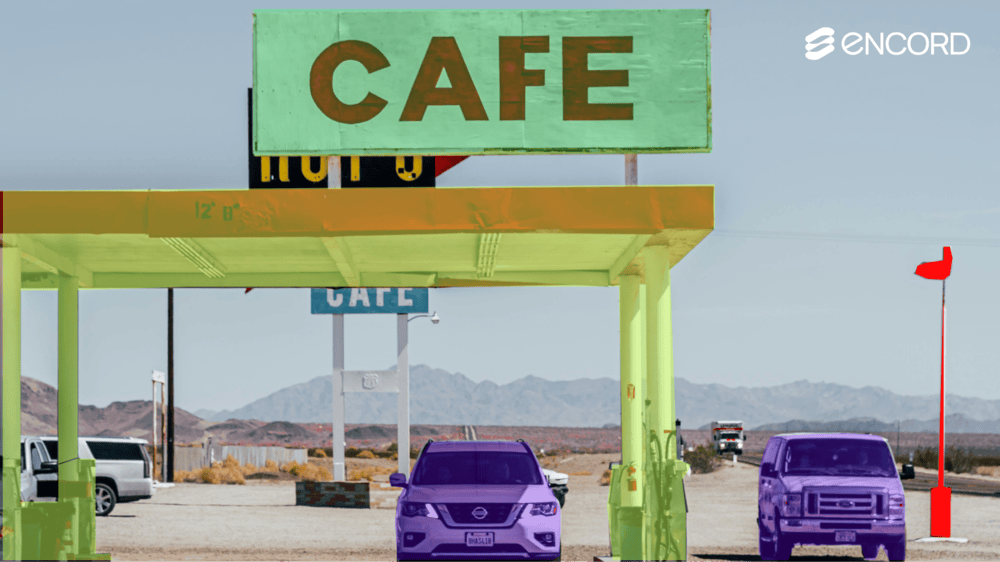
Labeling Image data with Encord
Text and NLP labeling
Involves named entity recognition, sentiment classification, and part-of-speech tagging, used to train models for chatbots, search, translation, and content moderation.
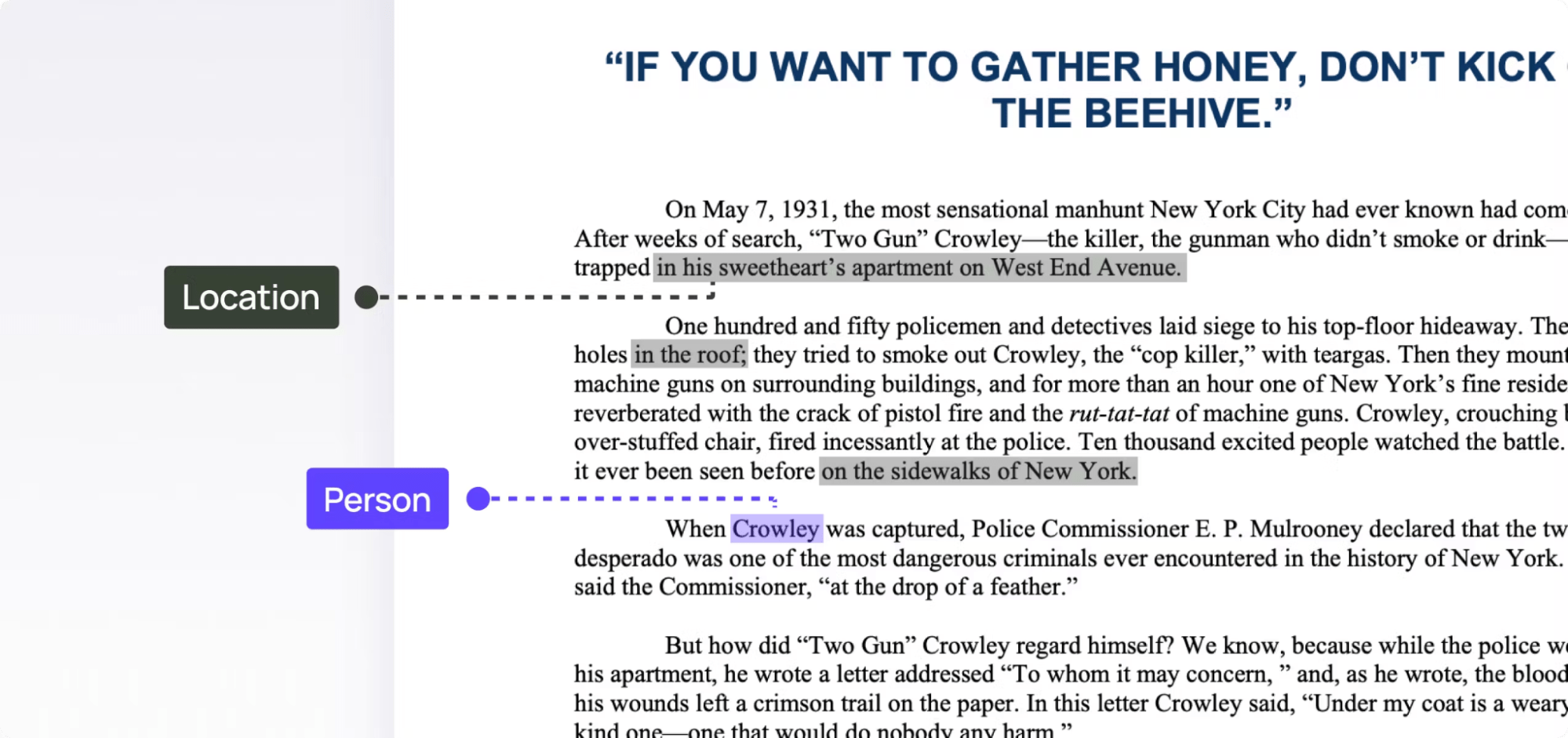
Labeling Text data with Encord
Audio labeling
Typically starts with transcription, then layers on classification or tagging, for use cases like speech recognition, call center analytics, and voice assistants.
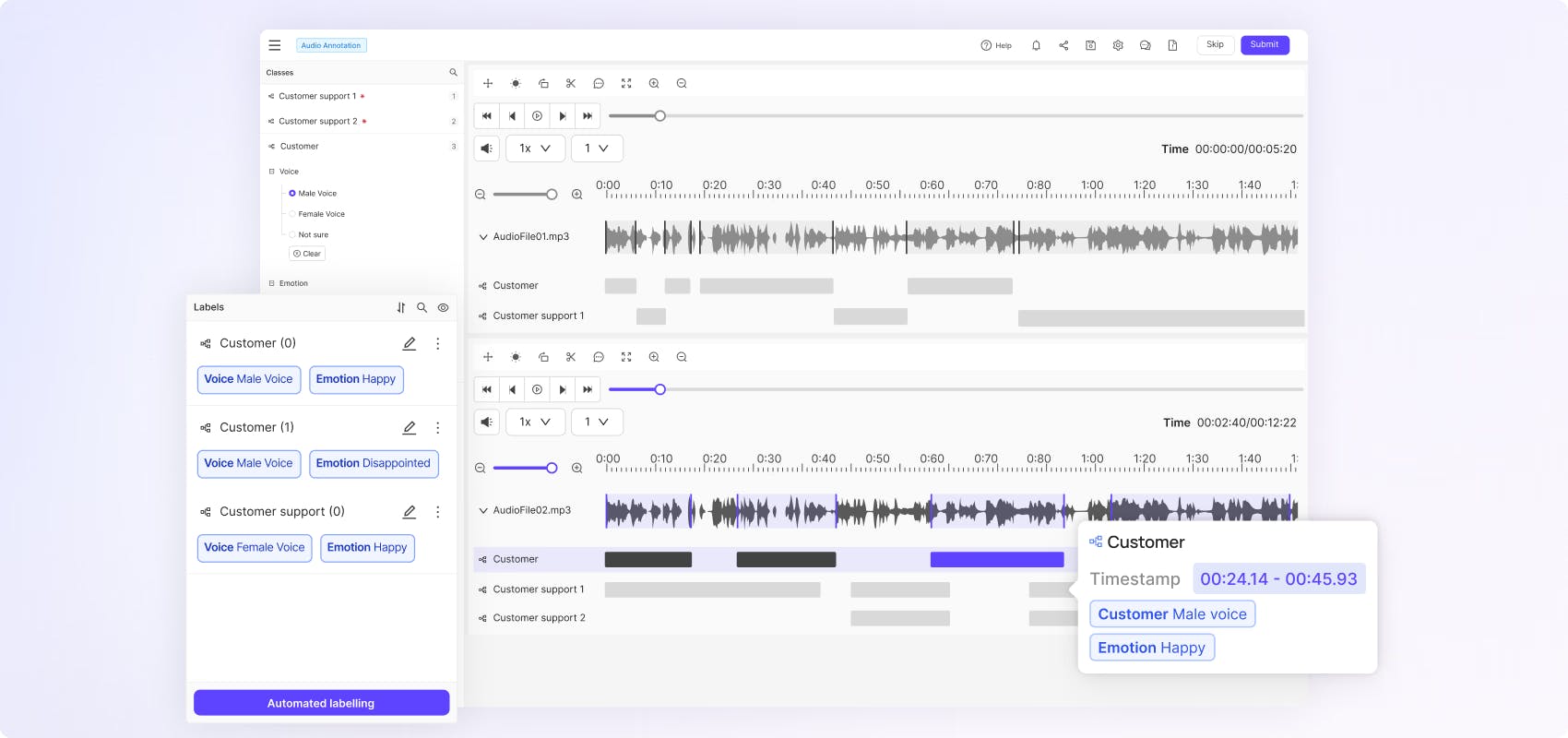
Labeling Audio Data with Encord
Multimodal labeling
Combines two or more of the above, such as video with synchronized audio transcription and object tracking, for applications like AR/VR scene understanding or embodied AI, where a model needs to reason across sight, sound, and text at once.
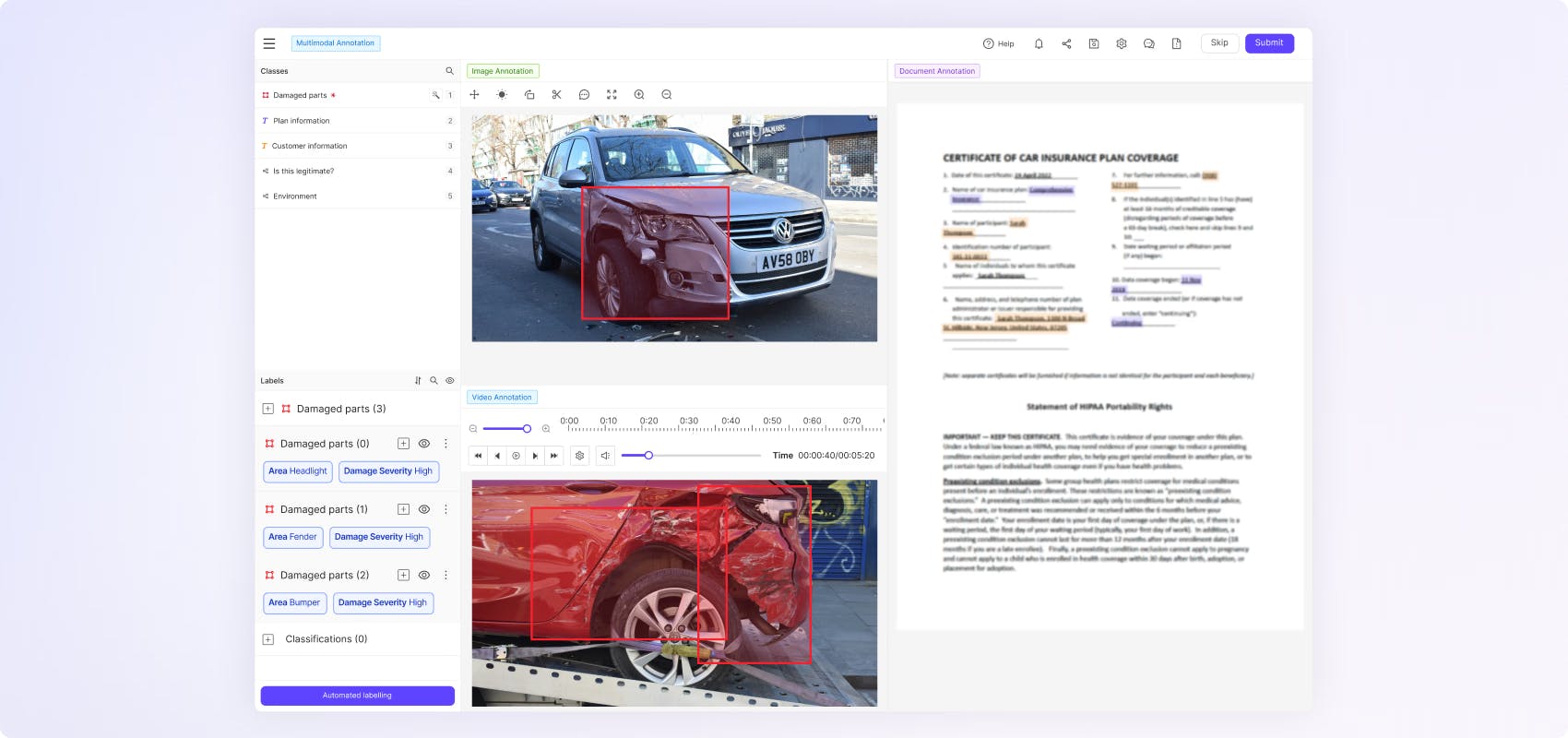
Labeling Multimodal data withe Encord
AI data labeling for Generative AI and Physical AI
Most explanations of data labeling are still written for the bounding-boxes-and-sentiment-tags era.
AI data labeling in 2026 covers a lot more ground.
For generative AI and LLMs, labeling increasingly means human preference data: ranking which of two model outputs is better, flagging unsafe or low-quality generations, and producing the reward signals used in reinforcement learning from human feedback (RLHF).
This is a different discipline from drawing a box around a car. It requires domain experts who can judge nuance, not just annotators who can trace an outline, which is part of why large AI labs have been investing heavily in labeling infrastructure and expert annotator networks rather than treating the work as a commodity.
For Physical AI and robotics, labeling extends into multi-sensor data: synchronized video, LiDAR, radar, and teleoperation logs that need to be labeled in a way that respects spatial and temporal consistency across sensors. A robotics team labeling warehouse footage isn't just tagging objects, it's building the training signal for a system that has to act safely in the physical world.
Both of these are areas where generic, CV-only labeling tools tend to fall short, and where platforms built for multimodal, sensor-fused data earn their keep.
Manual vs. automated vs. Human-in-the-Loop labeling
| Approach | How it works | Best for | Trade-off |
| Manual | A human labels each item from scratch | Ambiguous, novel, or high-stakes data (medical, legal, safety-critical) | Most accurate, slowest, most expensive at scale |
| Automated / AI-assisted | A model pre-labels data; humans review or correct | Well-understood, high-volume tasks | Fast and cheap, but accuracy depends on how well the pre-labeling model matches the target data |
| Human-in-the-loop | Automation handles straightforward cases; humans focus on edge cases and low-confidence predictions | Most production pipelines at scale | Best speed-to-accuracy balance; requires a workflow that can route between the two |
Human-in-the-loop labeling is the practical middle ground most production teams land on, and it consistently outperforms either pure automation or pure manual labeling on both speed and accuracy.
Teams sourcing at scale generally choose between labeling in-house, outsourcing to a specialized workforce, or using a managed service layered on a labeling platform. Each comes with real trade-offs in cost, control, and speed to scale, and the right choice depends heavily on data volume, sensitivity, and how much engineering time a team wants tied up in tooling rather than models.
What are common challenges in AI data labeling?
- Scale and cost. Data preparation, including labeling, is estimated to account for up to 80% of an AI project's total time (Big Data & Society, 2024) That's a lot of a team's runway going into a step that rarely gets budgeted for properly upfront.
- Consistency across labelers. Without clear instructions and regular calibration, different labelers will interpret the same edge case differently, and that inconsistency becomes noise in your training data.
- Rare events and edge cases. The data that matters most for model robustness (a pedestrian partially occluded by a truck, a rare medical finding) is by definition underrepresented in raw datasets, and easy to miss without deliberate curation.
- Regulatory documentation. Regulations like the EU AI Act are starting to require auditable data provenance and dataset documentation, which means labeling pipelines increasingly need to prove not just what was labeled, but how and by whom.
How do teams approach AI data labeling at scale?
There are a few common models: labeling in-house with your own team, outsourcing to a specialized workforce, or using a managed service layered on top of a labeling platform. Each comes with real trade-offs in cost, control, and speed to scale, and the right choice depends heavily on your data volume, sensitivity, and how much of your engineering time you want tied up in tooling rather than models.
Why Leading teams use Encord for AI Data Labeling
Most of the friction in AI data labeling doesn't come from the concept, it comes from the tooling. Teams outgrow open-source labelers, juggle separate tools for curation and QA, and lose weeks stitching together workflows across image, video, text, and audio.
Encord is built to remove that friction at every stage of the loop described above:
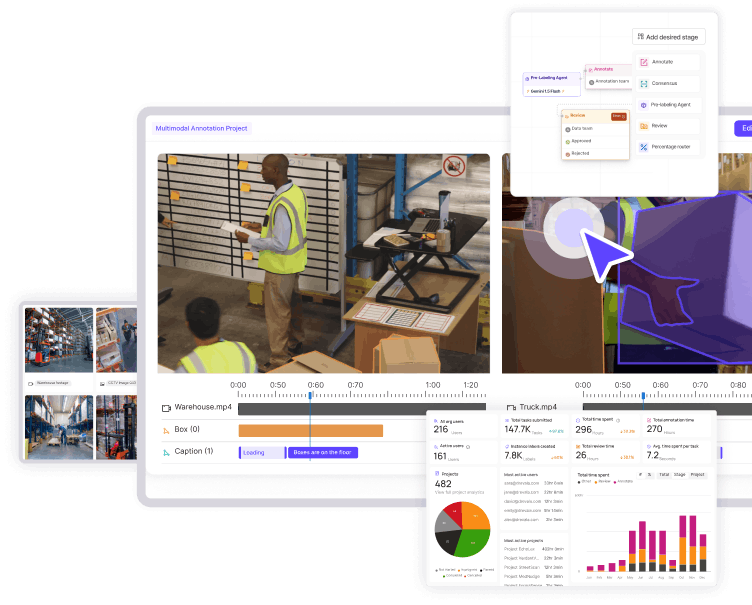
- Encord is a Multimodal tool by default. Annotate images, video, audio, text, documents, and DICOM files in one workflow instead of switching tools per modality, with native video support (frame-accurate, no downsampling) and synchronized multi-sensor labeling for robotics and autonomous systems.
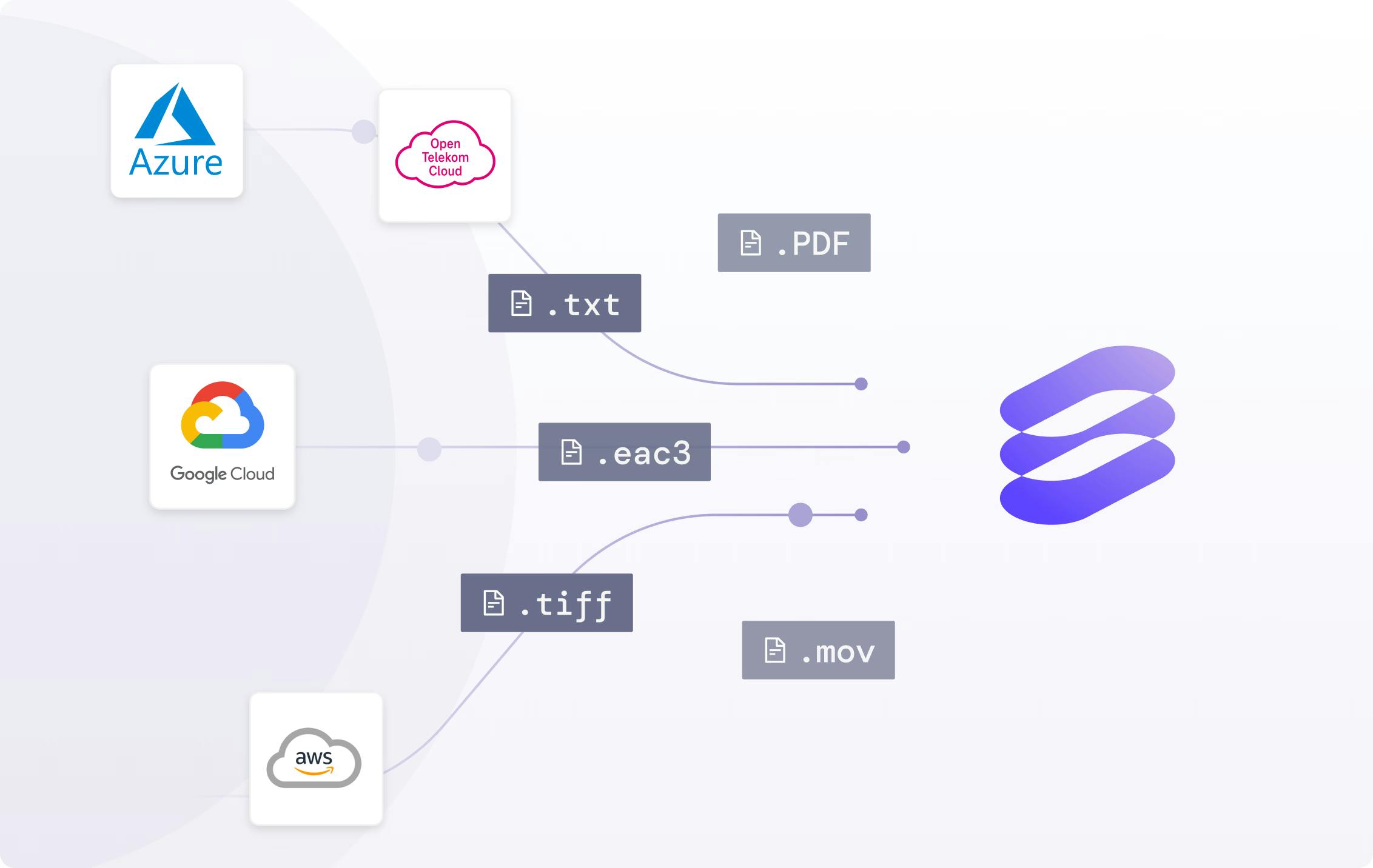
- Built-In integrations with model-assisted labeling: SAM 2, YOLO, GPT-4o, and Gemini pre-label data automatically, so human review time goes toward edge cases and low-confidence predictions rather than labeling from scratch.
- Human-in-the-loop quality control. Configurable review workflows, consensus labeling, and annotator performance analytics catch inconsistency before it reaches a training set, rather than after a model has already learned from it.
- Native RLHF and preference data support. For generative AI teams, Encord supports response ranking, rubric-based evaluation, and pairwise comparison workflows, the same preference-labeling work covered earlier in this guide.
- Enterprise-grade security. SOC 2 Type II certified, HIPAA and GDPR compliant, with full audit trails, meeting the provenance and documentation requirements increasingly expected under regulations like the EU AI Act.
- API and SDK-first. Programmatic access to projects, ontologies, and labels means labeling pipelines can plug directly into existing MLOps stacks instead of running as a manual, disconnected step.
Explore more resources
Frequently asked questions
Yes, in almost all practical contexts the terms are interchangeable. Where a distinction is drawn, annotation is sometimes treated as the broader term and labeling as the specific act of assigning a category.
Because labeled data is the ground truth a model learns from and is evaluated against. Errors or inconsistencies in labeling get learned by the model as if they were correct, which directly degrades prediction accuracy.
An approach where automated systems handle the bulk of straightforward labeling, and humans focus their review on edge cases, low-confidence predictions, and quality control, rather than labeling every item manually.
Cost varies widely by task complexity, required expertise, and quality bar, simple classification can be labeled cheaply at scale, while domain-expert tasks like RLHF ranking or medical image segmentation cost significantly more per item.